
Richard Phillips, the ship captain toasted as a hero after he was taken captive by Somali pirates, ignored repeated warnings last spring to keep his freighter at least 600 miles off the African coast because of the heightened risk of attack, some members of his crew now allege.This might be fun, lets second guess the second guessers. What would you do?
Records obtained by The Associated Press show that maritime safety groups issued at least seven such warnings in the days before outlaws boarded the Maersk Alabama in the Gulf of Aden, about 380 miles offshore.
A piracy expert and the captain's second-in-command say Phillips had the prerogative to heed the warnings or not. But some crew members — including the chief engineer, the helmsman and the navigator — say he was negligent not to change course after learning of the pirate activity.
"If you go to the grocery store and eight people get mugged on that street, wouldn't you go a different way?" said the ship's navigator, Ken Quinn, of Tampa, Fla.
Sailing beyond the 600-mile threshold would have added more than a day to the Alabama's voyage to Mombasa, Kenya, and used extra fuel, according to the ship's previous captain, who said Phillips had years of experience sailing in those dangerous waters.
Four of the 20 crew members told the AP that they blame Phillips for the hijacking.
"He caused this, and we all know it," said chief engineer Mike Perry of Riverview, Fla. "All the Alabama crew knows about it."
This is the Office of Naval Intelligence official listing for all hijackings from a period 1-1-2025 through 4-7-2009, the day before Maersk Alabama was hijacked.
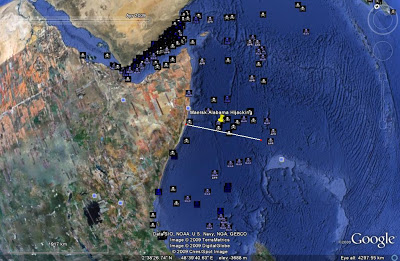
This is the Office of Naval Intelligence official listing for all hijackings from a period 1-1-2025 through 4-7-2009, the day before Maersk Alabama was hijacked.
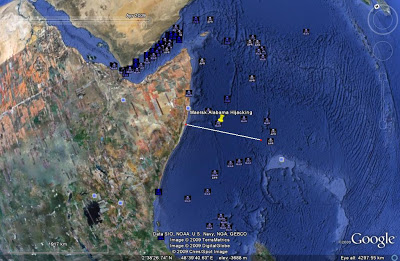
This is the Office of Naval Intelligence official listing for all hijackings for the 2 weeks before the Maersk Alabama was hijacked.
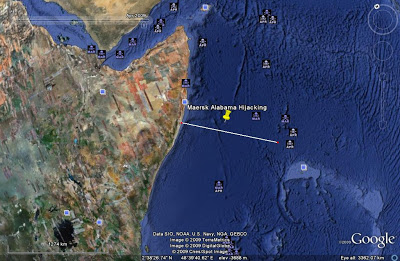
The yellow line in the pictures represents 600 miles, the recommended area for ships to travel as per the public broadcasts. Note there had been 3 hijackings within 2 weeks at the 600 mile point just due east of where the hijacking took place. Indeed, one of those boats hijacked to the east was hijacked on April 6th, just two days before Maersk Alabama would have been traveling that spot.
This armchair captain stuff from the crew that the AP is reporting doesn't impress me much. The raw data suggests that the Maersk Alabama was taking as good a course as any, indeed when 3 ships had been hijacked at the 600 mile point within the last two weeks and none had been hijacked where the ship was ultimately taken within the last two weeks, one could say Captain Phillips was making the right decision based on the data right up until the hijacking took place.
According to chief engineer Mike Perry as reported by the AP, the crew is basically saying it would have been smarter to travel a course at the 600 mile recommended route, despite the fact pirate activity in that area was known to be active. The AP writer John Curran apparently didn't fact check much, because I think the maps of activity at the time tell the story. If there are three shootings within 2 weeks on A street, and you have the option of taking B street to get to grandma's house, which street are you going to take? If a shooting occurs on B street anyway, does that mean not taking A street was a bad idea? In hindsight, vision is 20/20, but based on the data available at the time, Captain Phillips appears to have a better case than the one produced by the crew.
Now imagine being a Captain today, as below chronicles all known cases of piracy in the region.
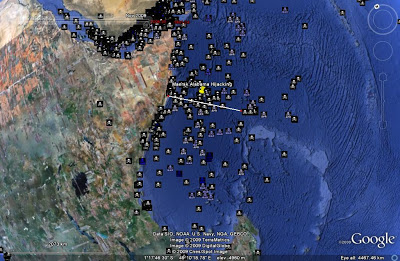
There are no safe zones at sea off the East coast of Somalia. When one considers that there were 12 attacks off eastern Somalia in the first 15 days of April 09, with several hijackings among those attacks, that was just a bad period for piracy. The crew is lucky they were not captured, or killed as others were that week, and oh btw... that luck is primarily due to the same Captain they are now calling out through the media.

No comments:
Post a Comment