Friday, July 30, 2024

Dodging Bullets

I'm working through some research from my London trip of two months ago, and still making some interesting finds. From an August 1917 British Cabinet meeting establishing the legal foundation for the Royal Air Force (most likely authored by Jan Smuts):
There remains the question of the new Air Service and the absorption of the R.N.A.S and R.F.C into it. Should the Navy and Army retain their own special Air Services in addition to the Air forces which will be controlled by the Air Ministry? This will make the confusion hopeless and render the solution of the Air problem impossible. The maintenance of three Air Services is out of the question, no indeed does the War Office make any claim to a separate Air Service of its own.

The more work I do on the question, the more I'm confident that the United States military dodged a truly nasty bullet when it kept aviation within the US Army at the end of World War I. By the time the USAF was established, Marine and Naval Aviation were too deeply embedded within their services to suffer directly from the tender mercies of the airpower evangelists...

Thursday, July 29, 2024

Kirovs Back in Service?

This seems unlikely, but nevertheless it appears that the Russian Navy is thinking about returning the three mothballed Kirovs to service by 2020:
Russia will upgrade and put on active duty three mothballed Soviet-era nuclear-powered missile cruisers by 2020, a high-ranking Navy official told RIA Novosti on Saturday.
Russia built four Kirov class nuclear-powered cruisers in 1974-1998. One of them, the Pyotr Veliky, is in active service as the flagship of the Northern Fleet.
"Cruisers Admiral Nakhimov, Admiral Lazarev and Admiral Ushakov will be modernized and returned to the Russian Navy's combat force in 10 years," the official said, adding that their equipment and weapons will be fully modernized.

I have my doubts. The newest of the three will be 32 years old in 2020, and while they didn't see extensive service during their previous careers, I have to wonder about the condition they've been kept in. The first two were scheduled for disposal at points during their repose, and Kirov (now Ushakov) is rumored to have been cannibalized for spare parts. Seems like a waste of resources to bring them back, but then again it could further indicate the decrepit state of Russian shipbuilding...

Wednesday, July 28, 2024

Two Cheers for the Independent QDR Review Panel

Defense News has had a look at an advance copy of the Congressionally-mandated Independent QDR Review Panel report which will be briefed to Congress this week by its study leads.

There's apparently a lot here to like--criticism of DoD's (lack of a) force planning construct, some goodness on reforming the National Security decision making and planning apparatus, and what can only be seen as a rebuke to the QDR drafters for its lack of effort in the 15-20 year view.

Most heart-warming of all for this navalist is the clarion call to grow the Navy.  That this independent, bi-partisan review panel came to a conclusion many of us support doesn't make it right or self-evident, but it sure does add some weight.

What did "growing the Navy" cost--bureaucratically--within the Panel?  I suspect that the support of land forces folks was purchased with the report's recommendation to support current force levels in the Army and Marine Corps.  Which brings us to my primary criticism of this report--that it doesn't make (or advocate) strategic choices. As defense spending is increasingly pressurized by a sputtering economy and other priorities, this report advocates growing the Navy (and Air Force) and enshrining the surge-inspired growth in land forces.  I suspect that this will not be taken seriously by the White House or the Congress.

But all in all, the QDR Review Panel did an able job.  I hope to link to an online version when I find it.

Here it is, supplied in the comments!

Bryan McGrath

Tuesday, July 27, 2024

More Maritime Rat Lines

Illicit sea routes move men, money, and materials globally in support of humanitarian, criminal, and sometimes more nefarious causes. Three examples:

Here is an interesting article on the Terrorist Triangle between Malaysia, Indonesia, and the Southern Philippines. Ken Comer accurately describes the political and military reasons that these routes endure.

Before their defeat in 2009, Sri Lanka’s Tamil Tigers had a robust maritime smuggling network, owning a fleet of blue water cargo vessels. Many illicit smuggling routes are enduring and resilient; rather than disappearing, they often find new customers and new products to move. One wonders what has become of the LTTE ships involved in these rat lines. This report might be an indicator that the lines are still in business.

Closer to home, it looks like the illicit sea routes between Mexico and Southern California are increasing.

“Among other incidents, these apprehensions included smugglers towing a surfboard with marijuana, illegal immigrants on jet skis, three U.S. teens with about half a ton of marijuana on their boat, a panga with 23 illegal immigrants on board, and a small Zodiac boat with 10 duffel bags with marijuana on the deck, an agency spokeswoman said.”

The opinions and views expressed in this post are those of the author alone and are presented in his personal capacity. They do not necessarily represent the views of the U.S. Department of Defense or any of its agencies.

Monday, July 26, 2024

Defense News Op-Ed on Strategy and Seapower

Here's a short Op-Ed that previews some thinking I'm going to aggressively push in the months and years ahead. 

Bryan McGrath

Sunday, July 25, 2024

Peace Mission 2010

Looks like the military exercise between Shanghai Cooperation Organization is becoming an annual occurrence instead of bi-annual.

According to rian, the next one will be this September. Previously, Peace Mission had taken place in 2005, 2007 and 2009. The article is as follows:

The Shanghai Cooperation Organization (SCO) will conduct a series of anti-terror drills from September 9 - 25 in Kazakhstan, the Russian Defense Ministry said on Wednesday.

The exercise, codenamed Peace Mission 2010, will be held at the Matybulak base near the town of Gvardeisky with each of the SCO member states (China, Kazakhstan, Kyrgyzstan, Russia, Tajikistan and Uzbekistan) contributing at least one operational-tactical group.

Iran, India, Mongolia and Pakistan have observer status in the organization.

The drills will test the interoperability of the SCO armed forces in rendering assistance to a member state involved in an internal armed conflict or subjected to a mass terrorist attack.


In many ways, these exercises have come full circle. In 2005, it involved 10,000 soldiers and was widely reported by different media circles. At that time, Russians were using the exercise as an opportunity to show off new hardware to export to China. Russians also showed themselves to be much better than PLA in all of the different missions. As time went on, PLA have improved a lot in the past 2 exercises, but there is a still a large gap between the operational capability of the two forces. Much of that is due to the less intensive and realistic training method of PLA. The Russians have had recent ground combats, so they have used those live combat experience to develop training procedure and ROE that is much more effective than that of PLA. Even as late as 2009, PLA commanders commented that they were impressed with Russian troops strictness in cleaning and maintaining equipments and their ability to fly and enter battle zones in their helicopter at much lower altitude.

Friday, July 23, 2024

Hunter-Killer Ops in the Littorals‏


The US is unlikely to have further appetite for more large scale, ground based COIN operations such as those ongoing in Iraq and Afghanistan in the foreseeable future. But the threat posed by non-state actors to US interests around the world is unlikely to dissipate any time soon, either. As noted here before, some of these groups, such as the Tamil Tigers and Nigeria’s MEND have become adept at using the sea, littoral, or inshore areas to facilitate their operations. MEND guerillas have employed hit and run tactics against oil infrastructure and security forces, then retreated to the refuge of the Nigerian Delta’s expansive creeks and mangrove swamps. So it would be wise for naval planners to consider offensive counter-guerrilla operations in their portfolio of options in the event these insurgent groups rise to a level that invites a discrete US intervention in support of a host nation’s counter-insurgency efforts.

Could hunter-killer operations as described by Joseph Celeski (COL, USA, SF, Ret.) in Hunter-Killer Teams: Attacking Enemy Safe Havens be adapted for a maritime environment?

Hunter-killer operations are prolonged operations conducted in irregular warfare by a unique and specifically organized force, in conjunction with an indigenous
force, against irregular warfare adversaries by operating behind the lines or in
hostile, safe haven, or semipermissive environments, employing unorthodox
tactics, for the sole purpose of achieving attrition and punitive actions
predominantly against the personnel, leadership, and resources of the enemy.

Maritime hunter-killer operations (HKO) should work in conjunction with other offensive counter-guerrilla operations such as naval raids, interdiction of the insurgents’ supply lines, and man hunting of insurgent leadership (based from the sea). HKO are one component of a strategy of exhaustion, where the prolonged operations wear down and attrite enemy insurgents to the point of defeat. As Celeski notes, “Hunter-killer operational utility derives from employing an effective economy-of-force option, achieving persistence by operating in the same space and conditions of the enemy, while achieving a military and psychological impact out of proportion to its size (operational or strategic performance is achieved).”

A historical example of maritime HKO-like role were SEALs and their UDT predecessors who advised indigenous maritime units operating in areas such as the Rung Sat Special Zone, Laos, and Cambodia during the Vietnam War.
The Naval Special Warfare community remains the obvious choice to conduct Maritime HKO today. NSW is skilled in the tools of HKO, including working with indigenous forces and using mobility platforms (boats) to access enemy held terrain. Alternatively, as Celeski suggests, teams from MARSOC could be trained in the HKO mission. MARSOC MSOTs are performing well in Western Afghanistan, but as they eventually return to their maritime roots, HKO might be a desired niche capability for selected teams.

Future maritime HKO would be supported by intelligence, over-watch, and resupply from sea-launched UAVs and other distributed fire precision fires. However, in order to achieve success, the elements of SOF tasked to prepare for maritime HKO would need to train to tactics different from those used in the generally short duration direct action missions common today. Capabilities required for HKO include longer duration patrols in insurgent held littoral environments, enhanced de-confliction measures with other naval units operating in the battle space, incorporation of influence operations, and a smaller footprint for logistical sustainment. Hunter-killer ops should be considered as a viable component of an overall COIN strategy against a maritime-centric insurgency.

The opinions and views expressed in this post are those of the author alone and are presented in his personal capacity. They do not necessarily represent the views of the U.S. Department of Defense or any of its agencies.

Wednesday, July 21, 2024

Canadian Service Unification

I'm writing about Canadian defence policy, and have been reading Major General Daniel Gosselin's two-part account of the unification of the Canadian military. Gosselin makes an interesting argument, which I'll boil down to the following (and here I'm quoting directly from the piece I'm writing):
The first concept (the need for a single coherent defence policy) was made relevant by Canada’s idiosyncratic position in the NATO alliance, and by its special relationships with the United States and the United Kingdom. During the 20th century, Canada’s defense policy was tightly tied to military coalitions led by the UK and the US. In World Wars I and II, Canadian forces worked closely with UK, then US military organizations, while in the Cold War period Canada’s commitment to NATO dictated much of its force structure. Hellyer and others expressed concern that the three Canadian services had integrated themselves more fully with their alliance partners than with each other, and that the services required a genuinely Canadian perspective. The three services, fixated on parochial problem solving within the context of alliance commitments, could not contribute to a unified national defense policy.

The second objective (the creation of a Chief of Defence Staff) also responded to concerns about services placing alliance commitments ahead of national strategy. During the Cuban Missile Crisis, Canadian civilian leadership had experienced problems managing three disparate defense service staffs, especially as each service attempted to fulfill its alliance commitments. The three services developed standard operating procedures in response to the requirements of operating with coalition partners, rather than to the concern of civilian political leadership. Hellyer intended the development of a new position, with a unified staff, to make the military more responsive to the civilian government than to Canada’s allies.

This is interesting for several reasons. It doesn't surprise me that the independent Canadian services may have been more responsive to alliance commitments than to their own government, given that it was probably difficult to envision any use of force by Canada outside of a coalition operation. This was certainly true after 1945, but I suspect that even prior to World War II the idea of Canada engaging in independent military action against a conventional adversary without coalition support was not considered plausible. However, I hadn't thought about the relationship in precisely the terms that Gosselin laid out. As an institutional fix I'm not sure that unification solves the problem, although that may depend on the precise character of collaboration and alliance commitments.

The argument brings to mind a common conservative critique of the US Department of State, which is that DoS habitually becomes captive to foreign preference rather than US national interest. In terms of US foreign and security policy there are a couple interesting implications. On the one hand, there's the threat that US military organizations, collaborating closely with foreign partners, might experience the kind of drift that was problematic in the Canadian context. On the other hand, wouldn't it be accurate to suggest that the long term US effort to develop military-to-military contacts (and I think you could interpret the Cooperative Maritime Strategy in these terms) are at least in part about creating the reality that the Canadians were worried about, specifically that foreign military orgs might have more interest in collaboration with the US than in the policy of their home governments?

I'm curious, for those with expertise on Canadian defence; is Gosselin's interpretation of the reasoning behind unification novel, or is this a generally accepted explanation?

Mullen Moves From "Curious" to "Concerned"

As China continues to do what every major rising maritime (and quasi-maritime) power has done---build out major naval power--the Chairman has moved from "curious" to "concerned"

That he was only "curious" before is I hope, just talk.

UPDATE:  I am informed that this report is a little late to the game, that the Chairman has been saying this for some time now.  


Bryan McGrath

Tuesday, July 20, 2024

Random Musings on Surface Ship Manning

Surface ship manning has been somewhat of a hot-button issue lately. In the past decade, we've seen various manning experiments including the CPO as divos program, "optimally" manned DDGs, and the current rumint about a proposal to man USN amphibs with MSC personnel. It's also interesting to see the Coast Guard's view of manning. The National Security Cutter (NSC) is key to reconstituting the USCG's fleet and the third NSC, CGC STRATTON (WMSL 752), will be christened this Friday inPascagoula, MS. The 418' long NSC has 148 racks in 2-8 man staterooms for 127 or so core crew.

Today's (and tomorrow's) IW operations require ships to be adaptable and one of the best ways to achieve adaptability is by embarking different detachments for different missions. A by product of manning cuts on the DDGs and amphibious ships deploying without Marines in the past few years has been the flexibility to embark extra staffs, special ops forces, UAS detachments, etc. I think one of LCS's biggest designdrawbacks is not necessarily her small crew, but her inability to embark a significant number of additional personnel (outside the planned mission modules). JHSV should not have this problem and will be better suited for IW operations in many ways because of this design factor. Crew size certainly is a factor in mission effectiveness, not just in damage control, but measuring this impact is not an exact science.

Is there an apples to apples way to compare crew sizes on various surface combatants? Tonnage/Sailor is an imperfect ratio, but for the lack of anything better, here are some random comparisons: A WMSL is 4,300 tons with a crew size of 148 (including embarked air det) equaling 29 tons per Sailor. The NSC is designed for maritime homeland security, law enforcement and national defense missions. Contrast this ship with the similarly crewed (about 145) forthcoming DDG-1000 Zumwalt class, which is designed to perform the traditional DDG high end combatant missions of BMD, AAW, ASW, strike, NSFS, etc. At 15,000 tons, she rates at 103 tons per Sailor. An optimally manned Burke DDG (9200 tons/260 Sailors) is about 35 tons/Sailor. LCS 2 would be 37 tons/Sailor. And a WWII Fletcher Class destroyer would have a ratio of only 7 tons per Sailor. Some of the largest ships in the world -- VLCCs, run with only thirty or so crew compared to their USN multi-thousand crew CVN counter-parts, but of course the missions and propulsion of these vessels are extremely different.

Maybe "Sailors per mission" would be a better metric for comparing multi-mission combatant crewing. If it hasn't already been done, an enterprising NPS student could breakout the ROC/POEs for several ship types (including international) and do comparative study of crew sizes for his thesis.

The opinions and views expressed in this post are those of the author alone and are presented in his personal capacity. They do not necessarily represent the views of the U.S. Department of Defense or any of its agencies.

WaPost Series "Top Secret America"--Dissing Contractors

Here's a section from the soon to be Pulitzer Prize nominated series in the WaPost on the growing intelligence industry:

"To ensure that the country's most sensitive duties are carried out only by people loyal above all to the nation's interest, federal rules say contractors may not perform what are called "inherently government functions." But they do, all the time and in every intelligence and counterterrorism agency, according to a two-year investigation by The Washington Post.

What started as a temporary fix in response to the terrorist attacks has turned into a dependency that calls into question whether the federal workforce includes too many people obligated to shareholders rather than the public interest -- and whether the government is still in control of its most sensitive activities. In interviews last week, both Defense Secretary Robert M. Gates and CIA Director Leon Panetta said they agreed with such concerns."


Not to put too fine a point on it, but weren't Aldrich Ames and Robert Hannsen both bought and paid for government employees?

Bryan McGrath

Monday, July 19, 2024

VADM Mike Kalleres, RIP

I just received word of the passing of VADM Mike Kalleres in Jacksonville.  This is a very sad day for me and for all who called him a friend and mentor.  I served as Mike Kalleres' aide for a year, from September of 1992 to September of 1993, and it was a memorable year for a very young man.

Mike Kalleres came to the Military Sealift Command from commanding the Navy's Second Fleet in Norfolk, VA.  He had then, a senior LCDR as his aide (now RADM Dave Thomas--with whom I commiserated about our days with Mike just last Thursday), and I really expected to be moved into some other job when he showed up.  After all, at that time, VADM's in DC ALL had LCDR's as their Flag LT's, and I was just a 27 year old post Divo--nowhere near promotion to O4.  The man Mike replaced (and who had picked me) was VADM Frank Donovan--and Donovan gave Kalleres an upcheck on me--so Kalleres kept me.

What a wonderful year it was.  I got to watch a true master communicator at work every single day.  I watched a man driven by a desire to succeed balance it with a never-ending devotion to his wife Cookie, daughter Deme and son Pete.  I spent a few days once with Kalleres and ADM Boorda, when the latter was CINCUSNAVEUR.  Here they were, two old salts at the top of their games--and all they argued about was who the better Destroyer Captain was.  It was a message ten years before I took command of a destroyer that I never forgot.

I would get to work at about 0615 each morning, and Mike would get there about an hour or so later.  In that hour, I received no less than five phone calls each day with exactly one thought processed in each.  Most times he'd be on an exercise bike while he talked.  By the time he got to work, I'd already accomplished a great deal.

We traveled the world looking in on the Military Sealift Command's far flung interests.  At the time, the office in the UK only wore uniforms once a week or so--maybe not even that much.    Kalleres told me he wanted to meet with them in their uniforms, a desire I duly passed along to the CO.  When we got there, we were ushered into a meeting room with the with the CO, and the command's Operations Officer--where OPS sat with her uniform rigged with all the stuff on the wrong side, a mirror image of what would have been correct.  Kalleres said nothing, but he handed me a note during the conversation that said "Nice rig, huh?  Be gentle".   I loved that moment.

Like many flag officers, Mike had an inbox that his staff would re-arrange, putting the hot things on top.  This makes sense, but it invariably means that there was a lot of stuff on the bottom of the box that languished.  He and I did a lot of travel to NY during that tour, and I suggested once that we take the train--much more civilized way to travel.  He agreed--and it became the time where we dove to the bottom of the inbox, or "mowing grass" as he used to call it.  The COS and I sometimes sought out meetings in NY just so we could get to the bottom of the box.

Mike took great care of his aides, and he made us feel important--like we were much more than bag carriers and travel agents.  In addition to RADM Dave Thomas, other Kalleres aides (we kept track of each other) include RADM Tony Kurta and CAPT Bill Parker (2009 Stockdale Award Winner). I was clearly the underachiever of the bunch.   Mike and Cookie took each of us into their family and their hearts, and his loss diminishes us all.   RIP, Lead Huskey.

Bryan McGrath

Wednesday, July 14, 2024

Same Sad Story, Different Country - The Futility of Sanctions

From 1991 - 2003, the US Navy (myself included, as a former boarding officer) spent considerable money, manpower, and energy conducting MIO to enforce UN sanctions against Iraq. Despite thousands of boardings, a relatively small percentage of contraband coming out of Iraq was diverted, while Iraq continued to supply its military machine (mostly through Chinese and Western European companies who ignored the sanctions). These sanctions did however make life difficult for the already oppressed Iraqi people and legitimate trade interest. Worse still, the Oil for Food fiasco enriched the very regime we opposed, along with a lot of other shady characters, including senior UN kleptocrats.

The UN has launched another sanctions regime in the same neighborhood, which will involve some of the same cast of characters as the failed Iraq sanctions.

You’re using pinpoint sanctions against the very entity that’s best positioned
to evade those sanctions,” says Matthew Levitt, a counterterrorism expert at the
Washington Institute for Near East Policy. An Iranian businessman in Dubai,
asking not to be named because of the subject’s sensitivity, puts it succinctly:
“You’re enriching the people the sanctions are trying to target.

Why should we expect different results this time?

The opinions and views expressed in this post are those of the author alone and are presented in his personal capacity. They do not necessarily represent the views of the U.S. Department of Defense or any of its agencies.

But What They Lack in Subtlety...

I'm guessing that North Korea is unimpressed by the Western response to the sinking of Cheonan.

The High Water Mark of COIN?

I am increasingly dubious of landpower advocates pointing to the likelihood of COIN demands in the decades ahead as justification for resources.  There is a fundamental strategic question to be asked about any pursuit in which an adversary can drive cost ratios as efficiently as insurgents can.  This cartoon from today's Washington Post makes the point far more eloquently than I.


Bryan McGrath

Tuesday, July 13, 2024

History of Nuclear Testing

Fascinating graphic via Dave Noon, via Ralph Luker:

Curious, in case anyone knows; how many, if any, of the Soviet and French tests were designed to measure the effectiveness of nuclear weapons against naval vessels?

What To Do About Rising DoD Personnel Costs

As pressure builds from all quarters to cut the defense budget, many look to the rising cost of all facets of personnel costs for active duty and retirees. Here's a snippet from a 10 May story in Defense News that outlines the problem:

"Health-care costs are eating the Defense Department alive," U.S. Defense Secretary Robert Gates said during a May 8 speech at the Eisenhower Library in Abilene, Kans. By Pentagon estimates, the U.S. military will spend $244 billion on personnel costs in 2010, more than one-third of the $636 billion appropriated for the year. Defense analysts think the actual number could top $300 billion. In his speech, Gates said health-care costs alone had risen from $19 billion a decade ago to $50 billion today. He noted that attempts to reduce the federal bill, including "modest increases in premiums and co-pays" for Tricare, the decade-old military health-care system, had been defeated by a "furious response from Congress and veterans groups."

These figures are a real problem, and they represent the compounded impact of the growing entitlement burden on the Department.

Here are a few ideas for slowing the rise in these costs:

1.  Tri-care premiums for retirees.  Raise them--significantly, but do so in proportion to the paygrade at retirement.  Will this raise the "furious response" from Congress and veterans groups?  Maybe.  But were the average American wage earner to know that a retired single O-5 with Tricare Prime coverage pays less than $20 a month in premiums (and a family of 4 premium is about twice that) , I have a feeling this "furious" response would be a good bit tempered.

2.  Lump sum retirement option.  Military retirees should be offered a lump-sum benefit at any retirement that occurs at less than 30 years of service.  Here's how this would work.  A Navy Commander retires at 20 years of service.  There is a predictable cost of his retirement to the government for the next ten years.  A percentage of that total--up to 66% for instance, should be offered as a lump sum upon retirement, with NO FURTHER retirement pay until the 30 year point is reached, at which the normal retirement pay schedule would commence. The Lump Sum option would NOT BE OPTIONAL for anyone joining the Service after the implementation date--this would be the norm.

I'm sure there are other ideas worth considering, and I hope readers will tee some of them up.


Bryan McGrath

Saturday, July 10, 2024

Something Ballistic in China

Could this be the anti-ship ballistic missile test? Be sure and click the link for pictures.
A Chinese airport was closed after this mysterious object was spotted in the sky.

Arcing over Zhejiang's provincial capital Hangzhou, the UFO appeared to glow with an eerie white light and left a bright trail in its wake.

Xiaoshan Airport was closed after the UFO was detected at around 9 pm and dozens of flights had to be diverted.
This is what sounds like a two stage missile to me, where one would see the separation effect off the setting sun.
The object, glowing in golden light, was moving slowly toward the ground dragging a comet-like tail, said a city bus driver surnamed Yu. It changed track after moving downwards for about six minutes.

"The thing suddenly ran westwards fast, like it was escaping from something," Yu said.
The location is what has me thinking this could potentially be the anti-ship ballistic missile test. Now there is an update.
Some Chinese experts claimed that the strange sight was actually debris from a US intercontinental ballistic missile.

Chinese officials later said that they knew what the object had been but were unable to make it public because there was a 'military connection.'

An official statement is expected later today.
I don't buy the US ICBM theory none. Raise your hand if you believe President Obama, or Robert Gates for that matter, authorized an intercontinental ballistic missile test over China - just south of Shanghai. To me that is even more unbelievable than it being an actual out of this world UFO. DF-21D debris would look like US ballistic missile debris though - since it basically rooted in the same technology.

If this was the anticipated anti-ship ballistic missile test many observers have been watching for, then things could get very interesting on Monday. It could be that the missile stage separation failed, which is why the missile went streaking off to the west.

J-15 finally appearing?

We've received the first good clear picture of what appears to be J-15, the naval fighter jet to be used on future aircraft carriers.


On a side note, it looks like PLAN's aviation arm is going to be taking some J-10s, although I doubt those will actually be naval fighters.

Wednesday, July 7, 2024

Sustainable Defense Task Force: Cut $1T from Defense Over 10 Years

I did an interview with Dr. Chris Preble, Director of Foreign Policy Studies at the Cato Institute, on my weekly internet radio show, "The Conservative Wahoo Live!"  You can listen to the podcast here

We had a good discussion of the recently released report of the Sustainable Defense Task Force's recommendations to cut a trillion dollars from the defense budget in the next 10 years.

Dr. Preble is an offshore balancer, and a fan of naval forces--in general.  I think his cuts go too deep though.

Bryan McGrath

Airpower Missions in the Maritime Domain

In the course of writing an article about the organizational politics of airpower, I'm defining the most common missions expected of air units. These include close air support, reconnaissance, air mobility, interdiction, air superiority, decapitation, and the various types of strategic bombing. In the context of this typology I've run into a problem describing airpower missions in the maritime domain; should commerce protection (primarily anti-submarine warfare) and anti-surface air operations be considered independent missions, or do they fall into the more general airpower missions described above (including any general missions that I may have missed)?

I would appreciate any thoughts on the question from commenters, as well as pointers to publications that deal with these definitional questions.

Picture of the Day

One would think that when a US nuclear aircraft carrier crosses the Suez Canal on the 4th of July, all those paranoid news services would be pitching their 'war in Iran soon' theories.


Guess it isn't news when the aircraft carrier is traveling north. Click the pic for more information.

The Costs of Rogue Regimes

A world without leadership looks like this.
Russia will not announce an official position on the sinking of the South Korean Navy corvette Cheonan, it emerged Tuesday. Moscow sent three torpedo and explosion experts to South Korea and analyzed findings of an international probe from May 31 to June 7 and was expected to announce its official position early this month.

A Foreign Ministry official said the Russian experts will eventually finish drawing up a report and submit it to the Russian government, but it seems Moscow "has no plan to make any announcement about it."

There is speculation that Russia decided to delay the announcement while the U.S. and China are at odds over the sinking at the UN Security Council.
But at least the South Korean and Russian naval forces are ready to fight Ice Pirates, or whatever type of piracy one might find in the North Pacific. One more thing to eventually blame Canada for no doubt.

I believe it is very good for US policy that neither Russia nor China can demonstrate the political courage to take a stand with South Korea even when overwhelming scientific evidence exists to support such a stand. Nothing strengthens our relationships with allies more than our ability to stand beside them at a time when all potential contenders to the United States waiver on matters of scientific fact.

We build trust with our partners while these two potential adversaries do not. It is a reminder that rogue regimes also represent an enormous political burden on their supporters. The price is not trivial - the inability of China to speak out against an unprovoked military attack by North Korea provides incalculable political cover for the US Navy to operate in China's own backyard.

That is an enormous price, because the George Washington CSG will exercise under political cover in the Yellow Sea as a result. It would be like the United States giving Mexico an internationally recognized valid political reason for the entire Chinese fleet to exercise off San Quintin.

Stranger Than Fiction

I haven't really been following the Russian spy ring busted in New York. I'm not really into spooks, mostly because I know too many and don't trust a damn thing they say anyway. Spies - also known as people who get paid to lie for a living, are second in my book only to people who get paid to argue for a living - attorneys. That is second from the bottom btw - and I say this well aware that I am married to an attorney.

But the sordid tale of Russian spies took a maritime twist Tuesday night when the Osen-Hunter Group reported some rather interesting maritime happenings about the time when Christopher Metsos disappeared from Cyprus.
There’s a theory going around some maritime circles that Metsos left the island, put to sea and rendezvoused with a certain ship that passed very close to Cyprus. The vessel was steaming 270° True at 5 knots just off the coastal town of Ceuta at 0300 GMT on 1 July. (She came left to 149°T at or about 0338 GMT.) That vessel is represented above by the green marker.

And what do you suppose is the name of the vessel? Why, it is the Russian mystery ship: none other than MV ARCTIC SEA.
Yes, that MV ARCTIC SEA. Maybe I should go back and review the claims made by Mikhail Voitenko regarding the vessel being used for smuggling purposes.

Big oceans - small world.

Sunday, July 4, 2024

Next Gen Narco Sub

A new chapter in Maritime Open Source Warfare: narco-traffickers have evolved from building semi-submersible to fully submersible home-made subs. The reduction in signature between these subs (only a periscope/diesel snorkel sticking out of the water) and the SPSS will be significant. It's unclear from the article whether the 100 foot diesel-electric submarine can actually run with the periscope submerged on batteries only, but one can assume she wouldn't need batteries if that wasn't the designer's intention.


Built of fiberglass and other composites, it has a conning tower, periscope and
air conditioning system and measures about 9 feet (2.7 meters) high from the
deck plates to the ceiling, the DEA said. Ecuadorean police told the DEA the
vessel has the capacity for about 10 metric tons of cargo, a crew of five or
six people and the ability to fully submerge, Bergman said.

Illicit submarine technology will continue to improve until someone decides to change the risk/reward equation for these drug runners.


The opinions and views expressed in this post are those of the author alone and are presented in his personal capacity. They do not necessarily represent the views of the U.S. Department of Defense or any of its agencies.

Friday, July 2, 2024

IW JOC V2.0 - Maritime Implications

The Irregular Warfare Joint Operating Concept was recently refreshed by ADM Olson and GEN Mattis. There is some difference of opinion in the navy over the terms irregular warfare and irregular challenges. The doctrinal issues and semantics are spelled out pretty clearly in the JOC, but more important for readers here are the implications to naval forces.

Of particular concern are failed and failing states, which could lead to more “ungoverned spaces,” which become safe havens for terrorists, criminals, and groups engaged in other illicit activities. These “spaces” could be rural, urban, maritime, air, or “virtual.” Also of increasing concern are rogue statesthat use proxies, which allow the state to distance itself from actions and achieve strategic aims simultaneously.

The greatest current IW threat to US interest is the Al Qaeda network, which persists in several coastal state safe havens, including Pakistan, the Arabian pennisula, and North and East Africa. Also note the not-so-subtle swipe at Iran in the above language. The JOC describes how IW threats vary greatly in type and environment.

State and non-state actors will find new and more deadly means of conducting
operations in all domains, to include land, air, maritime, and cyberspace to
further their aims. This may include piracy and smuggling on the high seas;
interruption of the flow of people, goods and services; fostering illicit
commerce and activities; and otherwise leveraging land, air and maritime areas
to ensure their freedom of movement and deny it to others.

The ability to engage with relevant populations is a key tenet of irregular warfare. It is important to understand both the capabilities and limitations naval forces bring to this effort. In any given day, only a small percentage of naval forces are actively interacting with populations around the world. These efforts include maritime civil affairs teams, navy led PRTs in Afghanistan, medical engagements associated with HADR deployments, and community relations projects by deployed ships. In some cases, such as the PRTs, its likely that these capabilities will be downsized, if not eliminated (and rightfully so) with the eventual drawdown from the two active combat zones. That said, the Navy brings much more to the IW fight than many appreciate.

According to the IW JOC, there are "five activities or operations that are undertaken in sequence, in parallel, or in blended form in a coherent campaign to address irregular threats." These include counterterrorism (CT), unconventional warfare (UW), foreign internal defense (FID), counterinsurgency (COIN), and stability operations (SO). Naval general purpose forces have executed or supported from the sea special operations forces conducting all of these IW missions since 9/11/01.

The capabilities required to support IW are clearly articulated in the JOC and naval forces are well suited to provide all of them.

In particular, because these activities may be undertaken on a small or large
scale, depending on the level of the threat and the capacity of the host
nation, the joint force must be able to provide scalable, flexible force
packages to support distributed operations, including logistics support for
small unit operations, transportation, lift/mobility, air support, human and
technical intelligence, surveillance and reconnaissance (ISR), force
protection, engineering, communications, medical assistance, and other
enablers. In many cases this entails employing existing capabilities in new
ways rather than developing new capabilities. Advisory personnel with the
requisite language and cultural skills are needed. The footprint should be
the minimum essential to accomplish the mission at an acceptable level of
risk, since a large foreign presence tends to provoke opposition and
undermine the legitimacy of the host nation. Various sustainment and basing
options can be employed to include joint forces based at sea.

As tough decisions are made in the next few years with regard to joint force structure, defense budget cutters should note that besides special operations forces, the Navy and Marine Corps are the services most suited to conduct IW in austere expeditionary settings where large numbers of ground troops ashore are politically unacceptable and economically or logistically unsustainable.

The opinions and views expressed in this post are those of the author alone and are presented in his personal capacity. They do not necessarily represent the views of the U.S. Department of Defense or any of its agencies.

Anti-Piracy 2.0 Deploys to Somalia

Do Motherships + Submarines + Force Recon = Davy Jones Locker? Lets find out.

As the monsoon season hits the coast of Somalia, nations are in a period of naval rotation and planning for the next round of piracy expected to begin when the monsoon season ends. Through the first 6 months of 2010 there have been 29 vessels hijackings, compared to 52 for the entire 2009 year. While the pace of hijackings through the first 6 months of 2010 is slower than in 2009, the rate of hijackings in the second half of 2008 was much higher than in 2009, so the possibility for another record year of modern piracy certainly still exists.

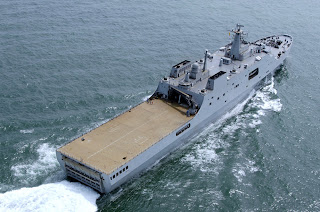
What we have not seen much to date is a shift in tactics. However, that may be about to change. As Feng noted on Thursday night, China's sixth naval escort flotilla departed Wednesday for the Gulf of Aden and Somali waters. What makes this noteworthy is that the composition of the sixth naval escort flotilla is different than the previous five.
The flotilla with more than 1,000 personnel, including Navy special forces troops, is to relieve the fifth flotilla, which has been cruising the waters off the Somalia coast for more than three months.

The amphibious landing ship Kunlunshan, destroyer Lanzhou, and supply ship Weishanhu of the fifth fleet, will escort vessels sailing through the region.
What is noteworthy about the Chinese approach to anti-piracy is how to date the activities by the PLA Navy has been escorting convoys. The Chinese have essentially forced much of their flagged merchant traffic to participate in a convoy system through the internationally agreed transit area. That isn't a bad thing, the PLA Navy has a perfect record of successfully escorting vessels in these convoys.

What I will be interested in watching is how the PLA Navy will use the Kunlunshan as an escort. The addition of the LPD is certainly the centerpiece of attention on the domestic front for China, the news reporting surrounding the Kunlunshan deployment almost looks like a state sponsored technology presentation in the newspapers - indeed I believe that is a fair and accurate description. Yes, the ship is interesting and it is something new to look at when observing the PLA Navy - but that isn't what has my attention.

Feng's post includes several of the popular images being circulated with this story. Note the small attack boats, which interesting enough are featured in every article including video I have seen of the deployment. As the sixth escort flotilla, China has now gained valuable experience in convoy escort responsibilities - something that will no doubt prove invaluable in wartime. What is noteworthy about the latest deployment however is that there also appears to be some tactical evolution taking place.

Not only will the sixth escort flotilla support more helicopters than any previous flotilla (7 total), but they will also have at their disposal several small, fast boats capable of dispatching towards threatening scenarios. As Mr. Boyko noted, China has observed the environment of indigenous vessels and has brought different capabilities to address the challenges being faced. That swarm of boats, which may or may not be pirates (but we see all the precautions being taken as if they are) represents an unknown that can be addressed by heavily armed fast, small boats through inspection. In many cases pirates will dump their weapons, ammunition, and pirate equipment before being boarded so as to avoid being arrested. Physical presence at sea with fast boats will give the PLA Navy capabilities for dealing with potential pirates that they previously did not have.

NATO Goes Hunting

This is an official NATO press release from earlier this week.
On the Alliance’s request, the Netherlands has agreed to deploy a submarine as part of multinational efforts to combat piracy off the east coast of Africa, from the Gulf of Aden - one of the busiest global shipping routes - to the Indian Ocean. The submarine will be used to monitor communication between pirate vessels and their warlords on shore, helping to curtail the hijacking of commercial ships for ransoms worth millions in US dollars.

This will be the first submarine to contribute to NATO’s anti-piracy mission “Operation Ocean Shield” off the horn of Africa. As one of four Walrus-class submarines belonging to the Royal Netherlands Navy, it is one of the most modern non-nuclear submarines. Built with stealth technologies, it is very difficult to detect - even by other submarines - and can remain submerged for long periods.

The submarine will be deployed from the end of September to the end of November 2010.

NATO recently extended Operation Ocean Shield for a further three years. Its current mandate will end in December 2012.
Now why would NATO request a Walrus class submarine? Lewis Page over at the Register is mostly correct, but he doesn't focus in on the details and gets a bit generic. All the rave these days when it comes to submarines is the advantages of AIP. On this blog we have to be more specific when focusing on propulsion systems - because propulsion systems on a submarine isn't only about sound and speed - it is also about power for systems.

The reason the silent service is so - silent, is primarily because submarines serve in the intelligence gathering role more than any other major piece of military hardware in the world. Submarines do amazing things that nobody likes to talk about in public, but lets just say you can buy a submariner a T-Shirt that says "I read your email" or "I listen to your cell phone" and you'd be keeping it real. You see, the advantage the Walrus has over every other conventional submarine in Europe (including all the AIP submarines) is that it has more power - thus is able to exploit more sophisticated electronic devices for eavesdropping purposes. By calling in the Walrus for anti-piracy, NATO is taking piracy surveillance to a whole new level.

The Walrus will be able to park itself unseen in these clusters of idle hijacked vessels and essentially watch and listen to everything taking place. Want to use your cell phone or a laptop from a hijacked ship? NATO will officially support that activity beginning this September! It is very likely that the US Navy has been doing similar things with nuclear powered submarines for a long time, and it is also possible that specific intelligence has been obtained that necessitates an expansion of eavesdropping capabilities - and the Dutch are being called in for an assist.

The bottom line here is that NATO is about to really know the pirate business, and that knowledge may be enough to shut down current operations. But how exactly might that happen?

We Trained For This

I would like to direct our professional reading audience to the July 2010 Proceedings article titled Pirates Beware: Force Recon Has Your Number (subscription only) written by Captain Alexander Martin, U.S. Marine Corps.
Hunting pirates with the U.S. Navy is what the 15th MEU—a wide array of ships and aircraft and even more Marines and Sailors—has just set sail to do.

The 15th MEU is a distinctive and historic Marine air-ground task force. This armada steams toward Africa more capable and ready for maritime contingency operations than any MEU in a number of years. It has among its numerous traditional capabilities and missions a trained, validated, capable, and lethal instrument now called the unit's Maritime Raid Force Capability (MRFC), a fully integrated Navy-Marine Corps team with the capacity to conduct visit-board-search-seizure (VBSS), kinetic strikes on non-compliant targets, maritime infrastructure seizure and reinforcement, host-nation training, and other maritime raid and interdiction operations as directed.

Its execution packages come complete with supporting air, medical and trauma units, sniper teams, shadowing ships, Navy VBSS and ship-control teams, small-boat units, and a direct-action assault unit with an integrated infantry trailer platoon for support. That second-to-last part—the assault unit—is our piece of the pie.
This article is great because it is real - indeed I may have quoted one of the few parts of the entire article that took itself seriously. It actually reads like a diary entry of a Marine Captain who has been training for over a year with an understanding his number is likely to be called. It is most likely the story of every Marine Captain in his position deploying as part of a MEU - except not every Marine Captain writes their thoughts down in Proceedings.

Leading up to the deployment of the Peliliu ARG - as I was following the news and articles covering the workup I took note of a stated focus on piracy in every article discussing training and exercises. I recall reading an article on the Harrier detachment that discussed piracy. There has clearly been some intense focus on anti-piracy integrated into this MEUs training. I knew something was different and was about to happen, and in passing I mentioned this a friend who works at the US Naval Institute. It was at that time I heard about this article being in the pipeline for Proceedings.

We don't know exactly what the 15th MEU intends to do differently that others have not done previous, but in making inquiries over the past month I have been assured by several people that the 15th MEU is different. Is the RoE going to be different? Are there already operations planned we don't know about? Can anyone provide any new information? So far.. nothing, but as the Proceedings article makes clear - the training and preparation of the Peliliu ARG does represent a new integrated Navy/Marine Corps approach to anti-piracy and at least one Marine Captain in the MEU thinks it will pay off.

Whatever happens we do know a few things.
  • The Chinese have just deployed three ships that brings with them more capabilities for anti-piracy than the PLA Navy has ever sent to the Gulf of Aden previously.
  • The Dutch are sending a submarine for anti-piracy operations at the specific request of NATO.
  • The US has deployed an ARG specifically trained in a new way to deal with pirates, and one of the MEUs Captains is so excited about it he basically teased the entire national security establishment (all of whom are readers of Proceedings) with a hint that good things are to come.
It sounds like a tactical evolution in dealing with piracy is taking place across the board. The next few months could prove to be very interesting.

Thursday, July 1, 2024

071 deploying to Aden officially

According to this Xinhua article, China will be deploying 998, 170 and 887 to Gulf of Aden. It also reports that the flotilla will have more than 1,000 personnel, including Navy special forces troops. We also find out that 998's displacement is 18,500 tonnes in its mission configuration. It should be not a surprise that 998 is going on this mission. China has been sending all of its new naval toys out there. They waited until the LCAC is in service before sending 998 on this mission. The more interesting part are the photos that came out.

First, we have a really nice detailed diagram of 998. It looks like the well deck can only hold one LCAC, but it will also hold a couple of high speed patrol boat. I presume that these will all be used against the pirates. It also looks like the hangar is large enough to hold 4 Z-8s (assuming they do 2 side by side on top of 2 front and back). The Z-8s accompanying 998 were specially fitted with gun pods to assist in attacking pirates.

Here are some photos of the LCAC from the same magazine. Looks like the one traveling to Aden will be 3320. There is also a nice photo of LCAC going at high speed.


A picture of the well deck with patrol boat.

Finally, more pictures of 998 going on this mission.


Anyway, good to see we are finally getting more details on this ship.

HNLMS Johan de Witt and soft power

HNLMS Johan de Witt ended her tasks of the Somali coast on June 29.

Just before her return to Den Helder she did a little soft power.

First it's crew gave a training session on the 17th for 50 members of the Yemeni Coast Guard. The CO of the ship, Ben Bekkering, said that having the landing craft enabled them to let the Yemenites do things on their own.

On June 24 Somali elders from Xhabo met with Dutch navy personnel aboard one of the LPD's landing craft. They told that local villagers are also at risk from the pirates, who confiscate boats from the local fishermen and rob the locals.

The village of Xhabo does not have any medically trained inhabitants, so the crew of the Johan de Witt organised a possibility for the locals the get medical treatment aboard one of the landing craft. It had to be done this way because the EU mandate does allow for operations on land. So on the 28th 73 people went to the landing craft by skiff to receive medical treatment.

The next Dutch ship off the Somali coast will be HNLMS De Zeven Provinciën, a frigate, that is already on her way. She will lead SNMG2 in NATO operation Ocean
shield.
That means wainting for another LPD untill September, when the Spanish will send SPS Galicia, a sister of the Johan de Witt, to Somalia. We'll have to wait and see if they will use the same tactics with their landing craft as the Dutch have used.

And I'll also use this blogpost to give kudos to the PR department of the Dutch MoD for the amount of attention they generated in announcing the Netherlands will send submarine HNLMS Walrus to Somalia, following a NATO request. I'm still wondering why it is that newsworthy.

(And for tho who want to sea the landing craft in operation and hear an explanation from the CO and the Dutch Minister of Defence (in English!) about the tasks the LPD performed: a video.)

Chinese Fireworks on the 4th of July

On June 24th the Chinese government announced a live firing training exercise to be held in an area of Zhoushan, Zhejiang Province in the East China Sea from June 30 - July 5. The 6 day exercise warns all civilian vessels to stay out of the exclusion zone for safety purposes. With the decision to conduct a military exercise on the weekend of July 4th, the impression China is giving is that this exercise is intended to specifically target the United States.

The exercises are expected to feature numerous Type 022 Houbei fast attack missile catamarans in addition to other ships and submarines of the PLA Navy, as well as other branches of the PLA. The Department of Defense annual report on Military Power of the People’s Republic of China (PDF), the latest edition released in March of 2009, lists a count of 70 fast attack missile vessels currently in operation for the PLA Navy. The U. S. Office of Naval Intelligence report (PDF) (2010) notes there are over 50 Type 022 Houbei's in service, perhaps as many as 32 in the East Sea Fleet. The Type 022 is a relatively short ranged (500 nm) heavily armed stealthy catamaran that is thought to be utilized for swarming approaching warships and attacking from multiple axis with their 8 YJ-83 missiles. When I was at the Naval Postgraduate School last summer, Captain Wayne Hughes (ret) and I agreed that this vessel looks very similar to the "Streetfighter" capability discussion that he was centrally involved in on the pages of Proceedings magazine at the turn of the century.

As a technology the Houbei is not what US military observers will be watching, rather the command and control capabilities that are necessary to achieve a multi-axis coordinated joint forces integrated attack that also features Houbei fast attack vessels will be what experts are watching for. It would be no small feat for China to be able to demonstrate surface, submarine, and aviation capabilities in a coordinated multi-axis attack- because in tactical military operational planning such coordination done well is extremely difficult, and requires communication and coordination integration across services and commands that represents a capability many nations do not have today within their armed forces.

But even that isn't why the Pentagon has both eyes focused on this exercise. The reason this exercise has many concerned is that China may test a DF-21D anti-ship ballistic missile. Andrew Erickson noted in his latest article that China has appeared to be getting close to their first DF-21D test.
Given the nature of the reported training, it is at least theoretically possible that it might incorporate tests by the Second Artillery involving missiles launched from land. Open source background and timelines on Chinese anti-ship ballistic missile (ASBM) development-as offered in my China ASBM Analysis and Archive post-suggest that this could even include some form of ASBM tests, based on China’s current state of ASBM development and stated desire to demonstrate the ability to threaten carrier strike groups (CSGs).

If so (and it may well not happen at this time), this would be the world’s first live public test of an anti-ship ballistic missile. There are a number of indications that China may have reached the point that it is able to conduct some fairly sophisticated ASBM tests, which would then make such tests a necessary step to reach the next level in the ASBM development that China has so clearly prioritized.

Recent indications include the reported completion of a DF-21D rocket motor facility in 2009 and the recent launch of 5 advanced Yaogan satellites, three of which were apparently placed in the same orbit on 5 March-thereby perhaps offering better coverage of critical areas along China’s maritime periphery. Another possible indication is a recent news release attributed to China Aerospace Science & Industry Corporation (CASIC) citing Wang Genbin, Deputy Director of its 4th Department, as stating that the DF-21D can hit “slow-moving targets” with a CEP (circular error probable, meaning half of missiles fired will strike within) of dozens of meters.
The DF-21D is the subject of much speculation and discussion related to Chinese military capabilities, and there are several valid reasons why. The DF-21D represents the first military capability of any kind developed by another country since the end of the cold war that is believed by US defense officials to represent an asymmetrical technological advantage over the United States military. For over two decades the United States has enjoyed technological superiority on land, air, and at sea over any potential competitors - that technology superiority is the foundation of our nations military power.

The DF-21D represents an evolution of technology that gives China the ability to reach out at long range and directly target the single largest and most expensive symbol of the technology superiority enjoyed by the United States - the nuclear powered aircraft carrier. As a weapon system, the DF-21D anti-ship ballistic missile can be launched from a concealed position on land in the general direction of a US Navy carrier strike group, and while in flight, adjust course as necessary to directly target the aircraft carrier.

The key point to why the weapon system does in fact represent a significant technology evolution and asymmetrical capability is the ability of the DF-21D to change course and identify its target in mid-flight. The current anti-ballistic missile defense system fielded by the United States is not capable of intercepting a ballistic missile that can significantly change course during flight and identify a target in mid-flight - and that capability to maneuver significantly in flight is what gives the DF-21D its asymmetrical advantage against existing US anti-ballistic missile defense systems.

Current US anti-ballistic missile technology, including the AEGIS anti-ballistic missile defense system, develops data during the launch of a ballistic missile to calculate course and speed. Factors that include the speed of the ballistic missile and the trajectory of the ballistic missile are part of the calculations that are made to develop an intercept track. Anti-ballistic missile interceptors can then be fired in the general direction of the calculated path of a ballistic missile - and when the anti-ballistic missile interceptor gets close enough, the terminal guidance and detection system on the anti-ballistic missile interceptor can then detect and intercept the ballistic missile target.

Because the DF-21D is expected to adjust course at high altitude and detect an aircraft carrier after launch over what could potentially be hundreds of square miles at sea, the calculations based on the launch of the ballistic missile could in fact feed an anti-ballistic missile defense system inaccurate data for intercept. A course change of only a few degrees by the ballistic missile to track a US aircraft carrier could mean that an interceptor launched to intercept a DF-21D could be hundreds of miles away from the DF-21D when the interceptor goes into terminal mode to detect the ballistic missile - leaving the interceptor unable to intercept. At speeds that will likely exceed 13,000 mph and on a direct flight path from near orbit, the DF-12D anti-ship ballistic missile will be extremely difficult for conventional anti-ship missile defense systems to detect and intercept - leading some experts to dub the DF-21D a "carrier killer."

China has designed the DF-21D to be an anti-access weapon with the specific intent of sinking a US aircraft carrier with a single shot. The DF-21D has been in development since 1996, but it wasn't until 2007 that US analysts began taking the threat seriously when Chinese rocket artillery and engineering publications were published that suggested the capability was advancing. It was at that point the DF-21D became a feature (instead of a footnote) in the DoDs annual Chinese military power report to Congress.

The evidence of how seriously the United States takes the development of the DF-21D is essentially the story of the US Navy "transformation" over the last 3 years. The decision to truncate the DDG-1000 in favor of more DDG-51s was stated to be for the specific purposes of increasing the nations anti-ballistic missile capability. The decision by the Obama administration to shift development of national ballistic missile defense towards the Navy's AEGIS solution aligned the investment of scarce financial resources towards the AEGIS capability that is most likely to be challenged. The financial investments of billions of dollars that Congress has supported to upgrade the AEGIS BMD system also represents a sign that the government is vividly aware of what the DF-21D represents as an asymmetrical advantage in favor of the Chinese. The continuous discussion within circles of naval observers and analysts regarding the future of the aircraft carrier in the 21st century is a reflection of the concern defense watchers have in large part due to the development of the DF-21D. The acceleration of plans regarding the capabilities of the AEGIS weapon system is largely due to recognition that the current system is not currently capable of addressing this emerging threat.

The Chinese DF-21D and US AEGIS anti-ballistic missile defense system represents the first major offensive/defensive military capability arms race of the 21st century. If China successfully tests a DF-21D ballistic missile specifically designed to kill 5000 US sailors on the 4th of July, then there will be no question the pendulum in that arms race will have shifted in China's favor.

The Balisle Report

The Balisle report is starting to gain traction with the latest reporting in the press. What has been reported in the press already is only a sample of the blunt nature of the report regarding all the issues surrounding Surface Force Readiness. This report is serious and all business, and I mean it when I say the language is blunt and direct. I also find the quality of the report to be very high - rich in detail, and with a quality of depth to many issues.

I currently have no intention to release my copy of this report to the public, although I have to admit that the casual dismissal as a response to the report as reported in Phil Ewing's first news article about the report has me thinking I should just print the whole thing in small pieces on the blog (or the USNI blog actually). The impression that the contents of this report can be casually or flippantly addressed by the Navy kind of ticked me off as a taxpayer. The contents are entirely too serious for such a response.

I'll add to the discussion of the Balisle Report started by Phil Ewing in his press reports to date by quoting from the Financials section which, in theory, should hold some value for our Congressional readers.
Observations/Findings. Surface ship maintenance has been significantly underfunded for over ten years. This is manifesting itself in the degraded material condition of the ships as reflected in recent INSURV reports, corrosion audits, and CASREP data. The decision to transition to condition based maintenance from an engineered operating cycle maintenance resulted in the reduction of over 500 man days per month of depot level maintenance from DDG 51 class ships alone and a corresponding reduction in programmed operations and maintenance dollars for ship depot level maintenance.

While the difference was intended to be compensated by an increase in funding and opportunities for continuous maintenance availabilities throughout the year, that never translated into reality. A clear indicator of the fallout of the lack of funding is the steady increase in TA-4 (ship force capable) level work.

It may legitimately be said that insufficient funding applied over recent years has not been the result of an unwillingness to fund to the requirement as much as the result of not having a properly identified requirement.

For example, as programmed, it may appear that overall ship maintenance is funded at 95-99%. In reality, since we don't know the true maintenance requirement for conventional surface ships (the "denominator"), it is reasonable to assume that our surface ships receive a lower percentage for maintenance funding when compared to a true requirement. Currently as maintenance dollars are allocated by the Fleets, public shipyards (where the majority of CVN and submarine work is performed) are funded at levels between 97-100%. That leaves the balance of the maintenance funding left to be allocated to conventional surface ship maintenance. Currently one of only two items in the CNO's Unfunded Requirement list to Congress is $200M for ship maintenance.

The end result is the surface navy is funded below their identified requirement at the start of the year with the goal of making up the balance as money becomes available during the execution year. This unstable funding environment almost exclusively impacts the private shipyards, where most of the non-nuclear ship maintenance is performed, and results in higher work rates aas jobs get screened into the availability package laer due to uncertainty of funding commitments. The end result is an understanding requirement that has been underfunded in the budgeting process that is frequently going to cost more in actual execution because of an unpredictable funding stream, in other words, a low return for maintenance dollar invested. To further impact material readiness, the surface Type Commander frequently has to make irrevocable mitigation decisions earlier in the fiscal year due to projected uncertain (or unfavorable) levels of funding. If a CNO availability is subsequently canceled, or de-scoped prior to a midyear money bring available, that maintenance most likely will not be made up later in the year. Alternatively, cash flowing throughout the year on the hope that more money will be available later is a tenuous business plan that can leave availabilities scheduled for the end of the fiscal year exposed and unfunded.
I was very tempted not to post or quote any part of the Balisle Report until I read the response given by the Navy to Phil Ewing in his first article. Now that I have read the report in full, this kind of answer doesn't satisfy me, as a taxpayer, none.
Capt. Cate Mueller, a spokeswoman for Fleet Forces Command, said Balisle's report didn't tell the Navy anything it didn't already know.

"Fleet leaders, based upon their own prior analysis, believed that many of the problems that the panel subsequently identified - including manning shortfalls, inadequate shipboard and shore maintenance, and insufficient training - were taking a toll on surface force readiness," she said. "In that regard, the fleet review panel confirmed, in context and in detail, what fleet leaders had suspected."

She also reaffirmed what senior Navy leaders have hinted for the past few months: They're swinging the pendulum in the other direction by looking to increase crew sizes, improve training and re-teach the fleet to maintain its ships and equipment.
If any leader wants to strut around with a position that the findings "didn't tell the Navy anything it didn't already know" then I see serious problems. I understand that some of the issues raised in the report are well known and had previously been identified - ADM Harvey himself has discussed the manpower shortfalls and insufficient training issues on several occasions, and has been direct when discussing solutions. The report is so much more than that though, and if Navy leaders already knew what the report would find - you've been intentionally covering your ass by not disclosing this information to Congress or the taxpayer. The American public deserves a better answer than a 'nothing new here to see' type of response.

The part of the Balisle Report I quoted identifies the absence of a "properly identified requirement" for maintenance funding going back over a decade - meaning that every single Admiral who is also a surface warfare officer has only known the broken system of maintenance that has existed for over the same period of time every single Flag SWO was in major Command.

This report is seriously troubling, and raises legitimate questions regarding the quality of the fleet in reality vs paper, and an even more serious question whether the US Navy is a good steward of taxpayer investment. There are so many areas to discuss that I understand why Phil Ewing is putting out a new article that only covers part of the Balisle Report every week.

If you didn't read Phil Ewing's contribution this week, take a look. That is such an enormous issue it deserves its own blog post, and absolutely should have every Congressman on the HASC demanding to get an informed and impartial brief on the Balisle Report.

I don't see how Gene Taylor avoids a hearing on the findings of this report - because it raises serious questions regarding the quality of testimony the US Navy has been giving the HASC Seapower Subcommittee over the past few years on questions related to maintenance and the quality condition of the surface fleet. The Navy has stated in testimony they are going to extend the surface fleet out to 40 years life, and yet the report makes clear that under the current maintenance condition of the past decade, ships would be lucky to make it past an average of 28 years - below the prior expected life of the ship. WTF? The report also raises serious questions regarding new maintenance concepts in development - LCS comes to mind.

The Balisle Report is too blunt, too detailed, and too revealing of serious problems to go ignored or be casually dismissed as 'something the Navy already knows.' That is an unacceptable dismissal of a rather lengthy and damning report on the status of the surface fleet with detailed analysis of numerous problems.

6th Fleet Focus: Port Search

There are all kinds of good reasons why Rota, Spain would be a great place to forward station AEGIS BMD ships - the main reason being Spain deploys AEGIS ships and Rota can support that. Location, location, location though... From Navy Times.
The Navy is in talks with European countries about where and when it could forward-deploy the surface ships that will be assigned standing patrols to defend the continent from ballistic missiles, the commander of 6th Fleet said June 14.

But Vice Adm. Harry Harris, the Navy’s No. 2 commander for Europe, said that because the negotiations were still taking place, he would not name the countries under consideration.

“Many locations are being looked at,” he said. “I can’t go into the locations because we haven’t decided on one yet; there are location and country-to-country issues and all that, but certainly we’re looking at it — and no decision has been made yet, but it’s certainly something that’s on the table.”
But where exactly?
So, where could the Navy be looking? One spot likely high on commanders’ list is Gaeta, Italy, which is already the home port for Harris’ flagship, the amphibious command ship Mount Whitney, and has hosted U.S. and NATO warships since 1967.

Another contender could be Rota, Spain, where the U.S. Navy has shared a base with the Spanish navy since 1953. Although it’s less geographically convenient than Italy, Rota has the advantage of having more repair facilities, which American ships could share with their Spanish hosts.
If it was me, I'd advocate like hell for Rota and tell Congress that we also need a BMD tender to provide forward capability to the Eastern Med. It is probably more expensive, but maybe by not as much as you think, to build onto the existing facilities at Rota and build a tender for forward support. While the operation of the tender will probably be expensive, someone please explain why we won't absolutely require a BMD tender in the Pacific at some point in the future anyway.

Might as well start discussing it now.