The interwebs were aflutter yesterday with the indomitable Sam Lagrone's report that the White House had indicated its discomfort with OSD plans in the FY15 Budget Submission to cut a carrier from the Navy's Fleet, from 11 to 10. A brief Facebook exchange ensued, in which one discussant indicated that it was a sign of just how disconnected the White House and the Pentagon are, with me then countering that it could also be a reflection of the Pentagon's inability to get beyond Least Common Denominator/Budgeting by Consensus, as in "the Army has to shed people, so the Navy has to shed a carrier". Others chimed in saying that it could be both, which I can definitely see.
I do think that there is a disconnect between the White House and the Pentagon, but I don't think it peculiar to this White House. Put simply, the White House is not bound by the same Marquess of Queensbury Rules that dominate the way things get done in the Pentagon. I have railed against Jointness here enough for faithful readers to know my view that the requirement for consensus has dulled sharp edged-debates among the Services over strategy and capabilities. Consensus and collegiality are valued above all else with the result that the building has ceased to be able to make hard strategic choices in the allocation of scarce resources. Instead, it whittles down a generally unchanged proportional distribution of resources, resulting in a force that can do less, in fewer places, to a lesser extent.
The White House--specifically the National Security Staff--plays by different rules. Specifically, they play by the rules evoked in this exchange from The Hunt for Red October:
The President of the United States is ENTITLED to options when it comes to the use of military power. Surely $600B is enough to buy a sufficient range of options, right? Well, no, actually, because so much of it is mis-allocated to capabilities and capacities that serve the ends of the Pentagon well, but serve the ends of providing the President with options less well.
I have no insight into the current National Security Staff and its relationship with the President, and I may be guilty of preference bias and other incredibly noticeable analytical mistakes. But I think this President is TIRED of not having OPTIONS. Don't get me wrong--I don't believe necessarily that he'd have made different decisions in the early days of Libya, the fateful night at Benghazi, or the day the Syrians used chemical weapons. And don't get me wrong--I am NOT saying he made the wrong decisions in each of these cases. But what I am saying is that in EACH of these situations, there was a distinct lack of forward deployed credible combat power from the sea AT THE MOMENT OF DECISION. Sure, a week or so later we were able to rally appropriate forces--but that's not what the President expects out of the Navy. He wants it to be available to him when it counts. And the current 11 Carrier, 285 ship, two hub Navy is just not cutting the mustard.
We have seen this President balk at cutting carriers before, in the 2011 budget deal. That OSD might go back to that well indicates either an assessment that political calculations had changed or simply--as some on the Facebook exchange indicated--a disconnect from the views of the President and the White House (driven in my view by the bureaucratic weight of Jointness).
What's to be done? How about this. PRIOR to the Secretary of Defense and the Chairman of the Joint Chiefs promulgating their program guidance to the Services to start the POM process each year, the President should issue to the Secretary and the Chairman THE PRESIDENT'S GUIDANCE. In it, he would issue HIS priorities and provide top level guidance. This would be different from OMB's dicing up the budget pie and allocating resources to the departments. It would be "commander's intent" from the Commander in Chief designed to shape the way the Services prepare their budgets.
I realize that doing this for every Executive Department would be onerous (though worthwhile)....but doing so for the Defense Department just seems to make good sense.
Bryan McGrath
Update: The more I think of this, the more I realize that the recommendation I make in this piece is not original thought. I am pretty sure it comes from a conversation I once had with Shawn Brimley of CNAS, who should be properly credited.

Friday, January 31, 2024

Monday, January 27, 2024
Sunday, January 26, 2024
The Fifth Element: Enhancing Conventional Deterrence in East Asia
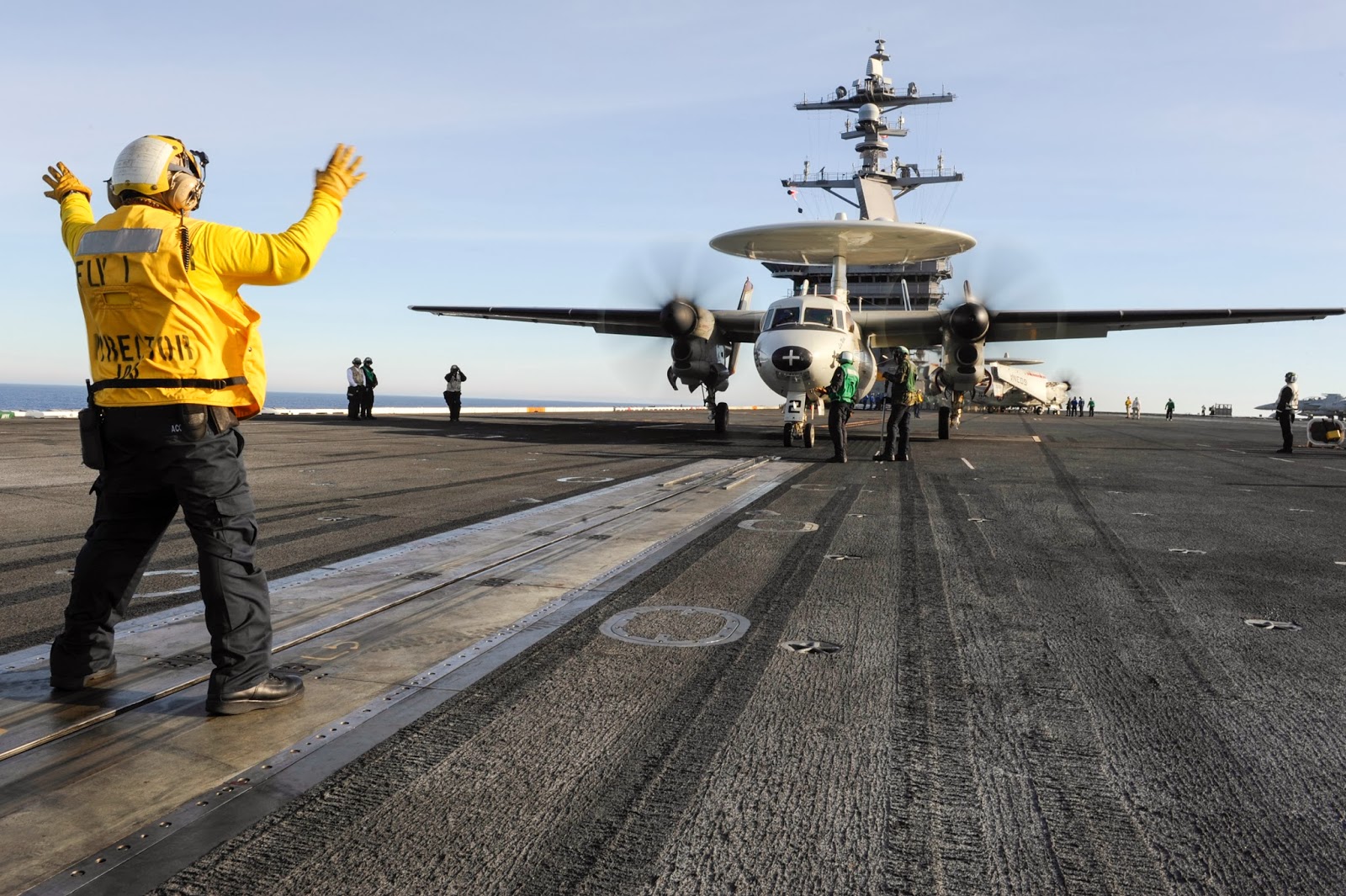 |
| PACIFIC OCEAN (Jan. 22, 2014) Aviation Boatswain's Mate (Handling) 1st Class Reynaldo Acuna directs an E-2C Hawkeye, assigned to the Sun Kings of Carrier Airborne Early Warning Squadron (VAW) 116, on the flight deck of the aircraft carrier USS Carl Vinson (CVN 70). Carl Vinson is underway conducting Tailored Ship's Training Availability off the coast of Southern California. (U.S. Navy photo by Mass Communication Specialist 3rd Class Scott Fenaroli/Released) |
The following contribution is written by Robert C. Rubel, Dean, Center for Naval Warfare Studies at the Naval War College.
In a 21 January post on this blog, guest contributor Bryan McGrath extolled an article in the Winter 2013 Strategic Studies Quarterly by Jonathan Solomon entitled “Demystifying Conventional Deterrence: Great Power Conflict and East Asian Peace.” I too found the article worth extolling as it not only takes my favored challenge-response approach to analysis but produces conclusions generally consistent with the work we have done here at the Naval War College over the past decade. In the article, Solomon identifies four factors - or elements - which he considers central to conventional deterrence: capabilities, quantities, positioning and readiness. While I agree with this list of elements, I would like to offer one more to it that I believe is as important: operational concept.
The term operational concept will be interpreted in different ways if left undefined, so let me offer a temporary definition to be used only in the context of this post: it is the general approach to using military force to achieve strategic objectives. To make this clearer, let me nest it within a kind of strategic dialectic that Solomon uses: counter-force and counter-value. These are two different approaches to military strategy, the first being concerned with denial and disarming, and the second with coercion. Solomon correctly points out the dangers and imponderables associated with counter-value strategies and in the end advocates a deterrence posture based on a denial or counter-force approach. Within that general category of strategy there are a number of possible operational concepts. T. X. Hammes, in his treatises on offshore control, and Solomon seem to advocate a robust operational concept of control. Hammes envisions a more rigorous regime - control of waters inside the first island chain - than does Solomon, whose approach is at least implicitly more modest in advocating denial. However both of these “operational concepts” set the bar pretty high for what we say we must achieve. Given the number of land-based systems that compose the Chinese A2AD edifice, achieving control or denial seems to imply strikes on them or, in Hammes’ strategy, somehow dealing with them without strikes on the mainland. Alternatively, a concept I have been thinking about is “disruption.”
Solomon’s worst case scenario is if conventional deterrence is based on bluff and the antagonist calls it. In such a case all the nasty dynamics of uncontrolled escalation threaten to kick in unless we capitulate. Following this logic, if, with an operational concept of control, we set the performance bar so high (as a presumed necessity to achieve the desired results) that it can be “designed around” (to quote Solomon) or becomes otherwise not credible, are we essentially bluffing? This is my worry when we talk control and dominance, especially in waters closer to China. Even denial has the implication of persistence amounting to control. A quick examination of the map reveals that the distance from the Senkakus to the southern part of the South China Sea is the same as from Maine to Key West. That’s a heck of a lot of difficult geography to try and control. Solomon remarks that one mode of deterrence is to convince the potential attacker that a contemplated quick military checkmate will likely deteriorate into an extended war of attrition. But that can work both ways, especially if we appear to be unable or unwilling to engage in such a contest on the basis of seeking or maintaining control of waters inside the first island chain. In my view, it sets us up for a nasty dilemma.
A concept of disruption might be more operationally feasible and therefore more credible. The basic idea is to engage in a form of sniping, posturing our forces to sneak in and disrupt any instance of Chinese military aggression with an eye to taking a quick fait accompli off the table and establishing the basis for an extended war of attrition of a type we could actually afford. Disruption, as a military approach, would allow us to focus on what the Chinese do rather than try to patrol and defend a huge littoral area (the implication of Hammes’ proposal). The Chinese may be getting strategically over-confident, but my guess, following Solomon’s discussion, is that their leadership might lack confidence in their ability to deal with a crisis, especially one in which their plans go off the rails. The idea of a disruption concept is to play to that weakness at all levels from the unit up to the Central Committee, on the basis of an approach to fighting we can actually conduct in those waters and can sustain indefinitely - no bluff. This gets us on the correct side of the cost curve; it’s more expensive for them to counter our disruptive threats than it is for us to pose new ones. Additionally, also following Solomon’s good analysis, disruption is inherently defensive and less liable to be seen as a prelude to something intolerably offensive.
As Solomon suggests, a concept like this requires a lot of development. As with the nascent flotilla concept I and others have espoused elsewhere, the concept of disruption must be subjected to detailed and iterative gaming and research to determine its feasibility. However, if it proves to have merit, it then becomes the critical “Fifth Element” for a conventional deterrence posture in East Asia that has legs.
As a postscript to this post, let me offer that there is a heck of a lot more to the issue of conventional deterrence than either Solomon or I have covered here. One concern I have is with the notion of “tailored deterrence” which was popular in the Bush Administration. I believe that deterrence is a form of conflict management, and that is an approach that reflects a structurally weak position with respect to the underlying dispute. See my article in the Fall 2012 Orbis magazine.
Saturday, January 25, 2024
Unmanned Systems, Autonomy, and Naval Culture
What do unmanned systems have to do with the future of naval command, control, and culture? In an attempt to answer that question, I wrote this piece several months ago and it recently hit USNI's site.
For some more interesting discussion on drones, listen to my friend Matt Hipple over at his podcast (you'll have to sit through some Africa discussion to get to the piece about the drones, which is also fascinating).
The views in this post are those of the author's alone and not reflective of the U.S. Navy or any other organization.
For some more interesting discussion on drones, listen to my friend Matt Hipple over at his podcast (you'll have to sit through some Africa discussion to get to the piece about the drones, which is also fascinating).
The views in this post are those of the author's alone and not reflective of the U.S. Navy or any other organization.
Thursday, January 23, 2024
Chinese Centers of Gravity
Many
distinguished scholars, journalists, and strategic analysts have provided
compelling visions of why and how the People's Republic of China (PRC) would conduct a naval and
military campaign in the Indo-Pacific basin. Several viable U.S. responses to
such a Chinese operation have been articulated. These include a blockade-based
“offshore control strategy” to deprive China of resources and trade, and the
“Air/Sea battle” operational concept involving a joint U.S. naval and air power
effort to directly combat Chinese forces in the Western Pacific littoral. Both
visions suggest allied participation and perhaps can be combined into an
overall military strategy. Before moving further however, it is useful to
examine current and evolving Chinese strategic “centers of gravity” and look at
how the People’s Republic of China (PRC) has conducted recent military actions.
Past Chinese conflicts may not provide a complete picture for U.S. leaders, but perhaps offer a window into how the PRC thinks about its military
activity.
Changing Centers of Gravity
China
has fought four significant military conflicts since becoming a Communist state
in 1949. Two distinct strategic concepts figure in all four wars. China first
“covered its six” by ensuring it was potentially angering only one of the
superpowers by its actions. China also sought to contain each war as a limited
conflict, but dispatched more than enough forces to ensure victory and/or
attainment of its objectives. In addition, the Chinese state was willing to endure
significant military casualties in pursuit of strategic objectives. In China’s
Korean War intervention, Chinese leader Mao Zedong first confirmed support from
then Soviet dictator Joseph Stalin before undertaking action against United
Nations (U.N.) forces in Korea in October 1950. The Chinese military effort did
not destroy U.N. forces but its action met Chinese objectives by preserving the North
Korean state. Some U.S. figures suggest the Chinese suffered over 400,000 dead
in the course of the Korean War.
China has fought
three additional short “border wars” since 1953 against India, its former
Soviet ally and its sister Communist state of Vietnam. In the October 1962
Sino-Indian conflict fought over disputed territory on India’s Northwest
frontier, the two superpowers were occupied in the standoff over Soviet missiles
in Cuba and did not play a role in the conflict. Casualties on both sides were
light but the Chinese took all of the Indian border territory of
Aksai Chin. The 1969 Sino-Soviet conflict over an island in the Amur River
claimed by both states was relatively minor compared with the fighting on the
Indian border. The Chinese, however, fought fiercely and suffered heavy
casualties in order to capture a disabled prototype Soviet T-62 tank. The
Chinese supported reconciliation attempts made by the United States during the
increasingly poor Sino-Soviet relations that followed the Amur River incident
and allowed Secretary of State Henry Kissinger to visit in 1971, beginning the
U.S. rapprochement with the People’s Republic. Finally in its 1979 “punitive
expedition” against Vietnam, the Chinese sought to prevent the Soviets and their
Vietnamese allies from altering the Cambodian-Vietnamese border. They committed a large
force to invade Vietnam and threaten its capital of Hanoi. The Soviets were too
distant to support the Vietnamese war effort and the United States was courting
Chinese favor and acceptance of its Cold War aims against the Soviets. The
battle-hardened Vietnamese Army fought well, but was pushed back, as the Chinese
desired, after a fierce four week campaign. The Chinese then pulled back to avoid
a wider conflict. The Cambodian border issue remained unresolved until the end
of the Cold War and China suffered somewhere between 8000 and 28,000 soldiers
killed in action.
Changing Centers of Gravity
 |
| Tiananmen Square Protests, 1989 |
The
most important center of gravity for post-revolutionary China has been the
survival of Communist party authority over the state. The definition of the
Chinese Communist party however has changed since the official Party program of
“Modernization and Stability” began in the wake of the Tiananmen Square
massacre of 1989. While the rest of the Communist world collapsed in the face
of the perceived superiority of the Capitalist system, the Chinese party was able
to adroitly turn the Communist system on its head and adopt the best practices
of its Western opposite number. The “modernized” China now resembles a large
corporation rather than the revolutionary state of Chairman Mao Zedong. Its
Politburo, with orderly successions of authority, and Party Congresses filled
with departmental representatives reporting on modernization efforts are
similar to a Corporate Board of Directors reporting to a meeting of
shareholders. The economic model fits well as the Chinese party essentially
“purchased” the loyalty and support of its citizenry. The exchange of
traditional Marxist patterns of life including poor quality consumer goods,
overt repression, and little or no upward mobility for economic
growth, security and prosperity has served to insulate the Chinese Communist
leadership from pre-1989 style criticisms. One wonders if Mikhail S. Gorbachev
lays awake at night wondering why he did not attempt the Chinese method for the
Soviet Union. While the Party itself remains the principle Chinese center of
gravity, the continuing prosperity and support for the party from the PRC
citizenry is nearly equal in importance to that of the party itself since both are mutually
dependent on each other's support.
 |
| Leaders of a fictional "corporate state" from the 1975 movie "Rollerball" "And now, our Corporate Anthem!" |
The growing
prosperity of the average Chinese citizen is supported in large part by the
vast system of ocean-going trade that fuels “Wang Q. Public’s” accelerated
standard of living. Heritage Foundation analyst Dean Cheng has stated that as
of 2010, 85% of all Chinese trade moves via ocean routes. The upward trend in
the percentage of China’s maritime trade as part of overall Chinese economic
activity shows no sign of abating as Chinese citizens now expect and demand a
higher standard of living. Any disruption in this seaborne trading system for a
significant length of time could call into question the Communist Party’s
ability to deliver its promise of better living standards. A maritime blockade
of China, either from distant chokepoints like the Strait of Hormuz or from
closer locations such as the Malacca Strait could over time seriously reduce
confidence in the Chinese Communist Party’s ability to deliver prosperity.
China appreciates
these challenges and has sought to minimize disruptions, especially in the
supply of petroleum products to its hungry industries. In recent years the
Chinese have invested large sums of money in Pakistan. Just last July the
Chinese signed an agreement with the Pakistanis to build an 1200 mile long “economic
corridor” from the port city of Gwadar on the Indian Ocean to the Chinese city
of Kashgar, first by road and later by rail. China would like to avoid having
to send so much valuable economic traffic by vulnerable sea routes and this
connection would alleviate some of their concerns.
How Has the PRC Fought Past Wars?
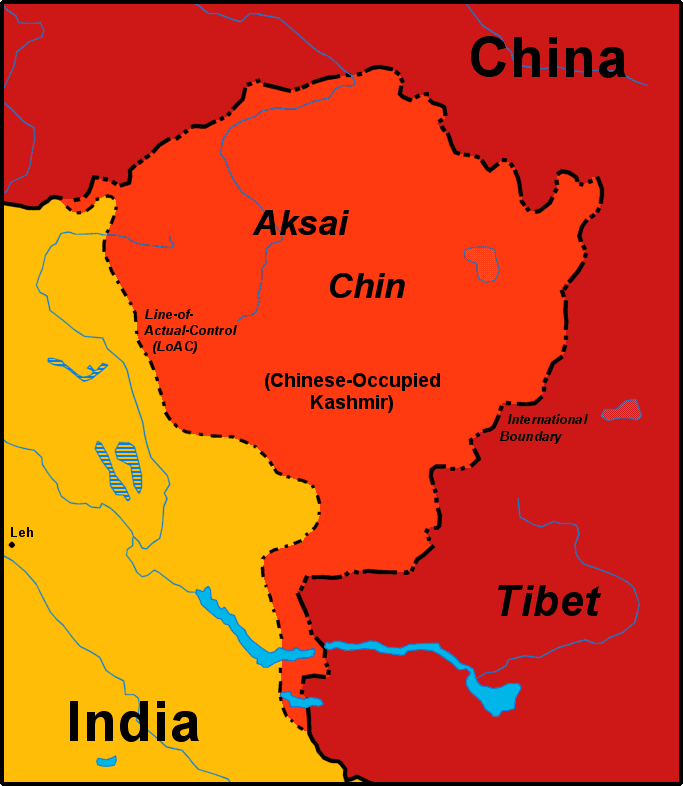 |
| Disputed area of Kashmir occupied by China in the 1962 Sino-Indian War |
 |
| Time magazine cover from the period of the 1979 Sino-Vietnamese War |
Wednesday, January 22, 2024
Offensive ASuW and The Rules of the Game
The Surface Navy Association held its annual gathering last week, and some of the biggest news to come out of it thus far has been a focus on offensive ASuW, aided in no small part by the speeches of ADM Samuel Locklear (PACOM), VADM Tom Copeman (SURFOR) and RADM Tom Rowden (N96). PACOM's quote "I’ve never wanted to enter any tactical scenario where all I had is a
defensive capability. It’s a losing proposition...you will defend yourself until you’re dead" certainly put a smile on my face. The surface navy appears to be all over this one, with a number of important options to explore from lasers to railguns to missiles. I like where this is headed.
But there is more to this than hardware, and I have been thinking about it quite a bit after finishing Andrew Gordon's magisterial "The Rules of the Game: Jutland and British Naval Command" over the holidays. The book is actually two books--the first, in which Gordon traces the development of the Royal Navy from Trafalgar to the start of WWI, and the second, which is an exhaustive overview of the Battle of Jutland. My interest is in the first part.
In it, Gordon traces the evolution of the Royal Navy from its zenith at Trafalgar, to a more hidebound, administrative, and ineffective Navy at the start of the First World War. The key variable of individual initiative within the ranks of commanding officers is studied closely, with Gordon finding that over time, it came to be somewhat less valued. It is cruel of me to reduce this masterpiece to this paragraph, but this is a blog and I want to be concise.
Gordon's thesis is that the poor performance of the RN at Jutland can be directly traced to this century-long evolution (or devolution, if you will). The "peacetime" RN lost some of its edge, and it showed when it had the chance to crush the High Seas Fleet, and couldn't.
I've begun to wonder whether or not our own Navy has similarly evolved (devolved) over time, perhaps since WWII but certainly since the fall of the Berlin Wall.
I don't want to go too far with the historical comparison, but I will use Offensive ASuW as an explanatory point. During the 21 years I served on active duty, I often underwent numerous "Harpoon Tactical Qualifications" or some other similar assessment of my ship's ability to proficiently wield the Harpoon Weapon System. As an Operations/Combat Systems type, this was one of our big inspections, one of the things you practiced over and over and over again for. Yet no matter how many times I submitted to and passed these inspections, one thought was never far from my mind--and that was "God I hope my Captain doesn't employ this weapon the way they are training us to do it."
You see, the heavy influence of the PEACETIME NAVY was at work. We overanalyzed, over-plotted, over-targeted and over-thought every single engagement, driven in no small measure by the fear of hitting "white shipping", or the clueless merchant who meanders into a hot war zone during the scenario. Never mind that the flight path of the missile avoided the merchant by hundreds of yards. Never mind that its seeker head wasn't active when it CPA'd the merchant. Never mind that the height of the missile at that part of its flight path would have flown over most of the merchants in the world at that time. Never mind that merchants don't have AAW radars and missiles.
No, invariably we would hold off on the shot to allow for "adequate" separation, or as some unfortunate watch teams found, take the shot and then suffer the ignominy of some OS Chief who couldn't sit watch supervisor on your watch team tell you that you had failed to account for white shipping.
I came to despise the Harpoon weapon system, not for any reason except the ridiculous pain it caused me as a leader in preparing for the elaborate kabuki that was a Harpoon Cert. Some of us would whisper..."if we were really at war....then...." and discuss how we might ACTUALLY want to employ the weapon.
By the time I had the ability to make a real difference--command--the Navy had ceased to put Harpoon on its new construction ships and I commanded one of those Harpoonless ships. We haven't built a warship with the organic ability to disable another surface vessel over the horizon since the year 2000.
So now the community is getting justifiably concerned, and the wheels are turning to return a surface to surface over the horizon weapon to the surface fleet. I am pleased. I am also pleased at the words used by both VADM Copeman and RADM Rowden at SNA pointing to the requirement to embrace warfighting--basic blocking and tackling again.
It sounds as if we may not need our "Jutland" to shake us out of the peacetime Navy mindset, or at least a mindset in which we concentrated on other aspects of the warfight and allowed our Sea Control skills to dull a bit.
Whatever direction the Navy ultimately takes in re-equipping its surface combatants for the war at sea, one thing is clear to me. We must from the get-go, plan and train to employ the weapon the way we would in war, a war in which we might once again be challenged at sea. We must not train out the aggressiveness that we seem to want now to reinsert. The temptation to "overthink" these new capabilities will be HUGE, as they will likely fly far greater ranges than the Harpoon did. So be it. We should not waste weapons indiscriminately, but we must ensure that the technologies we acquire promote the greatest forward lean possible in taking the offensive.
These are the rules of the game.
Bryan McGrath
But there is more to this than hardware, and I have been thinking about it quite a bit after finishing Andrew Gordon's magisterial "The Rules of the Game: Jutland and British Naval Command" over the holidays. The book is actually two books--the first, in which Gordon traces the development of the Royal Navy from Trafalgar to the start of WWI, and the second, which is an exhaustive overview of the Battle of Jutland. My interest is in the first part.
In it, Gordon traces the evolution of the Royal Navy from its zenith at Trafalgar, to a more hidebound, administrative, and ineffective Navy at the start of the First World War. The key variable of individual initiative within the ranks of commanding officers is studied closely, with Gordon finding that over time, it came to be somewhat less valued. It is cruel of me to reduce this masterpiece to this paragraph, but this is a blog and I want to be concise.
Gordon's thesis is that the poor performance of the RN at Jutland can be directly traced to this century-long evolution (or devolution, if you will). The "peacetime" RN lost some of its edge, and it showed when it had the chance to crush the High Seas Fleet, and couldn't.
I've begun to wonder whether or not our own Navy has similarly evolved (devolved) over time, perhaps since WWII but certainly since the fall of the Berlin Wall.
I don't want to go too far with the historical comparison, but I will use Offensive ASuW as an explanatory point. During the 21 years I served on active duty, I often underwent numerous "Harpoon Tactical Qualifications" or some other similar assessment of my ship's ability to proficiently wield the Harpoon Weapon System. As an Operations/Combat Systems type, this was one of our big inspections, one of the things you practiced over and over and over again for. Yet no matter how many times I submitted to and passed these inspections, one thought was never far from my mind--and that was "God I hope my Captain doesn't employ this weapon the way they are training us to do it."
You see, the heavy influence of the PEACETIME NAVY was at work. We overanalyzed, over-plotted, over-targeted and over-thought every single engagement, driven in no small measure by the fear of hitting "white shipping", or the clueless merchant who meanders into a hot war zone during the scenario. Never mind that the flight path of the missile avoided the merchant by hundreds of yards. Never mind that its seeker head wasn't active when it CPA'd the merchant. Never mind that the height of the missile at that part of its flight path would have flown over most of the merchants in the world at that time. Never mind that merchants don't have AAW radars and missiles.
No, invariably we would hold off on the shot to allow for "adequate" separation, or as some unfortunate watch teams found, take the shot and then suffer the ignominy of some OS Chief who couldn't sit watch supervisor on your watch team tell you that you had failed to account for white shipping.
I came to despise the Harpoon weapon system, not for any reason except the ridiculous pain it caused me as a leader in preparing for the elaborate kabuki that was a Harpoon Cert. Some of us would whisper..."if we were really at war....then...." and discuss how we might ACTUALLY want to employ the weapon.
By the time I had the ability to make a real difference--command--the Navy had ceased to put Harpoon on its new construction ships and I commanded one of those Harpoonless ships. We haven't built a warship with the organic ability to disable another surface vessel over the horizon since the year 2000.
So now the community is getting justifiably concerned, and the wheels are turning to return a surface to surface over the horizon weapon to the surface fleet. I am pleased. I am also pleased at the words used by both VADM Copeman and RADM Rowden at SNA pointing to the requirement to embrace warfighting--basic blocking and tackling again.
It sounds as if we may not need our "Jutland" to shake us out of the peacetime Navy mindset, or at least a mindset in which we concentrated on other aspects of the warfight and allowed our Sea Control skills to dull a bit.
Whatever direction the Navy ultimately takes in re-equipping its surface combatants for the war at sea, one thing is clear to me. We must from the get-go, plan and train to employ the weapon the way we would in war, a war in which we might once again be challenged at sea. We must not train out the aggressiveness that we seem to want now to reinsert. The temptation to "overthink" these new capabilities will be HUGE, as they will likely fly far greater ranges than the Harpoon did. So be it. We should not waste weapons indiscriminately, but we must ensure that the technologies we acquire promote the greatest forward lean possible in taking the offensive.
These are the rules of the game.
Bryan McGrath
Tuesday, January 21, 2024
On Conventional Deterrence: The Smartest Thing You Will Read This Month
A few years ago, someone brought to my attention a Georgetown MA thesis on resurrecting some of the imaginative things we did during the Cold War on the Electronic Warfare front. I found the writing to be superb and the thinking first rate. I shared the thesis with several folks who were better positioned to act on some of the recommendations than I. But I didn't forget the author.
Last month (or it may have been the month before), he (Jonathan Solomon) sent me a link to some of his latest work, a piece that somehow escaped my attention. Entitled "Demystifying Conventional Deterrence: Great-Power Conflict and East Asian Peace" . I set it aside, thinking I would get to it over the holidays. Other work intervened, and I have only this morning digested it.
Please read this piece. It is not short, but it is straightforward and clear. It is one of the best bits of writing and thinking I have encountered, well, since the last thing I read that Mr. Solomon wrote.
The only (slight) quibble I have with Mr. Solomon's argument is his belief in the effectiveness of diplomatic outreach with China as a means of reinforcing our deterrent posture, removing some of the fog and doubt, and building confidence. My view is that these kinds of negotiations/diplomatic overtures are MOST effective when the parties believe themselves to be evenly or near evenly matched. As active as the PLA has been in the last few years, my sense is that they are not yet sufficiently incentivized to negotiate. While I agree that we should and MUST continue to pursue these measures, I am not confident in their effectiveness.
Bryan McGrath
Last month (or it may have been the month before), he (Jonathan Solomon) sent me a link to some of his latest work, a piece that somehow escaped my attention. Entitled "Demystifying Conventional Deterrence: Great-Power Conflict and East Asian Peace" . I set it aside, thinking I would get to it over the holidays. Other work intervened, and I have only this morning digested it.
Please read this piece. It is not short, but it is straightforward and clear. It is one of the best bits of writing and thinking I have encountered, well, since the last thing I read that Mr. Solomon wrote.
The only (slight) quibble I have with Mr. Solomon's argument is his belief in the effectiveness of diplomatic outreach with China as a means of reinforcing our deterrent posture, removing some of the fog and doubt, and building confidence. My view is that these kinds of negotiations/diplomatic overtures are MOST effective when the parties believe themselves to be evenly or near evenly matched. As active as the PLA has been in the last few years, my sense is that they are not yet sufficiently incentivized to negotiate. While I agree that we should and MUST continue to pursue these measures, I am not confident in their effectiveness.
Bryan McGrath
Sunday, January 19, 2024
Wishlist and Listicle
Contributing my thoughts for the updated Maritime Strategy:
Chatter suggests that the U.S. Navy will soon release an update to the Cooperative Strategy for 21stCentury Seapower. The Cooperative Strategy envisioned the maritime commons as a space for collective action, in which productive rules of the road could lead to partnerships that could help every player win. The Cooperative Strategy made provision for “bad” actors, but at its heart sought to include and acclimate, rather than isolate. Thus, the strategy was, in some sense, dependent on the willingness of the world’s major navies to agree on several critical areas, including the reality of U.S. maritime leadershipAlso, I have another listicle over at the National Interest:
As with previous “5 Greatest” lists, the answers depend on the parameters; different sets of metrics will generate different lists. Our metrics concentrate on the strategic utility of specific submarine classes, rather than solely on their technical capabilities. · Was the submarine a cost-effective solution to a national strategic problem? · Did the submarine compare favorably with its contemporaries? · Was the submarine’s design innovative? And with that, the five best submarines of all time:I struggled a bit with the Soviet submarine fleet, and I'm curious whether someone can make a good argument that a Soviet sub class should displace the George Washingtons or the 688s.
 I'm an assistant professor at the Patterson School of Diplomacy and International Commerce, University of Kentucky.
Saturday, January 18, 2024
A quick update before Chinese New Year
In less than 2 weeks, we will have Chinese New Year. Every year as with other Chinese companies, all of the military industrial complex stops working from a few days before Chinese New Year until 2 weeks (sometimes longer) after the Chinese New Year. This is a very short update before that period hits.
This past week, we saw a new J-20 prototype (No. 2011) coming out. It seems like the previous J-20 prototypes were all part of the technology demonstrator phase of the program. This new prototype features some changes like redesigned intakes, installation of nose mounted EOTS, smaller wing actuators, clipped tail fins, frame strengthened canopy and frameless holographic HUD. It is said that unless major problems are found in this prototype, the changes before the production version will be minimal. The changes in this prototype explains why we had such a long wait until this prototype. This prototype had its first low-speed taxi test on the 16th. I think it will not make its maiden flight until sometimes after Chinese New Years. Here are two comparisons of No. 2011 vs previous J-20 Prototype No. 2002 from different view. In both cases, No. 2011 is the one on the bottom
In the naval side of things, there are some rumours that I think is probably fairly accurate. It is said that Dalian shipyard will probably start the construction of the first domestic carrier. I would expect it to look very similar to CV-16 Liaoning. Dalian shipyard is also expected to start work on the 052D project (if it hasn't already). Previously, Dalian and JN shipyard have both been the shipyards responsible for building larger surface ships designated in the destroyer class for PLAN, so it's not surprising that they will be participating in the 052D project. The production run of the 052D class is now estimated to hit 12 ships. 4 of which will be produced by Dalian shipyard and the other 8 will be by JN shipyard. We know that 3 052Ds have already been launched at JN shipyard. Based on the current rate of production and commissioning, all of 052Ds from JN shipyard will probably be handed over to PLAN by around the end of 2016. It is likely that the Type 055 project will start before then. All of the above are from a pretty good source, but things could obviously change before then.
This past week, we saw a new J-20 prototype (No. 2011) coming out. It seems like the previous J-20 prototypes were all part of the technology demonstrator phase of the program. This new prototype features some changes like redesigned intakes, installation of nose mounted EOTS, smaller wing actuators, clipped tail fins, frame strengthened canopy and frameless holographic HUD. It is said that unless major problems are found in this prototype, the changes before the production version will be minimal. The changes in this prototype explains why we had such a long wait until this prototype. This prototype had its first low-speed taxi test on the 16th. I think it will not make its maiden flight until sometimes after Chinese New Years. Here are two comparisons of No. 2011 vs previous J-20 Prototype No. 2002 from different view. In both cases, No. 2011 is the one on the bottom
In the naval side of things, there are some rumours that I think is probably fairly accurate. It is said that Dalian shipyard will probably start the construction of the first domestic carrier. I would expect it to look very similar to CV-16 Liaoning. Dalian shipyard is also expected to start work on the 052D project (if it hasn't already). Previously, Dalian and JN shipyard have both been the shipyards responsible for building larger surface ships designated in the destroyer class for PLAN, so it's not surprising that they will be participating in the 052D project. The production run of the 052D class is now estimated to hit 12 ships. 4 of which will be produced by Dalian shipyard and the other 8 will be by JN shipyard. We know that 3 052Ds have already been launched at JN shipyard. Based on the current rate of production and commissioning, all of 052Ds from JN shipyard will probably be handed over to PLAN by around the end of 2016. It is likely that the Type 055 project will start before then. All of the above are from a pretty good source, but things could obviously change before then.
Thursday, January 16, 2024
The Cost of an Army Path in the Pacific
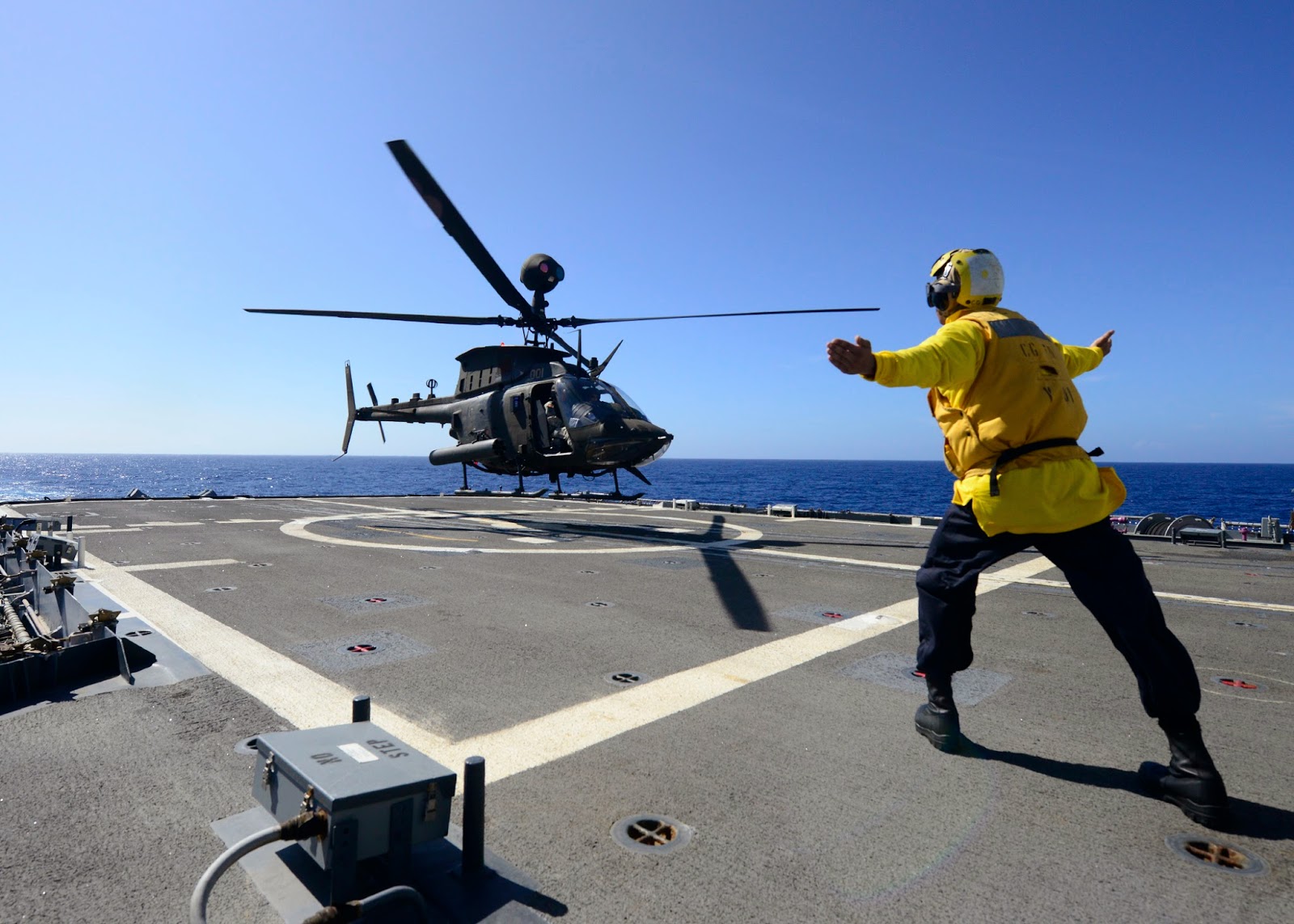 |
| PACIFIC OCEAN ( Dec 9, 2024) Sailors aboard the guided-missile cruiser USS Lake Erie (CG 70) direct an Army OH-58 Kiowa Warrior helicopter from the 25th Combat Aviation Brigade (25th CAB) off the coast of Hawaii during joint training operations. The 25th CAB is expected to participate similarly in other training exercises in 2014. (U.S. Navy photo by Chief Mass Communication Specialist John M. Hageman/Released) |
Recently, Rajiv Chandrasekaran discussed the Army’s efforts to become more expeditionary and maritime capable. Yet, as Mr. Chandrasekaran points out; the United States already has a maritime expeditionary force: the Marine Corps.
In business, new initiatives are challenged by various barriers such as cost, equipment design, licensing, and market saturation. If a hardware store wants to expand its business, it’s unlikely to diversify into car tune-ups. Just because a handyman can turn a wrench doesn’t mean he can drop an engine. However similar the Army and Marine Corps may appear to the untrained eye, the same may be said regarding amphibious operations. While the Army did amphibious landings quite well in World War II, they involved a short time at sea as a preamble to the sustained operations ashore that armies are designed for. Today’s amphibious operations are more diverse and require a force designed, trained and equipped to operate at and from the sea over extended periods—as Marines are.
The Army’s current barriers include:
Cost: Army equipment is not “marinized;” a process where everything from engine intake systems to the metals and paints used are designed to withstand high levels of salt water so that corrosion can be minimized and service life extended. This is why several Army aircraft were scrapped after Operation Uphold Democracy in Haiti, as Mr. Chandrasekaran pointed out. The Army subsequently explored the price of marinization and concluded it was cost-prohibitive.
Equipment design: The majority of Army helicopters have neither rotor brakes nor folding blades and tail booms. These features are unnecessary for land-based operations but essential for safety, shipboard stowage, and operational tempo reasons in sea-based operations. Without brakes rotor blades continue spinning for extended periods of time, gradually drooping as they slow and endangering crews and equipment on a pitching flight deck. Without folding components most Army helicopters take up an inordinate amount of precious deck space on an amphibious ship. A few do have manually folding blades to permit occasional embarkation in C-17 transport planes, rather than the faster and less manpower intensive automated type found in Marine aircraft. As a result, in the time it takes to tow, spread, spot and start a single Army H-60, a typical Marine squadron can launch two full waves of six aircraft.
Licensing: Most of the Army’s aviation weapons systems are not certified for shipboard use or storage. Why does that matter? Because the many emitters aboard the ship could make them launch, fire, or detonate prematurely. Sure, the ship could turn off those emitters, but then it can’t see or communicate with other ships, or identify threats, making operations in hostile or congested waters unsafe.
Market saturation: Plenty of global business exists for expeditionary crisis response forces, so the market is not saturated. What is in short supply, however, is the number of Navy ships capable of projecting forces in “ready to fight” condition. Amphibious ships, specifically designed for that purpose, are obviously the preferred platforms. Unfortunately, the Navy does not have enough amphibious ships to lift the force specifically designed to operate from them: the Marine Corps. While aircraft carriers may appear a viable alternative, the Navy’s inventory is smaller today than it was during Operation Uphold Democracy, meaning that the ability to replicate that model without disrupting existing deployment and maintenance cycles is problematic and likely to occur only in the event of a dire national emergency. What about the USS Lake Erie as cited in the article? She had space because she was at home. When a cruiser, destroyer or frigate, deploys, she does so with a detachment of Navy helicopters designed for sea going missions, like anti-submarine warfare. So, while the market is not saturated, the current budget environment and underfunding of the fleet means the shortage is not sea-based expeditionary forces, but the ships from which they operate.
So, why go to the hardware store to change your muffler?
Rather than trying to diversify its business, what if the hardware store found another means to deliver its existing products? The Army and Marine Corps have experimented with high speed logistics vessels since 1999. The Westpac Express, leased from Austal Marine, has internally transported Marines, aircraft and vehicles throughout the Pacific theater. The Army conducted similar operations aboard TSV-1X Spearhead. With these logistics ships, aircraft and other equipment can be carried internally, requiring no special equipment or training. While they are not capable of conducting sea-based operations, they provide a means to project forces via austere port facilities. Upon arrival, vehicles are driven off and stowed aircraft are craned off and reassembled for operations. These ships and others like them are available for contract for a fraction the cost of marinizing Army capabilities, allowing the Army to improve their expeditionary responsiveness without attempting to become a second Marine Corps.
Maj Andersen is a Marine Corps AH-1W Super Cobra pilot who has conducted three Marine Expeditionary Unit (MEU) deployments, twice as a pilot where he served in the squadron Maintenance Department (OIC of the Airframes and Quality Assurance Divisions) and once as the MEU Air Officer where he was responsible for all MEU aviation operations. During these deployments he conducted extended amphibious operations into Iraq, Kuwait, the Horn of Africa, Bangladesh and the United Arab Emirates. In Bangladesh he was responsible for all MEU aviation operations in support of Humanitarian Assistance/Disaster Relief operations for Operation Sea Angel II following Typhoon Sidr. Maj Andersen also participated in one of the first deployments which utilized the Westpac Express during which his squadron deployed a detachment of 4 AH-1W and 3 UH-1N helicopters as well as required support equipment aboard the vessel, along with additional ground combat equipment, to support exercises in the Commonwealth of the Northern Marianas, the Republic of the Philippines and Thailand. Maj Andersen has also completed combat tours in Iraq and Afghanistan.
Wednesday, January 15, 2024
Sharp Elbows
I think of this mainly as an effort to improve the quality of arguments in favor of the independent USAF. To my mind, such a case must grant that the following priors are at least contestable:
That may sound restrictive, but there are a universe of arguments in favor of independence that can nevertheless satisfy all three. For example, technological change has remedied the (admittedly problematic) strategic bombing theories of the interwar period; the shift of the USAF in a tactical direction after Vietnam has remedied the (admittedly significant) problems of the early Cold War; and while having an independent USAF is not the only way to maintain American airpower, it's likely the optimal institutional constellation.
I don't believe those arguments, but I can take them seriously.
- The strategic bombing arguments made in favor of the founding of the USAF were empirically and theoretically problematic.
- The performance of the USAF in the first half of the Cold War demonstrated serious organizational deficiencies.
- Airpower and the Air Force are not the same thing.
That may sound restrictive, but there are a universe of arguments in favor of independence that can nevertheless satisfy all three. For example, technological change has remedied the (admittedly problematic) strategic bombing theories of the interwar period; the shift of the USAF in a tactical direction after Vietnam has remedied the (admittedly significant) problems of the early Cold War; and while having an independent USAF is not the only way to maintain American airpower, it's likely the optimal institutional constellation.
I don't believe those arguments, but I can take them seriously.
I'm an assistant professor at the Patterson School of Diplomacy and International Commerce, University of Kentucky.
Sunday, January 12, 2024
Strategy 101
The U.S. Navy is soon to release its update to the 2007 “Cooperative Strategy for 21st Century Seapower”. One would hope that history and geography play substantial roles in formulating this document. The long-range strategic interests of the United States have been relatively unchanged in many ways since the end of the Second World War. The Navy has always been the principal service protector of these interests and senior naval officers should be vocal in explaining this to civilian leaders. The service can accomplish this task by ensuring that these three specific concepts are strongly reflected in its latest strategy update.
Preserve the Post World War 2 Economic System
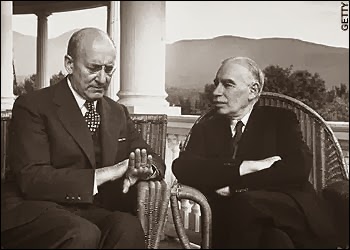 |
US Treasury Secretary Henry Morgenthau jr.
with John Maynard Keynes at Bretton Woods1944
|
The
Second World War destroyed many old patterns of great power politics and
replaced them with a truly “new world order.” These changes were embodied in
the package of postwar economic structures and regulatory agencies collectively
known as the “Bretton Woods System”. The World Bank, the International Monetary Fund, and
other currency and finance regulatory measures exemplified the concepts of free
trade, lower national tariffs, and moderate government interventions in
economic affairs as advocated by the British economist John Maynard Keynes.
Together this globalized financial regulatory effort would identify and be able
to mitigate financial catastrophes like the Great Depression before they could
lead to widespread economic chaos and breed future insidious dictators like
Adolf Hitler, whose fascist movement rose to power in large part due to
Germany’s dire economic distress caused by the financial depression. There have been many changes to this system since the
late 1940’s. Floating currency values, inflation of the U.S. dollar, and shocks
caused by rapid increases in international oil prices caused significant
changes in the postwar economic construct. Nations devastated by the Second
World War have rejoined the global economic community as powerful contributors;
the U.S. is no longer the absolute dominant force in global economics as it was
in the Cold War; and new members of the global market such as China, India,
Russia, and Brazil have made their presence felt in international economic
planning. Despite these changes, the roots of the system in the support of free
trade are alive and doing very well. Advances in technology, especially in the
electronic movement of currency and financial resources have made the system
more profitable than in the past. As its manufacturing system has declined and
diversified, the U.S. has become dependent on the postwar international system
for its financial security. It is the true “center of gravity” of the United
States. The protection of this system should be the principle U.S. strategic
goal.
Defend the Global Commons
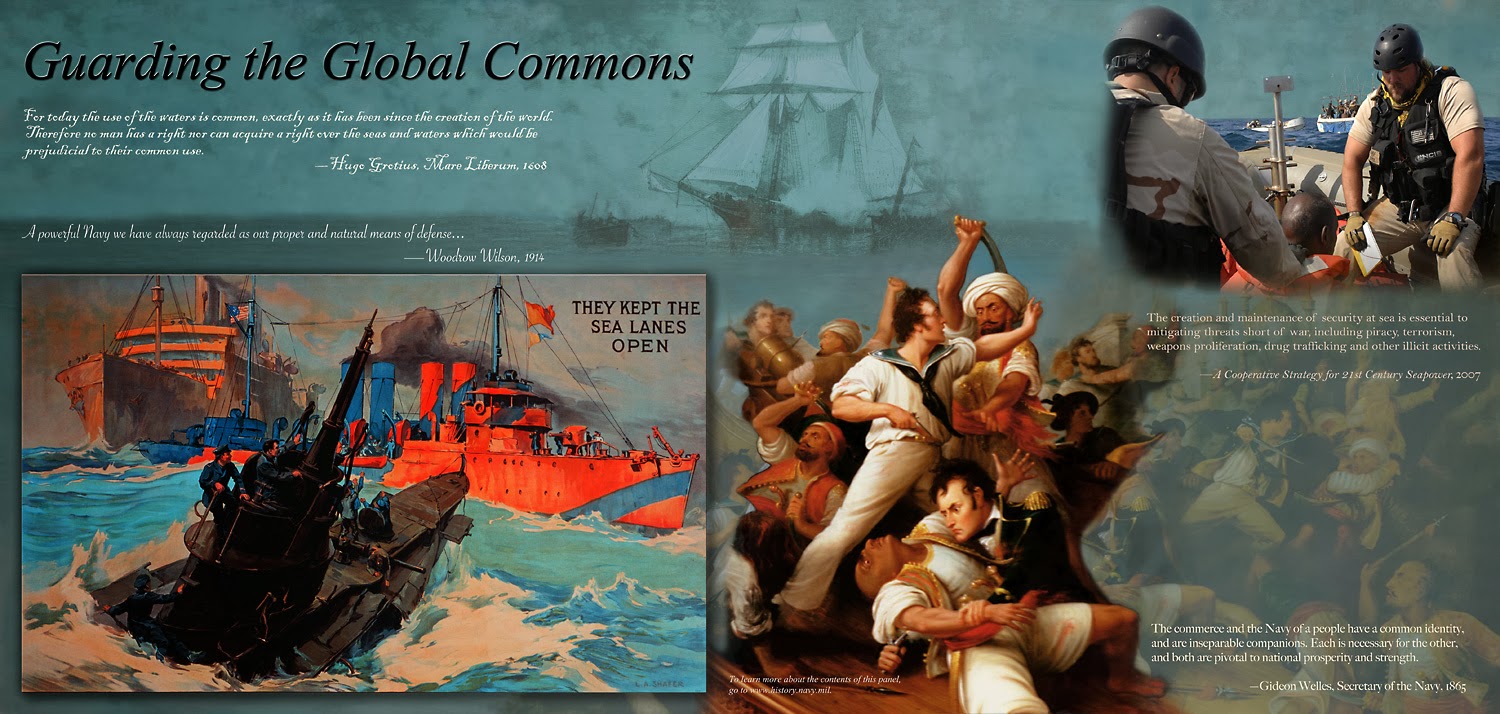 |
| Guarding the global commons has long been a USN mission |
Maintain the Ability to Strike "From the Sea"
 |
| Robert Strausz-Hupe |
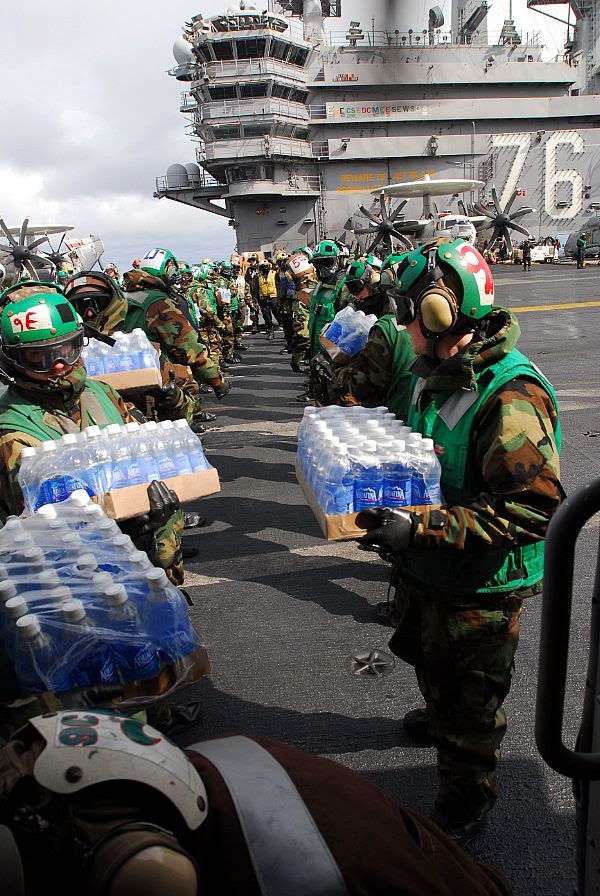 |
| Operation Tomodachi aid |
The
last element of national strategy is preserving the ability to strike as
necessary from secure maritime locations to more remote inland areas as
required in defense of the international economic order and its commercial
lines of communication. The distinguished Austrian-born U.S. diplomat and
geopolitical theorist Robert Strausz-Hupe from the University of Pennsylvania
stated, “one cannot argue with geography.” Seapower has always been based the
exploitation of geographic advantages.
Sufficient expeditionary ground forces are needed to accomplish tasks in
securing those Eurasian and other territories adjacent to the sea. Geopolitical
analysts such as Alfred Thayer Mahan, Jacob Spykman, and Sir Halford Makinder
all concurred that control of this “rimland” area (Spykman’s term), was vital
to the continued freedom of trade in the maritime world. Naval forces made
possible rapid access to remote coastal areas. The British Navy incorporated
this movement into its doctrine in the 19th and early 20th
century to the point that iconoclast British Admiral Sir John Fisher referred
to the British Army as a “projectile” to be “fired” by the Royal Navy in
support of British strategic interests. Much of the geopolitical theory involved in the conduct of both World
War 2 and the Cold War revolved around preventing hostile “continental” land
powers such as Nazi Germany and the Soviet Union, and heretical maritime states
like Imperial Japan from gaining access to and subverting the free flow of maritime
trade. In the absence of large aggressive continental powers, the ability to
move “from the sea”, also has the ability to prevent violence and restore order
to sections of the global economic system damaged by natural or man-made
disasters. The U.S. Navy’s ability to mount relief operations such as the
“Operational Tomodachi” effort in the wake of the Japanese Fukushima reactor
accident, and more recent aid to the Philippines following Typhoon Haiyan
represent this sea-based capability.
The U.S. Navy has played a significant part in the
achievement of each of these three elements of U.S. national security. Any new
Navy strategy must support these requirements. The Navy has many choices in
what future force structure it builds to support these strategic
components. Technological
advancements will make that force structure more powerful and budget cuts will
limit its ability to conduct its mission. That structure however must support
these strategic principles that have formed the foundation for U.S. national
security since the end of the Second World War. The U.S. Navy must consider
these strategic “building blocks” as the foundation for any new strategy it
pursues in order to support future national security needs.
Subscribe to:
Posts (Atom)