
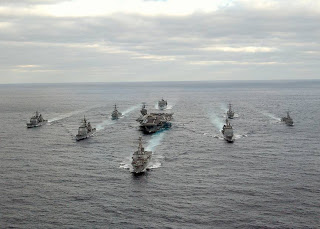
 NPR's All Things Considered recently gave an interview to Barrett Tillman, and the topic of Fleet Constitution came up. This is the summary.
In an article, "Fear and Loathing in the Post-Naval Era" for Proceedings Magazine, historian Barrett Tillman questions why the U.S. spends so much on a Navy it hardly ever uses.You can hear the interview by hitting the "Listen Now" link here. There is a Q&A part to the interview that is included, which is interesting because it gives some insight on how the folks outside the bubble are seeing things. The second question annoyed me, but the answer to the third question (regarding the 'silent service') was important. The last question is a major part of the context of the entire QDR debate in my opinion.
In the article, Tillman writes, "justifying the high cost of a large fleet of warships and aircraft is a tall order."
The Navy discussion in the QDR has become the battlefield for the first real debate between conservatives and crusaders.
The conservatives are claiming the way ahead is with aircraft carriers, major surface combatants, and nuclear submarines for control. This Air/Sea blue water conservative force structure begins at 25nm at sea and works out to blue water away from land. Ballistic Missile Defense, nuclear submarines, ballistic submarines, space control, aircraft carriers, and air attack top the threat list, thus get issued the most priority for the development of force structure. Any funding beyond the Air/Sea blue water priority goes to everything else, which to the conservatives means the LCS and Amphibious fleet. The conservatives believe they are in a naval arms race with China and are building their force structure for a direct war with China. To a conservative quality trumps quantity, the further one is from land the higher the priority, and technology is emphasized over manpower on ships.
The crusaders are claiming the way ahead is to shape the fleet to address the littoral battle space with smaller littoral vessels and amphibious ships screened by a blue water force slightly smaller than the one today, specifically the crusaders believe the answer is fewer than 10 aircraft carriers and cap the major surface combatant force at 90. This Expeditionary crusader force structure focuses on control of the seas, land, and air from about 200nm offshore to around 100 miles into land. Crusaders believe the most likely threats the US Navy will face over the next 20-30 years are small boats, littoral submarines, mines, sophisticated criminal networks, and unconventional challenges by small belligerent states. The crusaders believe that if there is a war with China, it will be indirect and unofficial, and take place somewhere besides the western Pacific. To a crusader quantity is quality, the closer one is to land the higher the priority. Manpower is emphasized as a littoral requirement.
I believe that as of right now, the Navy is ready to push hard for the conservatives. Put another way, I believe the overwhelming majority of Navy leaders believe the conservative approach is the best way ahead.
For the record, I'm in neither camp, I believe in a third balanced force that is more similar to crusader but makes the case for the conservative. If Bob Work is the conservative and Wayne Hughes is the crusader, I'm with Frank Hoffman somewhere in the middle. Neither the conservative nor the bi-model fleet approach, I think the Navy either finds a balance, or ADM Roughead gets fired. After studying his testimony since the budget release, unless he is the best poker player in Washington DC, I give him a 50% chance of making it to December. The guy really is in a terrible position right now with the budget, and every option he must make carries considerable risk to the Navy, and his career.
I'll be writing articles on this topic all week.

No comments:
Post a Comment