
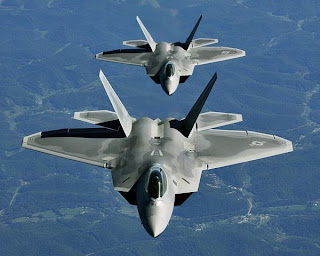
 I really like this Greg Grant article on DoD Buzz. It lists out the talking points for the F-22 and highlights many of the flaws in some of the arguments made for supporting the platform. However, the article also has a paragraph that I believe is where serious consideration is warranted on the F-22 program.
The oddest thing about this whole debate is that it’s not about whether or not to develop and produce the admittedly impressive air-superiority fighter. That has already happened. The F-22 is operational and current plans are to build the final of 187 Raptors by 2011. The argument F-22 advocates make is that 187 is not enough and that only by buying more Raptors will strategic catastrophe be avoided in what has become the ultimate “bean counting” game, conjuring memories of measuring the NATO vs. Warsaw Pact balance, with the difference, of course, that no adversary currently exists to bean count against.Now Greg Grant is a smart guy, but he clearly hasn't been hanging out with many strategic thinkers to make the last comment. The threat based analysis strategic planning approach is a failing myopic view that reporters like Greg Grant should call people out on when they suggest it in the Pentagon, because unfortunately it is something some people in DoD are doing a lot of lately.
Two things happened last week that grabbed my interest regarding the F-22, and neither was the stunt in the House to keep the F-22 line open in the HASC bill. The first thing I find pretty incredible is the rumor mill that in virtually every force structure analysis and operational planning capability study prepared by the Air Force for the QDR, the necessity for more than 187 F-22s continues to pop up. In other words, the analysis consistently says the Air Force needs more F-22s to meet existing requirements, and only the Secretary of Defense is saying otherwise.
I didn't really believe the rumor though, surely this isn't true or someone would be speaking up, right? Next thing I know, this article shows up in CQPolitics.
Gen. John D.W. Corley, the four-star chief of Air Combat Command at Langley Air Force Base, Va., wrote a letter to Sen. Saxby Chambliss , R-Ga., about the impact of Obama and Defense Secretary Robert M. Gates ’ decision to limit the number of F-22s in the U.S. inventory to 187.When 4 star Generals are saying this with full knowledge of previous firings by Secretary Gates, people should be giving this issue a lot more attention, and more importantly, asking tougher questions of Gates even after he gets dismissive.
“In my opinion, a fleet of 187 F-22s puts execution of our current national military strategy at high risk in the near to mid term,” Corley wrote in the June 9 correspondence. “To my knowledge, there are no studies that demonstrate that 187 F-22s are adequate to support our national military strategy.”
For years the F-22 requirement was always 381, a specific estimate intended to provide teh Air Force one F-22 squadron per Air Expeditionary Force [AEF]. That is a perfectly rational analysis that never gets enough attention. What has been bothering me in the F-22 discussion is why nobody is asking the question: What are the absolute consequences of building only 187 F-22s? Because there was no study that recommended 187, you can bet your press pass that no one ever studied the consequences to existing operational profiles by stopping the purchase at 187. Well, absent anyone else doing it, I solicited a few opinions from some Air Force dudes and I think there is something there.
First, it should be noted the F-22A is in the field and is operational, in fact, there is very often if not always a 1 squadron requirement from the PACOM Combatant Commander for the F-22. If that is the requirement today, and has been the requirement for over a year now, we can expect this requirement to exist for many years and potentially increase or decrease depending upon the intentions of China and North Korea over the next few years.
Well, we don't have very many F-22A squadrons, which means our limited number of squadrons will be on a sustained, regular rotation to and from the Pacific as the Air Force meets existing mission requirements with fewer platforms. Has anyone stopped to consider the effects of this sustained rotation? If so, that study was classified.
We have every expectation that the F-22A is going to provide the nation with decades of service in providing air superiority, but with fewer platforms and a very high operational tempo, that is a very unreasonable expectation. Due to fewer total F-22s, we are going to pile on the years of flight time on these planes much quicker than originally intended, which has several consequences.
1) We will have to start a program for the F-22A replacement sooner than we expected, likely at very high cost removing any potential cost savings of not building more F-22As. Why? Because if you know jack about the F-22, you know the Air Force has spent on average more developing the F-22 than it does actually building the damn thing (about $200m per plane R&D, while a new F-22 costs less than $175m today). Anyone who suggests truncating the F-22 for cost purposes is making a very shortsighted, like incorrect opinion.
2) The F-22s we have will be fatigue faster and require a lot of money to sustain their full lifetime due to having to conduct the same mission requirements with fewer platforms. This is not the cold war when the Navy F-14s added redundancy to Air Forces air superiority fighters, there is no other air superiority fighter except the F-22 in the US military today. The idea behind the F-22 was that the Navy could move towards a multi-mission capability aircraft as the F-22 provides the absolute air superiority required to win major war against other powers with air capabilities. The existing requirement for the F-22 does not change simply because we build fewer, and it is noteworthy that as the F-22 is canceled, the DoD failed to produce any alternative, whether a F-16 Block 60 or even more F-18s to fill that gap, to make up for the reduced number of F-22s.
Lets be honest, if the Air Force was dropping the F-22 to build F-16 Block 60s, or even the latest F-15 models instead, the argument would be centered completely on capability vs numbers. But with aviation shortfalls in the Air Force, Navy, and even the Marine Corps right now, the DoD is canceling the F-22 with zero alternatives presented, and zero reductions in requirements from the combatant commanders. In the end, the DoD is telling Congress the Air Force of the future will do more with less, and we do it for cost purposes. That doesn't add up, and I honestly see the whole suggestion as something of an insult to the intelligence of Congress. Does the DoD really think Congress is that stupid, or does the DoD believe they have that much power over them? The second part could be true, there are a lot of freshman Senators and House members you know, and the historical record suggests the DoD is better than anyone in exploiting that.
But here is the real problem with the F-22 debate, and actually, it may be a reflection of a much larger narrative driving the long view. I was very happy to see Stephen Biddle hit this point in his CFR article today. If we were any good at predicting the future, and suggesting we knew what the 'threat' would be, there would never be a debate regarding what was needed in defense procurement. Since fortune telling is an inexact science, only fools look out decades and suggest what the world will look like.
When people ask who or what the F-22 is intended to fight, it ignores a very important point about the F-22. Whatever that fight looks like, history tells us that if it was to happen 10 years from now we likely don't even see it today, and it could be remarkably dangerous and we still wouldn't see it today. We live in a very strange time where the three enemies that topped our list of bad actors over the past decade; Iraq, Iran, and North Korea; are all nations that we have been engaged militarily against for several decades. North Korea going back to the 1950s, Iran since 1979, and Iraq every year since 1991. Expectations that the trend of knowing which specific enemy we will be engaged in conflict with in the future are highly dubious in my opinion, because the current global economic situation is changing the future even as we speak.
I am disappointed that the Naval War College did not put up Kenneth Rogoff's presentation on their Current Strategy Forum page, because that presentation was fantastic. I hope they put it up, because when economists take a strategic view into the future, I think sound defense planning discussions result.
The debt is reducing the value of the dollar, and of all the plans of the current administration, there is no plan for dealing with the debt. The value of the dollar will likely remain low for awhile compared to other currencies, and that will have an effect on energy prices. We are already seeing the price of oil rebound, up to around $70. When the global economy rebounds, knowing that the debt will still exist, what do you expect that will do to the price of oil as demand globally shoots up, likely to a higher point than anytime in history? You know, Obama may be very prescient in how he has dealt with the automobile industry, because when oil becomes static at a minimum $150+ a barrel that brand new hybrid fuel GM could look like one of the smartest domestic political moves in decades.
But at $150 a barrel, a bunch of countries are going to be flush with cash, including countries like Russia, Venezuela, Iran, and many others. Unless you haven't watched the news recently those authoritarian oil nations don't really care about their people and have no problem using a club or pistol to prove it. We can expect those nations to spend their influx of cash on military capabilities to consolidate their power internally while expanding their influence regionally, and we can expect that because that is their historical pattern.
This will be particularly dangerous with countries like Russia, because they are soon to modernize their nuclear forces. That is no small achievement. We are soon going to have to modernize our nuclear forces, and the costs of such an undertaking are going to limit what else we can do, particularly when the Navy has to replace the SSBNs.
For Russia, that means they get to build all kinds of conventional capabilities instead, and since their R&D for aircraft has remained solid over the years, very modern latest generation fighters is likely to be a big part of that purchase (and exports to virtually any buyer are also very likely) because it is one of the few industries Russia has a workforce that can step up quickly.
Want to know what keeps strategic forecasters up at night? Ask them what they expect to happen in all the oil rich authoritarian places of the world when the next global economic rise makes those nations flush with cash while the US struggles to pay debt, manage the bills, and play the global strategic balancing act role.
Don't use the argument that the F-22 is for fighting some unknown adversary, because the bottom line is We Don't Know. All we can do is plan and address the capabilities we know we need to meet our requirements, and not get sucked into the often fluid and constantly changing threat matrix that ebbs and flows too rapidly for our defense acquisition process to attempt to maintain pace with.
Take the long view. Do we need more F-22s? If not, how do we meet the mission requirements that fewer F-22s than originally planned cannot meet as to not strain our smaller but vital F-22 force over the expected duration of that platforms life? Requirements planning begins with our requirements for the capabilities we need, not by adapting to the fluid threat matrix of the other guy. If we are basing requirements planning on the emerging threats instead of the emerging trends, the enemy is already inside our OODA loop and we need a new requirements planning process, and not the one where the analysis is trumped by theories absent supporting analysis.

No comments:
Post a Comment