
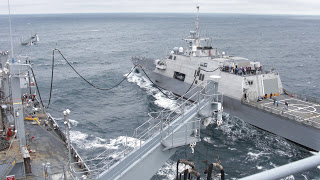
 The June 9th Sentinel has the story of the UNREP of USS Freedom (LCS 1) and the USNS Kanawha (T-AO 196) back in April. I had previously posted the image here for discussion, but the details of the Sentinel story add exceptional value (I think) to understanding the Littoral Combat Ship. Something tells me there will be no shortage of opinions...
UNREP in-port training was conducted on April 9 in Norfolk, Va., with the Fueling At Sea (FAS) rig with USNS Kanawha (T-AO 196). UNREP on Freedom was completed successfully on April 15, 2009, and the ship is now able to receive fuel. This is a significant accomplishment in that not only is Freedom the first Littoral Combat Ship (LCS), but this also marks the first time an UNREP maneuver has been conducted on a U.S. Navy ship powered and steered by using water-jet propulsion.One more part.
Command personnel involved in in-port training and underway maneuvers included Jim Collins, L Dept. project officer in the pilot house, and Bill Massioni and Scott Perry, UNREP ISEA at the FAS rig. Steve Aronson, L Dept. project engineer, also led early planning efforts and participated in UNREP in-port training.
Collins’ primary focus was on ship maneuvering and operations. He observed that the navigator stood watch as the: Officer of the Deck, the conning officer, the helmsman, and the leehelmsman while sitting at the Integrated Bridge System. He inputted speed and heading changes into the “Motion Mode” of the automated pilot. The Officer of the Deck also used a parallel index line he had set up on his navigational display to allow him to accurately and effectively gauge his distance during approaches. Ranges were verified and called back to the Officer of the Deck from the bridge wing by the Commanding Officer using a hand-held laser range finder. This revolutionary reduced-manning restricted-maneuvering bill allowed the ship to approach, maintain station alongside, and break away safely and effectively. Having the Engineering Officer of the Watch sit at his own console aft of the Integrated Bridge System watch standers, rather than in the engine room, increased the Commanding Officer’s and Officer of the Deck’s situational awareness of the engineering plant configuration and casualties during restricted maneuvering.
The LCS’s design agent incorporated a significant amount of automation in order to allow less people to do more tasks, enabling the ship to hold only a 40-person crew. At the FAS station, it required considerable physical effort on the part of the crew to haul the span wire and fuel hose across 160-feet of ocean. Usually, all boatswain’s mates and deck seamen serve as the rig team. However, with only 40 personnel, and a large fraction of those serving in restricted maneuvering detail, no rank or rate was exempt from lending a hand.OK... Obviously the thing that probably stands out to many of you is the implication that there was only a 3 person bridge watch team. When I was on Freedom during the ships journey through the Welland Canal from Buffalo to Montreal, which was basically 3 full days of all-hands-on-deck evolutions for USS Freedom (LCS 1), the suggestion of only a 3 person bridge watch team sounds pretty realistic from what I saw in my time on ship, and is not unreasonable. With the cameras, technology, and viewpoints the three crew members can see a lot more than one thinks for an evolution like this, although I still imagine this is hard for some to believe.
One other change that the reduced manning concept has driven during an UNREP is that Freedom did not tend the phone and distance line. Kanawha fired over the phone and distance line, which was then tied off by Freedom crew members and tended by crew from Kanawha.
And that is the thing about LCS we still don't know. The 3 days of all-hands evolutions I saw back in November left me with the impression the LCS is going to be a challenging ship to operate sometimes, and will push the crew to the limits of fatigue under operational conditions, so that is something that needs to be examined closely. Point blank, being a member on a LCS is a lot of work, A LOT of work. UNREP is one of several evolutions for the Littoral Combat Ship that will turn what many in the Navy consider a routine task on most types of ships currently in the fleet into an all-hands, 'everyone has a lot of work' evolution where there will not be many folks in places like the bridge, while the majority of the crew will be back at the FAS station.
This is one of several examples that highlight where the Navy is going with smaller ships, smaller crews, and/or potentially both.

No comments:
Post a Comment