
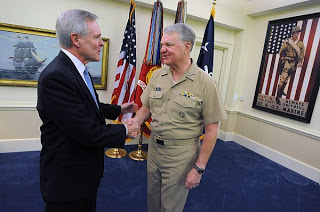
"I believe that the public has to be part of the dialog and discussion that we are going to have. I think they should think about the risks and the opportunities for the worlds oceans, and particularly for our Navy, and that the public should have an opportunity to influence that dialog. I also believe it is important for current and future strategists to think about, to write down, and debate the thoughts that are taking place here because it is in the aftermath of sessions such as this that we get some great thought going."The Naval War College website has posted video from the Current Strategy Forum for all to see. The above is one of several quotes from Admiral Roughead I wrote down during his speech, but decided to wait for the video and get the wording exactly right before discussing. Rather than talk about the presentation, I'm going to follow ADM Roughead's advice and talk about some of the points of his discussion that I think contribute to the debate, and can stimulate the thought process that Admiral Roughead appears to be asking for.
-- ADM Gary Roughead, Current Strategy Forum, June 16, 2024
The Mothership
"And I get down to what is the right mix. There are some who would say small patrol boat showing a small coastal Navy how to conduct a fisheries patrol is the best form of engagement, but consider what we have done with our African Partnership Station, where we took a little bit larger ship, an amphibious ship, where we could still go off and work with that coastal nation. But then we could ballast that ship down and pull their boats in, and teach them how to repair and maintain. Where we could have an international staff on board of young officers who will rise to the top of their Navy, who are developing friendships and relationships that will last the next 15 or 20 years. And a capability large enough to where we can hold conferences and meetings and mix with the various inter agency groups in the countries where we operate. That to me covers a broad spectrum of engagement."AMEN. First thing I wrote down next to my notes was David Axe. You have no idea how excited I was to hear the CNO describe the use of an amphibious ship as a self-sustaining Sea Base for inter agency, international cooperation of small vessel naval forces towards the development of maritime security at the local level. Twice during his presentation the CNO articulated the African Partnership Station incredibly well describing how that engagement contributes to a forward thinking maritime strategy that goes out into the hard to reach places in the world, and contributes towards long term partnership while also meeting mutually shared strategic objectives of regional maritime security.
Now I understand the capability described is primarily an educational and logistics function specifically for developing partner forces, and ADM Roughead offers no evidence here that an amphibious ship would support US Navy forces in a similar way. I'll take the minor victory of suggesting the CNO sees the potential of the mothership concept, because in my opinion getting naval leadership to recognize the conceptual value of motherships as a logistical enabler for distributing smaller naval forces over a broad area for providing maritime security is, at this point, a major evolution towards a strategic view of what sea basing can be for naval forces.
You see, the US Navy is excellent at providing logistics for a handful of large naval vessels, and sees this existing model as a description of what a global navy is. In my opinion, a global Navy, particularly one that is ready to challenge the OODA loop of the enemy from the littoral will also have many small vessels ready to exploit the littorals as a space to influence enemy forces. Properly distributing and sustaining many small vessels will require an operational doctrine that no longer exists in the US Navy, so it is with the conceptual logistics requirements where the ideas for motherships to enable that capability begin.
Sea Control
"I think that one of the biggest challenges that we will have in the future is being able to exercise Sea Control wherever and whenever we will be ordered to do so against some of these proliferating threats, whether it is advanced anti-ship cruise missiles, ballistic missiles, or the growth in submarines where the predictions are to see that inventory, global inventory of submarines, to increase by 280 in the next few decades. And if anyone looks at our shipbuilding plan we are not that much of a contributor to that growth."The solution to the IED in Iraq and Afghanistan was not the several billion dollars spent developing and fielding the MRAP. The solution to the IED was not a technology, rather a network capable in intelligence collection and dissemination, and effective in the identification and elimination of the threat before the weapon system was utilized.
Many leaders in the Navy today cite the truck mounted anti-ship missile attack on the Israeli corvette as an example of the hybrid threats facing the Navy today, but I want to propose that the solution to that capability is not an anti-missile technology, and the solution to that emerging trend will be found in how naval forces develop networks inside the really dangerous 25nm littoral zone and exploit that space for intelligence purposes, manned and unmanned, against the enemy and can fire effectively first against emerging threats.
I would argue the Sea Lion, or a similar concept, is just as capable of delivering as a piece of the network capability to defeat anti-ship missiles fired from trucks as say, a DDG-51 is. BLASPHEMY! Not quite. Every platform plays a role, and the DDG-51 role is not the same as the Sea Lion (insert any number of potential capabilities here) role.
I see the LCS as a critical component of that network capability due to its contribution of ISR to the littoral battle network that will be required to defeat littoral submarines and anti-ship missiles fired from trucks, probably more important than say a DDG-51. When I hear US Navy leaders discuss anti-ship cruise missiles, ballistic missiles, and submarines as the threat, I know that means the topic is technology... a single piece of technology. This was established in testimony before Congress when the Navy truncated the DDG-1000, and the Navy specifically highlighted the capability of the DDG-51 technology as the solution. That mentality reminds me of the 'MRAP as a solution' mentality that ultimately turned out incorrect. In fact, during the CNOs speech, this was how he sold the single technology centric solution.
It Takes a Network
"Intimately connected with any strategy that we develop is planning how to employ our limited resources in that strategy, and what weighs most heavily in my conversations, my thinking, and my work is planning not just for capability but really coming to grips with capacity. One ship can only be in one place at one time. We are the smallest Navy that we have been since 1916, but our responsibilities are global and our interests will continue to require a global presence. Another important planning factor of course does remain capability, ecspecially the ability to account for the trends that we see. Surely credibile combat power is required, but we must provide the right kind of capabilities to the Commander in Chief. We continue to see growing demands from our combatant commanders for more ballistic missile defense, more submarines and more survallience, intelligence, and reconnisance. And what we have seen is the high end capability has a better chance of going low than the low end capabilities have a chance of going high.On Tuesday night I went down to the Officer Club to have a beer on the SECNAV, because you know, they were serving free beer and providing free transportation. I introduced myself (and my wife) to the CNO as a blogger here at ID where immediately I could see a red flag rise up that associated blogger = media (which no doubt offends legit media), at which time the nearest agent of CHINFO was immediately summoned with orders to conclude our encounter.
Multipurpose ships come into play when you have capacity issues. They can win the battle, but they can also perform many other functions. For example, consider the Arleigh Burke guided-missile destroyer. It was the platform from which the rescue of Captain Phillips of the Maersk Alabama took place. It was also the source of Tomahawk strikes into CENTCOM. It was also the ship selected to carry in the first humanitarian supplies into Georgia after the conflict there because it could go in unattended. It is also the ship that is performing ballistic missile defense and long range search and track in the Western Pacific. And it is also a ship that is currently operating on the east coast of Africa in an Africa Partnership Station role.
It does not mean that everything has to be at the high end, but balance is the key."
During the next hour I was able to talk with several naval officers, including a bright young officer who became the unfortunate soul I questioned regarding the above statement. As I was taking notes of the CNOs speech, when I got to the "but" in the last sentence quoted above, as the CNO said balance I wrote down "what??" I don't see how the word balance belongs in that last statement, and this bright officer assured me the word was meant to be flexibility... which sounds more reasonable. I'll take her word for it.
My problem isn't whether the CNO meant to say balance or flexibility, it is the accepted notion that the above argument suggests the Navy believes a key, but quite expensive, technology can be everything to everyone. I rarely hear it discussed that instead of SEALs shooting from the USS Bainbridge (DDG 96), SEALs could have been shooting from a LCS or JHSV. Last I checked, Tomahawk strikes into any theater can be done effectively and with significantly more numbers if provided by SSGNs, a platform the 313-ship fleet did not replace. I'm a big fan of the USS McFaul (DDG 74), but I do wonder if we need a $2 billion, 9,000 ton ship to deliver 77.5 tons of humanitarian aid when a HSV can carry 500 tons at 35 knots 1100nms. I have no idea what the USS Arleigh Burke (DDG 51) has in common with Kenya for an east coast African Partnership Station, but I'm going to chalk this up to the theory good things can happen when we put sailors in a position to do some good, but also suggest a DDG-51 has very little to specifically offer as a technology to whatever activities those sailors are engaged in.
Lets get serious here... this is not a believable argument for more than the planned 65 Arleigh Burke destroyers, in fact it is quite distrurbing if Navy leadership sees these $2 billion battleships as an example of force constitution balance, or even a useful exercise in the battleships flexibility. We are a nation at war with the Russians moving major military gear towards Georgia, the Iranian government in a legitimacy crisis, and the North Koreans telling us they will nuke us all in the last week, and the Navy sees an Arleigh Burke class destroyer in a partnership role with east Africa as an effective use of resources during times of slim budgets?
I hope that sometime between last Tuesday and decision time for the QDR that ADM Roughead does a few things to get the best out of the strategic process for the QDR.
- Get away from the threat based approach to force structure planning.
- Get away from the multi-mission mentality of measuring ones own capabilities.
- How do we increase the range of our strike operations? If we can't do that, time to build more Burkes and reduce CVNs below 10.
- How do we get inside the 25nm littoral no go zone and leverage that space to get inside the OODA loop of the enemy ashore?
- Is Maritime Domain Awareness the ability to identify the threat or the ability to monitor the environment? Since it is often the threat, but sometimes the environment, how do we do either or both when required?
- At what capability level should Ballistic Missile Defense be established as a naval capability?
- How do we change the paradigm of littoral underwater submarine warfare to our advantage?

No comments:
Post a Comment