
 Why is the Politico reporting that Texas Gov. Rick Perry is asking the federal government to deploy 1000 National Guard along his states border with Mexico? Well, check out this analysis for additional context.
The lawlessness along the mexican border has gone way beyond a local crime wave: there has been a dramatic increase in armed robberies, not by lone gunmen but by heavily armed gangs. Kidnappings and homicides are way up—and not just murders but beheadings. Police are getting into shootouts where they are frequently outgunned. It is starting to look like a terrorist campaign. Rail lines and bridges are being sabotaged, and now an entire train has been derailed and its passengers assaulted and robbed.At first I thought I was watching Glenn Beck, but this is actually some outstanding analysis on Mexico coming from RAND. You have to keep reading to get it...
Isolated ranches and small towns have turned into virtual garrisons. Economic activity, especially in southern Texas, has seriously declined. People are frightened, and they are mean. Everyone seems to be carrying a weapon and shooting on suspicion. Mexicans are the targets. There have been disturbing reports of summary executions and lynchings by vigilante volunteers.
Central government authority no longer exists in the Mexican states along the US border. Warlords, commanding their own armies, are gunning down their rivals. Except for refugees heading north and guns being smuggled south, commerce across the frontier has ceased to exist. Some of the gangs are holed up in their sanctuaries just across the border, but the government in Mexico City cannot, or will not, bring the situation under control.
Although much of the violence along the border appears to be purely criminal, evidence of a subversive political plan has been uncovered. Mexican extremists have declared it their goal to recover the “lost territories”—land taken from Mexico after the Mexican-American War in 1848.
The plan calls for enlisting Mexicans residing in California, Arizona, New Mexico and Texas in a campaign to terrorize and drive out the Anglo population, thereby ending decades of what the planners call Yankee discrimination and tyranny. The movement, which apparently draws on support from some of the warlords in Mexico, appears to have few adherents on the American side of the border, but it could be the forerunner of a large-scale uprising on US territory. As a consequence of the terrible economic situation caused by the violence, there are many unemployed, restless men who might be receptive to radicalization and recruitment. And if the situation in Mexico is not brought under control, foreign foes of the United States, determined to distract US leaders from issues elsewhere in the world, will find opportunities to exploit. With the new challenges the US administration faces overseas, Washington has reason to fear unrest on its own territory.
The United States has already deployed more than half of the mobile forces of the US Army on the border with Mexico. The president’s federalization of the National Guard to reinforce the regular forces has brought an additional 150,000 troops to the frontier. Military commanders want a freer hand to go after armed groups just across the border, but that could easily lead to war with Mexico. The Mexican army is no match for US forces, but limited US forays into Mexico might achieve little, while an invasion and occupation could prove costly. The president is desperate to eliminate the possibility of an incident that might compel US military intervention in Mexico, which some prominent political leaders argue is the only solution.This is a great article, read the whole thing.
This grim assessment of the situation is not some imaginative movie script extrapolated from recent headlines or a hypothetical future scenario to be gamed at the Pentagon. These events—the crime wave, the armed attacks, the beheadings, the lynchings, the scheme to recover the lost territories, the deployment of much of the US Army and almost the entire National Guard—actually occurred in 1915 and 1916, when the Mexican Revolution left northern Mexico in chaos.
According to that Politico article linked at the top, there have been over 1000 deaths so far this year along the US-Mexico border, and it is only March 4th. The Mexican Army has the lead role in stopping the violence on the Mexico side, and there are signs of positive early results from the massive reinforcements arriving this week.
It is time to start discussing political solutions that change the flows between Mexico and the US. The status quo is the United States importing the worst products of South America through Mexico while exporting American currency instead of American product back to South America. The money from drug use in America, yes even the occasional pot smoker, is killing a lot of people and tearing the social structure in Mexico apart while promotion corruption throughout South America.
Without critical attention given to political efforts to change the flows both in and out of America and Mexico, the violence will not stop, and this will grow first into a security problem until it finally reaches the point of a military problem. The recommendations near the end of the RAND article are as good a place as any to start the conversation, even if they are not politically popular. Clearly the war on drugs has failed.
Somehow we need to change the system and take on illegal drugs the same way we have taken on tobacco. Is that even possible without legalization of some drugs? Is legalization even a legitimate solution or is it simply rearranging the deck chairs on the Titanic? I honestly don't know, but fighting the source is a failing effort without an unrestricted Sherman style scorched earth approach. Not only is that politically impossible, but the tactic would only create bigger problems. The only real solution is to significantly reduce drug use in the United States, which means applying the supply and demand approach. Reduce the demand, and the violent side effects of the supply will be reduced as well.
My thinking is this on legalization. As someone who has worked in government, I believe that any product we really want to screw up can be IF we apply a healthy dose of government bureaucracy combined with as much regulation and taxation as possible. For better or worse, that approach has certainly worked for tobacco and encouraging people to quit smoking. In New York, cigars are almost too expensive to enjoy on a nice summer weekend day by the pool.
I said almost...
Want to read something else interesting regarding Mexico? Another gem from RAND.
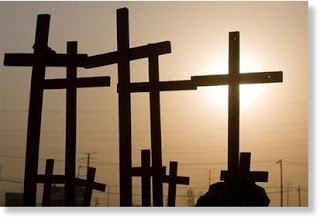
Photo: Alfredo Estrella. Photo shows wooden crosses standing where victims of Mexico's drug wars were murdered in Ciudad Juarez, state of Chihuahua. Eleven men, including a university student athlete, have been killed in the last drug-related violence to hit near the US border in northern Mexico, officials said.

No comments:
Post a Comment