
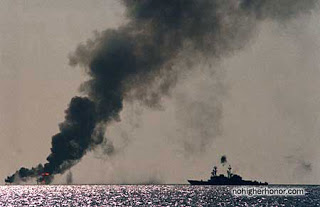
 If there is one truth of the modern US Navy, it is that ships designed for any specific role will find itself conducting mission profiles for a role it was never intended. This is also the history of major combat systems in general, but can be narrowly defined to the US Navy specifically for the purposes of this discussion.
In October of 1987 the USS Leftwich (DD-984) and USS John Young (DD-973) participated with the guided missile destroyers USS Hoel (DDG-13) and USS Kidd (DDG-993) in Operation Nimble Archer. Both Sprunace class destroyers, despite the lack of adequate AAW defenses, sailed at night through the Strait of Hormuz to attack a pair of Iranian oil platforms. Using their 5" guns, the combined force put thousands of shells on both platforms before special forces were sent over to gather intelligence and destroy the platforms. After the attack, the destroyers returned the following night back through the Strait of Hormuz. This wasn't the first time the Sprunace class had fired its guns in anger, indeed ships supported Marines with naval gunfire support off Lebanon in the 80s.
In 1991 and 1999 the Spruance class was also utilized in the Gulf War and Kosovo conflict respectively. Rather than defend against enemy submarines, as originally intended, the Spruance class was instead utilized as a launch vehicle for Tomahawk cruise missiles against enemy defenses. Throughout the entire career of the warship class, despite being designed and deployed specifically for ASW, the ship never engaged and sank a single submarine.
We have seen the same thing with the evolution of AEGIS. Despite the capability to shoot down multiple targets in both air and space, the only manned aircraft AEGIS has successfully engaged in a combat situation to date is a civilian airliner. The CG-53s in particular were built for blue water AAW supremacy, and yet to date the only combat actions these vessels have seen at sea are against small boats less than 100 tons in the littoral, whether off the coast of Iran, Iraq, or Somalia. When the designers thought up the concept of the blue water AAW supremacy cruiser, I don't think they foresaw a CONOP of patrolling in protection of ABOT and KAOOT, and yet here we are today.
Accepting the reality that ships are going to perform roles they were not designed to perform, is the Navy adjusting to conditions to prepare our ships for these roles? I would argue not enough, and our battleships, first and second rate, are the best examples. So here in the question:
What needs to be done to counter the ASuW threat against our AEGIS battleships face in todays threat environment?
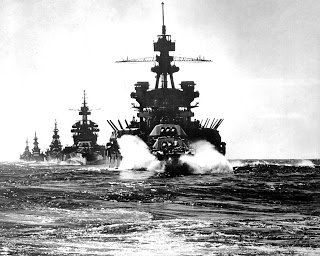 My thoughts. We need more small mounts. When I look at an AEGIS battleship, I don't see enough guns, and I'm talking about both crew served mounts and computer guided 30mms. To adapt to the threats in WWII, the Navy put every possible gun you could on our warships to deal with the threats those guns could counter. I do not see the same type of dedication towards defeating threats in the Navy today.
We need more small ships to screen our battleships. If one of our battleships is being swarmed by a dozen small boats, why are we putting our Captains in a position where they are required to engage with SM-2s at visual range simply because they have no other ships to screen them? Is the Littoral Combat Ship going to adopt the added role of screening our battleships in task force operations? Corvettes or Frigates, the LCS is neither. Otherwise we leave our battleships to engage at point blank range. Unacceptable. The recent Moskva incident in the Black Sea should be an unmistakable warning to the US Navy regarding the dangers of small boats in the littoral, even against inferior forces.
Unmanned technology is the future of warfare, and despite what the manual says, unmanned surface vehicles are good for only two things: They can be a glorified pair of binoculars, or they can blow stuff up with weapon payloads. Where are the fast launch capabilities for these USVs on our AEGIS ships. Are we even looking into rapid deployment capabilities? We should be.
Finally, if NETFIRES lives up to its sales billing, and it really is the solution to small boat swarms, why isn't it being built into the DDG modernization? If this system can be parachuted behind enemy lines, dropped off the back of a truck, are we seriously supposed to believe we can't find enough space on the top of a DDG-51 hull to chain one down ready to go? It never made sense that the DD-1000 was supposed to be fighting ship in the littoral and it doesn't even carry what is being labeled the primary weapon for littoral combat for the future US Navy.
The US Navy's AEGIS battleships are certainly very capable of the roles they were designed for, but when we look at the roles those platforms perform outside their intended design parameters, there is a lack of commitment towards preparing our battleships to face the threats they are most likely to face today, and by the way, have historically already faced. Failure to adjust to conditions is an unacceptable risk for our major battleships, each of which represents a major investment of national treasure.
Bottom picture caption: The battleship USS Pennsylvania leads USS Colorado, USS Louisville, USS Portland, and USS Columbia into Lingayen Gulf before the landing on Luzon, Philippines in January 1945. Battleships and other big gun naval vessels that served in the Pacific Theatre during World War II were used primarily for offshore bombardment of enemy positions and as anti-aircraft screens for aircraft carriers.

No comments:
Post a Comment