
 As bad as we thought Proceedings was last year, this year the publication has made a comeback with a vengeance. I get a considerable amount of email from active duty officers O-6 and below who love to rant against Proceedings. My recommendation, don't cancel your subscription, and if you already did, think seriously about subscribing again. Either Robert Timberg has grown in his role as editor, which is likely, or the Board has given some advice to refocus content to insure relevance in wartime, which is also possible. For whatever reason, April 08 had some of the best articles I have read in years, and so far I think May 08 is great. If you get locked out of any links from this blog to Proceedings, that means its time for you to subscribe.
As a creature of habit, I always dive into the comments section first to read responses to previous articles, and this one advocates something we have been discussing privately. About a month ago I wrote an article regarding our vision of Sea Basing as a strategic concept.
Our position reflects a belief that strategic speed for strike groups is more important than tactical speed on platforms, and strategic speed is achieved through forward deployed, well resourced, sustained presence. We believe Sea Basing is best developed bottom-up, not top down. We believe that with a bottom-up approach, the Navy and Marines will evolve capabilities that scale from small wars to major power war, and effectively address the unknown variables contained in each that will only be identified through operations. The capabilities desired for the Marines have been well defined within the context of Sea Basing as two MEB assault. We like this as a goal to work towards, but not as a standard to build first. What we have not observed to date with the emergence of the Marine Corps Sea Basing vision is joint integration.
We believe the Navy should resource to integrate joint supporting elements as Sea Basing evolves bottom-up toward major war scenarios involving the Marine Corps. Examples would include NECC roles including riverine and construction, forward air controllers and related equipment, EOD teams and equipment, SOCOM forces and equipment, and integrated agency follow-on support.
In developing a strategic approach for Sea Basing, the bottom-up approach for Sea Basing establishes the bottom as the logistical supply and repair, command and control, and reconnaissance enabler for naval forces to forward deploy smaller vessels in forward theaters to address irregular warfare environments. We base this assessment on historical analysis ranging from operation Game Warden in the 60s, but also Earnest Will in the 80s, modern afloat staging bases off east Africa today, but even going back to the naval activity in the early 1800s off Tripoli examples can be found.
As a strategic concept for the Navy Sea Basing becomes the Command and Control, but also logistical enabler for small vessels and unmanned platforms in forward theaters. We envision the starting place for this concept to be the large mothership, what amounts to an independent Forward Operating Base at Sea. While we envision motherships to carry unmanned and manned platforms, it has been suggested a well designed large mothership should also be designed to support and sustain patrol ships for independent operations. It is on the patrol ships topic Proceedings has an interesting comment in the May 08 issue.
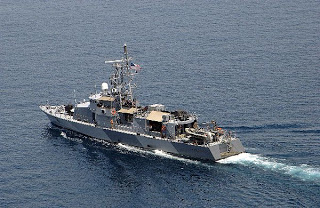
I read Rear Admiral Holland's article as I was finishing a deployment as CO of the USS Siroco (PC-6). The more I read about the Littoral Combat Ship, and the problems associated with the program, the more I am convinced what we need is more Cyclone-class coastal patrol ships (PCs). The PCs are the ultimate littoral combat ship, with a shallow draft of nine feet, plenty of speed (approximately 35 knots), and the right manning (28 Sailors). In addition, PCs are highly maneuverable, fast, and they pack a punch with a 25-mm MK38, 25-mm MK96, twin .50-caliber mounts, 240B mounts, and MK19 grenade launchers. Navy leadership should take a closer look at this program, conduct minor improvements to the engineering plant and weapon systems, and build 15 or 20 more ships. PCs can perform most littoral missions such as oil platform protection, maritime security operations, close combat support of riverine units, and shallow-water visit, board, search, and seizure (VBSS).
Also, these ships, the smallest commissioned vessels the U.S. Navy currently operates, are great for interaction with smaller navies in the Arabian Gulf, Africa, and Latin America. The Cyclone class needs a few improvements such as a better communications system, a replacement for the MK38 mod 0, and a small portable missile system for surface engagement that would give it more reach or a small multiple rocket launching system that could be used against small boat formations. If the Navy really wants to get creative, a medium-endurance PC can be developed. It would be approximately 200 feet long, have a 12- to 14-foot draft, incorporate the same hull design of the current PCs, and have a combat craft recovery system or stern ramp. These heavier PCs should be equipped with the Rafael Typhoon Gun System, allowing them to accomplish point air defense and have a better surface warfare capability.
The bottom line is that the PCs are the original littoral combat ships and they are a proven design. They provide early command opportunities to junior surface warfare officers, and invaluable shiphandling, weapons, and multi-discipline training to the entire crew. They are tough, minimally manned, and cost a lot less than LCS. Let's build more of them!
 There is a recent article in Newsweek by Christopher Dickey called Bluff and Bloodshed, The Persian Gulf is more dangerous than ever. Will the U.S. and Iran go to war at sea? While it is another story on how the Navy could escalate a full scale war with Iran over an accidental shooting, despite the fact the intent of the Navy's maritime strategy is to deescalate tensions, we found another aspect of the article excellent. We are huge fans of Herald Lee Wise's book Inside the Danger Zone: The U.S. Military in the Persian Gulf, 1987-1988. In our opinion, it is the best story of the Tanker Wars between the US and Iran from the 80s time period, and combined with The Night Stalkers by Michael J. Durant and Steven Hartov, one can get a real sense of the operations in that region during the Tanker Wars conflict period. Herald Lee Wise contributes some interesting insights to Christopher Dickey's article.
Low-tech weapons are effective in naval conflict.We conduct many naval simulations, and in our simulations have tried to figure out what about the Littoral Combat Ship 3000 ton mothership concept would be superior to much larger motherships supported by PCs. Perhaps our simulations are flawed, but we note Millennium Challenge 2002 and the entire Streetfighter development argues multiple small forces enabled by C4ISR offer a number of tactical and strategic advantages over adversaries, but more importantly scales very well in addressing both small wars and major power war. We believe there is a role for patrol ships in the US Navy today, although we acknowledge for them to contribute, they will require Sea Based logistical and C2 solutions to be effective.
"Modern technology remains weak at detecting undersea mines," says Wise. But mines are not the only problem. In the 1980s, as now, the Iranians used "swarming" tactics against larger merchant and naval vessels, sending relatively small boats at high speeds buzzing around and near the U.S. ships. The same thing happened in January this year, and possibly—the boats were never identified—just last week around a merchant ship on contract to the U.S. Navy.
Fight fire with fire.
In 1988 the most effective way to combat the Iranians turned out to be with weapons similar in scale to their own. Special Operations Forces using stealth helicopters from bases built on huge oil barges in the northern gulf effectively shut down Iranian mine-laying activity there.
By contrast, the billion-dollar guided missile cruiser USS Vincennes, gunning for Iranians near the Strait of Hormuz, fought a battle against a swarm of Iranian gunboats in July 1988 that was inconclusive.
What was memorable about that day was that in the heat of the moment the Vincennes mistook a civilian airliner overhead for an Iranian warplane and shot it down, killing all 290 people aboard.
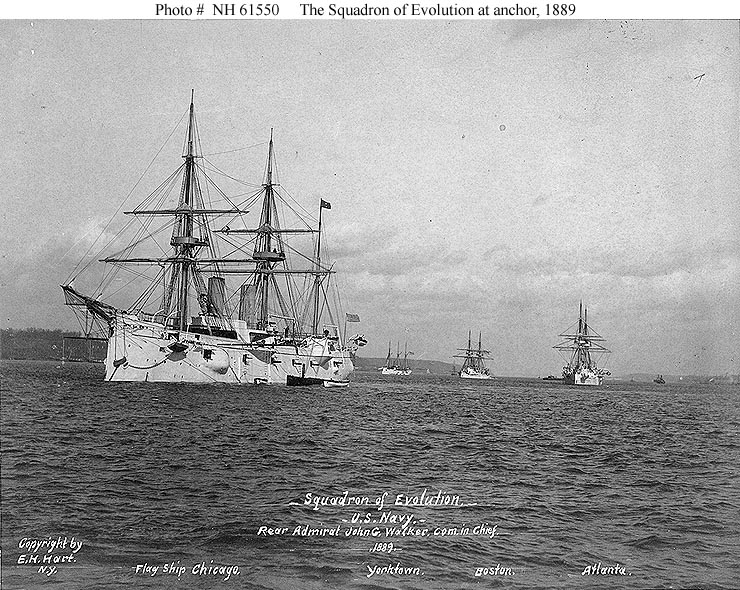
As the first picture in this article highlights, the Navy finds itself in a similar time period to that of the squadron of evolution. It has been a decade since the strategical and tactical ideas of our time were originally identified, and the Navy has only one more decade before the entire shipbuilding budget must be dedicated to replacing the most expensive part of the surface fleet as it ages out. We believe the Navy has all of the metrics and concepts for the surface fleet right, and unlike many we also believe the Navy has the strategy right. However, we believe the application of those metrics and concepts to strategy is flawed. There are a number of alternatives, and we don't claim to know which is better, but any alternative that chooses small combatants over big combatants, and large motherships over mini motherships is smarter than more battleships and an unrated flotilla. It is time for the Navy to align resources to strategy and patrol ships represent one way to align means with ends and ways for small wars at sea as outlined in strategy.
For Sea Basing that means realistic development and evolution. Today's ESG cannot even carry all the equipment for a modern MEU, and tomorrows ESG won't be able to either. Shouldn't both the Marines and the Navy establish what is required just to conduct an assault with one MEU against a hostile coast before both jump straight to 2 MEBs? How many small craft equipment sorties will be required to clear a beach from mines? How many UUVs are required to clear the sea of mines for a LCU to travel from the Sea Base to the shore? How quickly will air traffic controllers be able to deploy 200 miles in land with all equipment to support the new long range of MV-22s and Joint Strike Fighters? Sea Basing is going to be complicated, it includes much more than just the man and material of the Marines, because there is a rather long tail for the Navy extending well into land. With the 2 MEB Sea Basing concept consuming every resource for the Marines, what Joint capabilities are truly available in this strategy? In the 1980s against Iran, the Sea Basing platforms supported small Army helicopters, yet this transformation MPF(F) concept skipped that capability.
Sea Basing is going to be at least as complicated as Naval Aviation was to develop, yet instead of building the Langley, the Navy and Marines are developing a Nimitz. In our observations of proposed Sea Basing plans, the Navy and Marines have skipped over all of the various small war possibilities just to achieve the least likely, most difficult major war requirements. Shouldn't the services build up to this point rather than skip to it? Suggesting the highest end requirements scale down is dishonest because the Sea Base concept lacks the obvious capabilities of Sea Basing demonstrated historically in both Vietnam and against Iran. Unless we are parking LSDs/LPDs in the middle of small wars hot spots at sea and calling that a Joint Sea Base, the bottom-up joint services approach seems the wise way to invest in such an important strategic capability.
Why do I keep pounding this issue to death? Corbett warned about the dangers of a battleship Navy. While supporting all the big deck carriers and an AEGIS battleship fleet, it is hard not miss how the fleet continues to decline in numbers. Balance is key. For a nation like the US, which sends its Navy half way across the world to defend our interests, the processes that will be needed to support sustained forward presence is where change begins. The Navy will not recognize the value of small vessels until they recognize how to support and sustain them, and that is where the strategic concepts of Sea Basing comes into play. Once the Navy realizes that Sea Basing enables options otherwise not possible at sea, and the Marines see the advantages of a joint approach for going in to land, we believe that will be when the platform designs that define both the naval aviation fleet, surface fleet, and expeditionary fleet today will begin to evolve.

No comments:
Post a Comment