
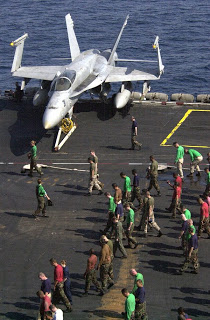
 I enjoyed Carrier, the 10 hour documentary series on PBS that ran last week. It was not what I expected, it was both better and worse. Like most Americans I never served on an aircraft carrier, unlike most Americans in that category I have been on an Aircraft Carrier. I liked that it highlighted sailors months into a deployment still startled by aircraft operations on deck, because it scared the crap out of me all the time during my experience.
I found the open nature of the format that exposed the character of a large number of sailors very refreshing. It is easy to claim the documentary was looking for contrary views, compelling story lines, and overemphasized those stories, but I think what we saw was very fair because it was very real.
The Carrier series didn't sell the Navy as an instrument of political power, and really didn't sell the Navy as an instrument of national power. The documentary sold the Navy as both a job and a career, as work and as a refuge from home, and most importantly it highlighted the nature of the Navy to become a family away from family. In my experience as an employer of many people who have served in the Navy, the stories of individuals seeking structure and fleeing a bad situation at home sounded very familiar to me. The military is a lot of things, structure and discipline are two of them.
I enjoyed the comparisons between officer and enlisted, but also the distinction between the E-6s and below and the E-7s and above. I liked that the series emphasized sailors doing their job rather than talking about their job. The viewer was exposed to the youth, the truth, the danger, the precaution, and the stress of navy life on long deployments. Carrier offers more understanding regarding Navy life than what is likely found at a Navy recruiting station, and within that truth Carrier gives the Navy a refreshing image of life uncensored.
As far as what I didn't like, I didn't care much for the musical score, and over all that is my biggest complaint. Other than the first episode where the music matched the scene as the Nimitz entered Pearl Harbor, the music sometimes seemed mismatched to the story being told. I'm not sure if I like how they handled faith, because it came off as agenda driven against religious faith in the form of finding and highlighting someone who was unable to sustain his faith throughout a voyage. For me I thought it was an example of looking for the exception instead of emphasizing the rule. I got sick of seeing Hornets, but by the end I got the impression that was the point. I was somewhat disappointed the series skipped Malabar 2005, which was an important aspect of that deployment at the time. It would have been interesting if the Navy informed the crew of the significance of that event, and whether the crew 'got it' or not.
In the end I thought it was a big win for the Navy, who unzipped their fly and let the whole world look the inside the biggest barn. I imagine people will see in the series what they want to see, as I think it is unlikely the series changes those with established preconceptions regarding what the Navy is. For those who had no frame of reference and approached the series looking for knowledge, they were exposed to what Navy life is like for the young men and women who join, and reminded this is a job done by people, not drones. That realism, exposed and in full living color, is what makes the series both interesting and enjoyable for viewers, and valuable to the Navy in telling the rest of the story regarding what the Navy offers young people in search of maturity.

No comments:
Post a Comment