
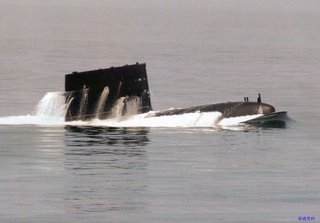
 The Federation of American Scientists Strategic Security Blog has an excellent review of Chinese submarine activity for 2007 up. It is a very interesting read.
China's entire fleet of approximately 55 general-purpose submarines conducted a total of six patrols during 2007, slightly better than the two patrols conducted in 2006 and zero in 2005.
The 2007 performance matches China's all-time high of six patrols conducted in 2000, the only two years since 1981 that Chinese submarines conducted more than five patrols in a single year.
The new information, obtained by Federation of American Scientists from the U.S. Navy under the Freedom of Information Act, also shows that none of China's ballistic missile submarines have ever conducted a deterrent patrol.
In a separate entry, FAS has defined a patrol based on the Defense Department’s unclassified Dictionary of Military Terms (JP 1-02) (PDF).
* Antisubmarine patrol: The systematic and continuing investigation of an area or along a line to detect or hamper submarines, used when the direction of submarine movement can be established.
* Inshore patrol: A naval defense patrol operating generally within a naval defense coastal area and comprising all elements of harbor defenses, the coastal lookout system, patrol craft supporting bases, aircraft, and Coast Guard stations.
* Offshore patrol: A naval defense patrol operating in the outer areas of navigable coastal waters. It is a part of the naval local defense forces consisting of naval ships and aircraft and operates outside those areas assigned to the inshore patrol.
* Patrol: A detachment of ground, sea, or air forces sent out for the purpose of gathering information or carrying out a destructive, harassing, mopping up, or security mission.
* Submarine patrol area: A restricted area established to allow submarine operations: a. unimpeded by the operation of, or possible attack from, friendly forces in wartime; b. without submerged mutual interference in peacetime.
 If you don't read the entire article, the FAS summery of 2007 activity by the PLAN submarine force can be deceptive regarding the capabilities of the PLAN submarine force, but the article does a really good job of analysis in our opinion. However, it shouldn't be surprising that media attention given to the FAS publication gives a different impression. This Government Executive article is a good example. If you read it, you'll notice the article gives a lot of statistics that gives a completely different impression to the reader regarding the Chinese submarine force than what one would get had you read the FAS blog article.
The reason the FAS analysis is so good and the media article is rediculous reporting is because statistical comparisons don't tell the story of PLAN strategy. PLAN submarine strategy, particularly with its large (and rapidly growing) conventionally powered submarine force is centered on regional sea control in a coastal defense or Taiwan strategy role. A nation like China, with no overseas military commitments can afford to spend time training submarine crews in short stints at sea, as opposed to dedicated trainings for long deployments overseas like western Navies. Citing patrol statistics ultimately gives a statistical comparison of over 100 patrols for the US Navy, and only 7 for the PLAN, giving the impression the PLAN is a beached force. That would be believable, if we didn't observe almost daily photography out of China of underway submarines, albeit near the shoreline.
The analysis based on patrols is an interesting measurement though, because it highlights the amount of operational experience the PLAN has in forward deployments.
Finally, the data was collected by Freedom of Information request by the US Navy. That means the US Navy, or perhaps regional allies, tracked 7 Chinese submarines this year. Readers of this blog have no doubt observed we track deployments of US Navy ships and submarines for simulation purposes and our Friday 5th Fleet Order of Battle. While we choose not to speculate openly the methods used by the US Navy to count patrols of PLAN submarines, the historical data for US submarine deployments paints an interesting picture.
We compared the numbers FAS provides between 2005 and 2007 with the number of US Navy attack submarines that deployed from the Pacific using open source historical data over the same time period. When we excluded Pacific based submarines that deployed to the Gulf, deployed specific to an exercise, or with a Strike Group, we noticed the graph between 2005 and 2007 we created is very similar to the graph reported by FAS over that three year time period. In other words, open source data accounts for 3 more independent submarine deployments in 2006 deployed to the Pacific under those conditions in 2005, and 7 more submarines in 2007 under those conditions than in 2006.
We don't have good numbers for deployments prior to 2005, but would imagine FAS does, and we would be curious if a similar comparison of years 2000-2004 for US Navy SSN deployments excluding those to the 5th fleet, exercises, or with strike groups would reveal a similar graph, representing higher or lower detection of PLAN submarine patrols depending upon the number of SSNs independently deployed. Based on dates of recent SSN decommissions and the current wars alone, we speculate that some of those trend lines would indeed be very similar.

No comments:
Post a Comment