
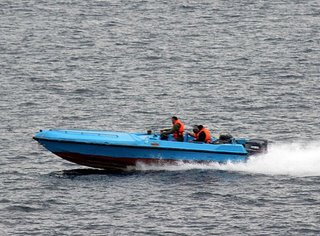
 Continuing to observe the events from last Saturday, the incident that occurred in the Straits of Hormuz is branching off into two different discussions. The political fallout of the incident, which includes the video and audio from the incident, will likely take on a life all its own as the President goes to the Middle East to discuss the various security issues of the region. We believe the video and audio will help the Presidents credibility regardless of quality, and while that may reign in the IRGC within the Persian Gulf, there are still a number of regional security issues that will be on the table. From Iraq to Pakistan to piracy, not to mention the expected upcoming announcement of military sales to Saudi Arabia, in total there is potential are a number of maritime security related topics in these political developments we intend to watch for.
However, we find ourselves still focused on the naval centric issues of this incident. In observing all of the facts presented, we couldn't but note some of the comments of CDR Salamander, who represents a number of SWO piecing this incident together wondering how in the hell those Iranians weren't blown to hell. Swarm tactics and mines by Iranians is serious business, life or death serious. In the opinion of many we have spoken too, these comments by the CDR represent a number of observers.
I am not second guessing any CO out there, as it is hard to make the right call. That being said, in an email exchange with MTH, I did a little play math. For those who don't spend much time on the water on anything larger than a Ranger, 200 yards is CLOSE.
200 yds is very close. If he can get 30kt closure, that is what, about 12 seconds until contact? 12 seconds on a bad day can get ugly. 2 to make the call. 2 to say "oh shi'ite!" 2 to get the command out of your mouth. 4 seconds for it to get passed to and processed by the man pulling the trigger. 2 seconds to make contact on the boat (I am being optimistic as this is all visual aiming at this point and is 50 cal.). That is, well, 12 seconds. Boom.
In the video I watched, 30 knots is the low end of what those IRGC boats could do.
We covered in some detail that press conference given by Vice Adm. Cosgriff, but in review we believe we failed to observe the most important statement he made.
I'd like to report that the training of our ships as they came in was more than satisfactory. They stepped through the procedures carefully, with good discipline, with due regard for all the factors, while at the same time taking the reasonable precautions to place their ships in conditions of readiness consistent with the environment in which they were entering. So I was very proud of their performance and the training they received.
Sounds pretty basic, but it reminds me of an article I read this past weekend by Lieutenant Commander Rory Berke called "Training for the Wrong Fight" which was the 2007 Naval Intelligence essay contest winner. The essay is a call for better training for OPINTEL folks to get with the 4GW program at sea, a call we agree with. However, the article also provides an easy to understand overview of the current role the OPINTEL folks have in the strike group as it works up for deployment.
Strike groups prepare for deployments and surges under the 2003 Fleet Response Plan (FRP). With training overseen by Fleet Forces Command and administered by training commands such as Commander Strike Force Training, Tactical Training Group, and Expeditionary Warfare Training Group, strike group staffs are exposed to the range of naval operations they are likely to encounter on deployment.
Throughout the training cycle and during the concluding qualification phase, strike group and warfare commander staffs undergo demanding in-port and underway simulations that require them to demonstrate proficiency in executing pre-planned responses to a variety of simulated threats. These exercises are designed to encourage routinized responses. However, they are not helpful for intelligence teams because they don't promote adaptive thinking or predictive analysis.
Due to the scripted nature of simulations, strike group intelligence teams are forced into the role of glorified white cells—they receive intelligence reports from the exercise scripters and perform a minimum of analysis before passing the information to the relevant warfare commander, who initiates a desired pre-planned response. Meanwhile, little is done to ensure that intelligence teams are prepared to provide intelligence on the threats they will actually see on deployment. This dangerously squanders the opportunity to provide meaningful, real-world training for intelligence personnel.
Current training evaluates a strike group's ability to engage a fictional adversary in a culminating naval battle—a low-probability scenario—while neglecting most high-probability situations. Ship boardings in support of maritime intercept operations (MIO) are scattered throughout the simulations, along with a range of asymmetrical threats, but these scenarios do not test the temerity of intelligence teams.
The article goes on to describe how intelligence from the theater defines the training for the strike group. From the evidence we have seen, the training the Tarawa Strike Group had was top notch for dealing with asymmetrical threats. This was the last question asked, ironically by the Pentagon spokesman, at yesterdays press conference with Vice Adm. Cosgriff.
Before I bring it to a close, is there anything else that perhaps we should have asked you, that you want to add before we bring this to an end?
Considering the number of questions many analysts still have, the press needs better reporters. Here are a few things we see missing in the details.
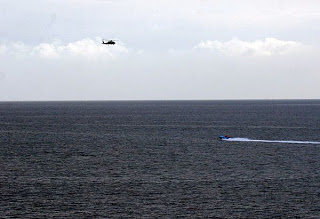 Was their any intelligence, and previous reports of incidents regarding the IRGC dropping objects, perhaps like white boxes, in front of ships... in the past? Were the ships able to confirm on the scene that the objects being dropped in the water in front of the USS Ingraham (FFG 61) were in fact not naval mines? Vice Adm. Cosgriff described tactical patterns of the boats forming 2 groups and staying in formation as he described the Iranians. What little video I have seen confirms this. In listening to him talk about it, it almost sounded like he had observed that before. We already know he will get to observe it again.
Given the results of the encounter, we tend to believe there was some intelligence provided detailing expectations for such an incident. We also tend to think either this isn't the first episode where IRGC have dropped objects in front of ships, or that the Navy was somehow able to quickly identify the objects as nonthreatening. Given the reaction of the officers, and the praise they got during the press conference and in other statements, we tend to think the 'training' getting credit is actually a combination of the intelligence paying off, the officers and crew being prepared with the training scenarios conducted in workups, and understanding the conditions while properly executing procedures.
If the Navy expected an encounter like this, and the officers on those ships recognized what they were seeing based on intelligence, and was able to communicate this effectively with each other and their crews, it makes a lot of sense that 'white boxes' could be thrown in the path of frigates, or small boats could operated in formation zooming around the three US warships and not get blown up from gunfire. It seems to us, that the missing element in this entire incident is the intelligence the ships had going into that situation. If that intelligence was good, and to us it appears it must of been, the IRGC tactics would have simply been a sideshow falling into the realm of expectations for the Navy based on the training for the ships, training which again is based on intelligence.
While SWOs, and admittedly many others are wondering why no Iranians took a swimming lesson last Saturday morning, keep in mind there are a number of very valid explanations. The Navy sailed through a tough incident, the crews were clearly professional in their response. Credit the training, and credit the intelligence.

No comments:
Post a Comment