Monday, March 18, 2024

Corvette, Frigate, or Destroyer?

I was on HuffPo Live earlier today trying to calm concerns about Iran's scary new "destroyer":  
 Also, in last week's Diplomat I wrote a bit about the state of the aircraft carrier debate (alarming headline notwithstanding):

I suspect that we will continue to see navies devoting resources to multi-purpose flat-deck aircraft carrying warships.  Put simply, as long as states continue to see utility in such ships, they’ll continue to build them. Larger ships with dedicated equipment will carry more and better aircraft. The largest ships, operated by the largest states, will carry an array of exceedingly advanced aircraft, both manned and unmanned. 
At the same time, the constitution of a carrier air group will always be an imperfect fit with the tasks of the day, because development of the air group generally takes place long before the specifics of future conflict are known. And this fact underscores the utility of aircraft carriers.
Any air group (whether consisting of F-35s, F/A-18s, Yak-38s, A-6s, or Sea Hawk helicopters) represents a best guess at the demands of future conflict, mediated through the lenses of bureaucracy and the defense industrial base. Many of the assumptions behind these decisions can and often do turn out to be incorrect. The carrier’s primary virtue is therefore its flexibility and adaptability to different circumstances, not in its unique capacity to solve specific problems.

Navy Stuck Between the Rock and Hard Place on Joint Strike Fighter

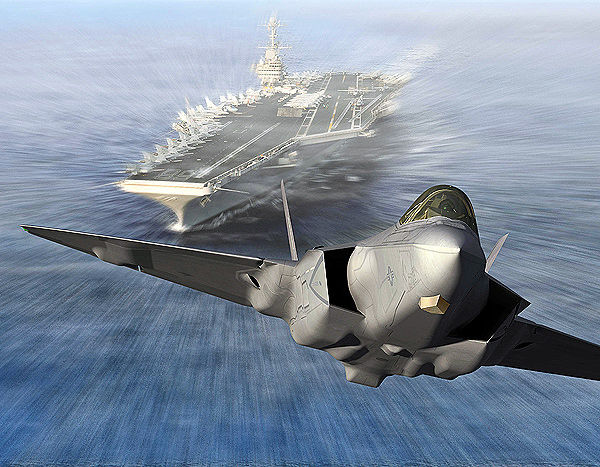
F-35C Art
National Defense Magazine blog has what appears to me to be the most insightful tidbits of information to date on the Navy perspective of the F-35C. At the March 12 Credit Suisse/McAleese defense programs conference in Washington, D.C. Air Force LT. General Christopher C. Bogdan, program executive officer of the Joint Strike Fighter, and Admiral Jonathan Greenert, Chief of Naval Operations, both made comments that in my opinion, gives the current view of the F-35C program from DoD perspective. The implications of these comments are worth consideration.
Throughout his presentation, Bogdan repeatedly hammered the point that the F-35’s eight international partners — the United Kingdom, Canada, Australia, Italy, Turkey, Norway, Denmark and the Netherlands — are losing patience and becoming increasingly alarmed by the trends in the program.

“The cost is up by tens of billions,” Bogdan said. “Our partners are starting to put really big dollars into this program.” By the time F-35 reaches lot 8 low-rate production, more than half of the aircraft will be for non-U.S. customers. “They need to know where their money is going,” he said.

Adding insult to injury, the JSF program office classified all documents as “U.S. only,” which upset partner nations. Even if they are all buying the same aircraft, each country has its own air-worthiness qualification processes and other administrative procedures that require they have access to the aircraft’s technical data. JSF officials are working to re-classify the documentation, Bogdan said. “These airplanes are important to them [our partners], politically.”

Pressure to keep allies happy might be one reason why the U.S. Navy will not be allowed to dump the F-35C. It has been known for years that some Navy leaders would prefer to continue to buy the F/A-18 Super Hornet, and not have to bother with the expense and trouble of having to bring a new type of aircraft into the inventory.

Chief of Naval Operations Adm. Jonathan Greenert insisted that the Navy is fully on board.

“We need the F-35C,” he said at the Credit Suisse conference. “It has to be integrated into the air wing.” He said the Navy has not yet decided how many it will buy, however. And he recognized that the Navy ultimately has no choice but to buy the F-35C. “If we bought no C's, it would be very detrimental to the overall program” and to international partners, he said.
As most of you know, the F-35A is the Air Force version of the Joint Strike Fighter (JSF), the F-35B is the Marine Corps version of the Joint Strike Fighter, and the F-35C is the Navy carrier launched version of the Joint Strike Fighter. Lockheed Martin is the prime contractor, and in order for all three versions of the Joint Strike Fighter to reduce costs per unit, the schedule for all three must improve. Scheduling delays and design flaws have turned the JSF program into the biggest runaway train wreck in modern DoD acquisition, if not of all time. The only version of the F-35 that everyone appears to agree is truly needed is F-35B, the vertical takeoff and landing version. The F-35A is the single most important of the three versions because current plans call for building thousands of these aircraft, and alliance interest is primarily for this version of the aircraft. The US Navy is the only purchasing client in the world for the F-35C, and my sense for the last year is that the US Navy would bail out of the program if they could.

In public statements, it has become very common to hear Admirals say the Navy 'needs the F-35C,' but it has become uncommon to hear any Admiral praise the aircraft. Why the Navy needs the F-35C is never addressed in context, primarily because the well documented problems of the F-35C make it clear that the Navy needs are not yet met by the F-35C at this time, and it is unclear if some of those problems can ever be truly fixed. Anyone who has read the latest annual report released by the Pentagon’s director of test and evaluation, J. Michael Gilmore, - not to mention the latest GAO report on the Joint Strike Fighter, knows that the Joint Strike Fighter program still has very serious problems. The GAO report in particular is the kindest report to date for the Joint Strike Fighter program, but after reading that report my primary takeaway is that the Joint Strike Fighter is at least as technologically and electronically complicated as even our most sophisticated Unmanned Aviation platform concepts. Quite honestly I find it hard to believe that any aircraft with so many technological moving parts will ever be reliable on any modern battlefield. The Joint Strike Fighter is a logistical nightmare, and is literally a helmet malfunction away from being a mission kill during wartime - with hundreds of proverbial helmets built into the aircraft.

LT. General Christopher C. Bogdan is emphasizing the multinational partnership of the program for a good reason, and the reason is specific to bringing down the cost of the F-35A. Stable funding across all 3 models of the Joint Strike Fighter is required if the F-35A price is going to have any chance to drop to $90M per aircraft. That means the Navy must stay completely invested in the R&D of F-35C, and must - at least initially - buy F-35C aircraft at the scheduled rate to maintain stability in the production schedule. When  Adm. Jonathan Greenert mentions the Navy still hasn't determined how many F-35Cs the Navy will purchase, the implication is the CNO is looking for the bare minimum threshold the Navy must spend to stay invested in the program.

What is important about the comments of both LT. General Christopher C. Bogdan and Admiral Jonathan Greenert is that when it comes to the F-35C, the F-35C is now being purchased by the Navy primarily for reasons of National Security Policy and not for any reason related to maritime policy or strategy. The Navy is now required to continue to pay for the F-35C for purposes of cost consideration of the entire program - all variants, and that consideration is primarily being driven by the multinational character of the program. It is now fair to say that Navy budget spending for the Joint Strike Fighter is now more important to the Department of the Air Force and the Department of State than it is for the Department of the Navy, because it is more important for the National Security Policy of the United States for the F-35A to be affordable to multinational partners than it is for the F-35C to fly off US Navy aircraft carriers.

While it is extremely frustrating that the Navy is essentially being forced to spend huge sums of money on an aircraft the Navy no longer appears to want, it is also valid that the Navy be forced to continue investment in the Joint Strike Fighter for National Security Policy purposes - even when that purpose is primarily for insuring the cost of the platform is affordable to allies. It is completely legitimate that the Navy buying the F-35C is the right thing for the National Security interests of the country even while buying the F-35C itself is not good for advancing naval aviation. This is not a zero sum game.

It would be a mistake to interpret validity and legitimacy as good or bad, because the context matters. National Security Policy trumps maritime strategy, even if I would like to see maritime strategy have more influence in the crafting of National Security Policy. In my opinion if (and this is a BIG "if") the cost of the F-35A comes down to $90 million per aircraft because the Navy spends money on the F-35C, and if international partners ultimately buy a bunch of F-35As at that price, then the Navy's investment in F-35C is simultaneously a poor investment for the Navy and a good investment for the country. What makes all of this really frustrating though is that a poor investment for the Navy and a good investment for the country is the best case outcome of the Joint Strike Fighter as things are today, and it should be noted there is no evidence to date that this represents the most likely outcome. At this point, all it takes is one country to bail out and the whole plan falls apart.

Imitation is the Sincerest Form of Flattery

Big news this weekend as the hardest working reporter in naval affairs, Chris Cavas, published this interesting story based on a report last year to the CNO by VADM Tom Copeman, Commander Naval Surface Forces (whose Creighton Bluejays open with tough Cincinnati squad in the Big Dance) .  In it, Copeman reportedly lays out a vision for the surface force that looks surprisingly like that put together by the Romney Campaign Navy team, albeit likely with fewer ships.

Our plan would have built the first 24 LCS (weighting mine warfare modules in synchronization), shelved the Flight III DDG in favor of continuing to build Flight IIA's (3 per year), and moved to an AMDR configured BMD "cruiser" built on either the LPD 17 or the DDG 1000 hull (there was great debate within the team about which path was better--some wanted to go with the DDG 1000--building 11 of them--others believed the hullform flawed and wanted to go with the LPD 17).  All of these steps are--according to Cavas--in Copeman's recommendation.

So if indeed, Vice Admiral Copeman would have the Navy move in this direction, he would have my full support. 

Bryan McGrath


Tuesday, March 12, 2024

China's new Type 056.

I did a little write up a couple of weeks ago when the first Type 056 was handed over to PLAN.  And now, it has officially arrived at its naval base at Zhoushan.  Xinhua has an article of its commissioning here.  The term stealth frigate is a misleading since it is more in line with a corvette.

The first 056 class No. 582 was officially handed over to PLAN on the 25th of February as Wu Shengli, Commander of PLAN personally came to inspect the ship. While it is referred to as light frigate by Chinese news, it really should be classified as a corvette or OPV based on its size and displacements. This class is expected to be the next mass produced PLAN shipping class.

The type 056 class fills the gap between the 4000-ton 054A class frigate and 220-ton 022 class FAC. As of now, at least 9 other 056s have already been launched by the 4 shipyards building them. The overall number of this class is expected to be between the final count of 054A (probably around 20) and 022 (around 80). They are expected to replace the 10 Type 053 class Jianghu frigates currently serving in the South China Sea Patrol flotilla and the close to 50 Type 037 class missile boats.

In many ways, the type 056 hull is based on the Pattani class OPV that China built for Thailand from 2005 to 2006, although more signature reduction work is done such as the shielding of the funnels. Currently, 056 is equipped with 4 YJ-83s and AK-176M for ASuW missions along with a 8-cell HQ-10, AK-176M and two automated new single 30-mm barrel CIWS for self defense. Although the first few ships are not fitted with Towed Array sonar, it could provide some support for near sea ASW missions with a helipad large enough to hold Z-9C (and possibly Z-15 in the future), appearance of bow sonar bulb and 6 torpedo tubes installed in what looked to be the hangar. Most likely, the earliest 056 units will be used to replace Type 037s in the Hong Kong garrison and green water patrol missions. I expect a good number of Type 056 to eventually be used to patrol the disputed areas in South China Sea. Compared to the ships it is replacing, Type 056 requires 1/3 of the crew size of Jianghu class while offering more punch and similar endurance. Compared to Type 037, it should have better endurance, seakeeping and far stronger ASuW and AAW capabilities. It should be able to handle the naval threats from neighboring countries like Vietnam, Phillipines and Thailand. The goal is to free up larger ships like the Type 054A class and Type 052C/D class for blue water missions. In the future, I could also see ASW variants of Type 056 replacing the Type 037 sub chasers and more dedicated patrol versions of Type 056 with hangar large enough to hold 2 S-100 size UAVs.

Monday, March 11, 2024

At What Cost a Carrier?

Captain Henry J. (Jerry) Hendrix is one of the smarter people wearing a Naval Officer’s uniform these days.  A career naval aviator, he has released a monograph through the good offices of the Center for a New American Security entitled “At What Cost a Carrier?” as part of their “Disruptive Defense Papers” series.  Bound to create a stir among navalists, its appearance is a sign of the continuing health of the intellectual core of the Navy and its capacity to engage in serious debate, even when one of its central capabilities is criticized.  That said, I think that while Hendrix has aimed at the carrier, his precision guided ideas did not find their target. Rather, he reinforces arguments made elsewhere that it is the carrier’s weapon system—commonly referred to as the air wing—that must evolve, in order to respond to threats he believes have sped the carrier’s obsolescence. 
Captain Hendrix contends “future wars should be characterized by smaller target lists that emphasize discreetly interrupting capacities, not destroying them.” While a convenient projection for the future of conflict, in doing so, he possibly falls prey to the “Last War-Itis” Secretary Gates warned of: in my view, entry operations in Afghanistan and Iraq (where the U.S. enjoyed overwhelming superiority, selectively engaged targets, and relatively easily weakened the will of the enemy) will likely be aberrations from the historical record, rather than strong indicators of the character of future warfare. Instead, the scale of air strikes in challenging scenarios—especially to counter the aggression of A2/AD threats such as China—would likely far exceed the number of targets engaged in the initiation of conflict the past few decades.
Additionally, the record of naval aviation support to counter-insurgency operations in the course of the last decade at times produces misleading statistics.  In support of his argument, Captain Hendrix bemoans that the lifecycle cost for each bomb dropped by an air-to-ground strike-capable aircraft in the Navy’s inventory was an astounding $7.5 million as an average of only 16 weapons per aircraft were dropped.  What he fails to mention is that naval aircraft spent a significant majority of their time (and sorties) not bombing terrorists or insurgents but rather providing support operations such as ISR and electronic warfare.  This was not a function of the lack of utility of carrier aircraft but rather the decision to employ carrier aviation in the CENTCOM AOR, the relative lack of threats compared to the number that would be found in a great power war, and at times restrictive Rules of Engagement.  
Moving on, Hendrix writes “No one can doubt the diplomatic power of carriers, for presidents, it seems, are always asking where they are.  Allied nations and the U.S. combatant commanders persistently request additional naval presence to shore up their interests….and no platform is requested more than the carrier.”  Assuming that both American presidents and the leaders of other nations are rational actors then, it seems that there might be something “special” about the presence of an aircraft carrier, something that even the agglomerated presence benefit of more numerous DDG’s or LCS’s simply doesn’t provide.  Hendrix then rightly questions “…can the United states afford the carrier”, a good question given both the state of our economy and the plain truth that those who very often seek the security of the carrier bear none of its costs.  So then, what are those costs?  Hendrix fixes the “life cycle costs of an associated carrier air wing, five surface combatants, and one fast-attack submarine, plus the nearly 6700 men and women to crew them, it costs about $6.5 million per day to operate each strike group.”  This may strike the reader as a colossal amount of money.  But let’s unpack that a bit.
Let’s start with GDP; if one assumes a $15.1 trillion GDP, we can then calculate a “daily GDP” of $41.4 billion.  What then, is the percentage of national treasure spent each day to operate three carrier battle groups?  My (admittedly spotty) math reveals that the $19.5M a day breaks down to about four one-hundredths of a percent of our daily GDP.  Does this strike you as excessive, given what we get from the investment?  Next, let us compare that $19.5M to the total military budget.  Let’s assume a $500 billion budget, so that we then arrive at a “Daily Military Budget” of $1.4B.  How does that $19.5M compare to that figure?  Three carrier battle groups out and about deterring aggression, providing presence and crisis response and assuring friends and allies comprises 1.4% of our daily military expenditure.  Again, does this strike you as excessively expensive?
My point is this—aircraft carriers, carrier battle groups, surface ships, submarines, aircraft—all of the accoutrements of naval power—do not come cheaply.  But what we GET for the investment—the ability to deter and assure, the maintenance of global trade and order—dwarfs what we spend to obtain and sustain them.  Yes, $13.5 billion is a lot of money to construct a CVN—but over the course of its 50 year lifespan, that initial cost comes down to $740,000 a day—a bargain for what it brings us.
Which brings us to the next question, and that is, can the CVN continue to “bring us” the things it does in the face of mounting A2/AD threats in the hands of a peer competitor. 
The first thing to consider is that the only “new” threat to the aircraft carrier in this vaunted Chinese A2/AD regime is the DF-21D anti-ship ballistic missile (ASBM).  The other components of the threat—cruise missiles, submarines, etc., have existed throughout much of the life of the aircraft carrier, and between the air wing and its escorts, the carrier has flexibly responded to all of them.  But the ASBM is important, and so it should be treated specifically.  Hendrix agrees, as it is featured in his report, first in a comparison of the costs associated with China’s production of the missiles (vis-à-vis the cost of an aircraft carrier) and then in the range advantage it the missile has over the aircraft carrier strike aircraft.
By estimating the cost of each DF-21D, Captain Hendrix informs us that China could build 1227 DF-21D’s for every carrier the United States builds “going forward”.  This is interesting, but I’m not sure it is entirely relevant, because China—believe it or not—has budgets and budgeteers just like we do.  And while I know it is fashionable to believe China capable of just about anything it wants to do militarily, China is also fixated on maintaining as close to double digit economic growth as it can on a yearly basis.  There are opportunity costs associated with building missile inventories, and I have seen no estimates that lead me to believe that China is now (or is capable of) building at the rate of Captain Hendrix’s hypothetical. 
Next, Hendrix makes a significant error—by stating that “U.S. defenses would have to destroy every missile fired, a tough problem given the magazines of U.S. cruisers and destroyers, while China would need only one of its weapons to survive to effect a mission kill.”  This just isn’t so.  U.S. forces do not have to destroy incoming DF-21’s; they simply have to not be hit by them.  Some incoming missiles will have to be intercepted, but unlike land targets, near misses at sea are as good as an intercept, and these near-misses could be hastened by any number of advanced electronic and cyber techniques.  Additionally, if the DF-21D works like other weapons systems, its accuracy and employability are both impacted by range to the target, something over which an aircraft carrier has some say.  In summary, any suggestion that our approach to this threat is to try and outgun it is simply incorrect. 
Captain Hendrix provides a simple graphic to reinforce the range issue, estimating the range of the DF-21D at 1087 miles while the unrefueled range of the F-35 maxes out at 690 miles.  This is, generally speaking, the relationship upon which most carrier critics seize most often, surmising that we would not risk our multi-billion dollar carriers in order to get close enough to launch meaningful strikes.  This raises the problem I brought up first with Hendrix’s argument, and that is, his beef should really be with the air wing, and not with the aircraft carrier.  Over the past few decades, naval aviation came to value sortie generation over range, as our ability to operate as close to shore as we generally wanted was barely challenged.  But it wasn’t always this way.  Carrier attack aircraft previously had unrefueled combat radii far in excess of that which even the F-35 will bring.  As we move to unmanned combat air vehicles, a premium must be placed on re-gaining that range—and in developing stand-off weapons that can fly extended ranges without exposing the launch aircraft to enemy Integrated Air Defense Systems (CNO’s emphasis on payloads over platforms applies here).  
Put another way, the carrier is not approaching obsolescence; its air wing is.  Extend the range of the air wing through long range UCAV’s and stand-off weapons, and the mobility, power and flexibility of the aircraft carrier remains.  In fact, it is the evolution of the air wing over the decades that have created the long life of the carrier.  No one seems to point to air bases as “obsolete”, yet they have been subject to attack throughout the life of the carrier.  The carrier brings with it the benefit of mobility, a tremendous asset in enabling it to evade targeting, especially when one considers the alternatives. 
In my view, unmanned aviation will create a new golden age of aircraft carriers.  In fact, the day is fast coming when we design a carrier from the keel up to launch and recover primarily unmanned aircraft.  When a UCAV returns from its mission, it will recover, be re-armed, refueled, re-greased, and re-missioned on an assembly line that will enable high sortie rates even with the extended range of the missions they will fly.
In the meantime, aircraft carriers will continue to provide forward stationed striking power—efficiently and economically—in addition to crisis response, deterrence and assurance. 
If—as Hendrix indicates—aircraft carriers are fast becoming obsolete, why then should the Navy invest a dime in a follow-on to the F-35, manned or unmanned?  With the same zest he exhibits in putting the carriers out to pasture, he advocates for unmanned strike aircraft operating from—you guessed it—aircraft carriers, albeit smaller (and presumably cheaper) ones.  Why these smaller (and less capable) carriers would be less subject to the Chinese A2/AD regime is beyond me, but apparently their best attribute is their cost.  Furthermore, I am open to design recommendations, and I wouldn’t be surprised if technology evolves. However, my understanding is that currently, range requirements largely influence low-observable aircraft platform design, thus dictating a large size for a long-range aircraft—be it manned or unmanned.  Hence, if you want the UCAV to have long range to be able to launch from outside the A2/AD envelope, it will need a large-decked ship to operate from.  Consequently, the idea of simply designing smaller UCAVs for smaller amphibious carriers might not fly.

Captain Hendrix has started a worthwhile debate and has added some serious intellectual fire-power to the argument to move faster to unmanned strike aviation.  He has not authored the execution warrant for the aircraft carrier.  

UPDATE (13 March):  It might be worthwhile to re-read Captain Hendrix Proceedings article from nearly two years ago that presaged this CNAS paper, and the response I posted then.