Showing posts sorted by relevance for query sea shepherd. Sort by date Show all posts

Wednesday, January 9, 2024

Lawfare and NGO Maritime Actors

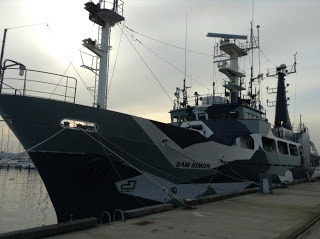
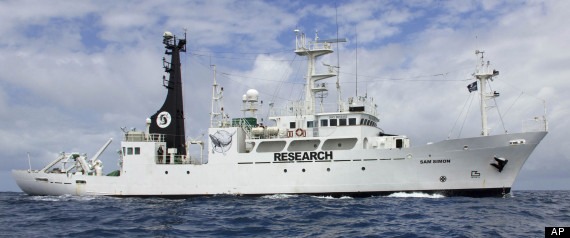
In this undated photo released by Sea Shepherd Conservation Society, its new Antarctic patrol ship SSS Sam Simon steams on the sea. (AP Photo/Sea Shepherd Conservation Society, Carolina A. Castro)
On the One Year Anniversary Special of Midrats 2 years ago, CDR Salamander opened his discussion with a question submitted by Admiral James Stavridis that asked what the panel believed would be the next big thing after next (over the horizon) for naval operations. In his answer, Claude Berube discussed the concept of emerging Maritime Shadow Zones which he defined as geographical maritime security gaps where naval power lacks the strength, authority, or interest to enforce maritime security in maritime regions globally. In his description of this potential emerging future, Claude mentioned that it is possible that both legitimate an non-legitimate non-governmental actors would be emerge to fill those voids.

While it wasn't the first time I had been exposed to that concept, his presentation of what a potential future role of the maritime NGO might look like inspired several ideas in my mind, and I admit I have thought about the topic in the way he presented it many times since. Due almost entirely to the his answer that night, I began paying closer attention to the activities of the Sea Sheperd Conservation Society, perhaps the most renowned of the modern legitimate NGOs currently filling the maritime shadow zone in the Southern Ocean.

Did that word bother you? The word I refer to is legitimate, which does require some definition and I am open to adopting a different word for the lexicon if you have any suggestions. Maritime piracy, maritime banditry, smuggling and trafficking, oil theft, and a host of other criminal activities at sea are conducted by non-legitimate non-governmental actors in various places in the world. While causes may be increased population density of coastlines, poor regional governance and failed states, or the absence of an effective regional maritime security enforcement agency, criminal activity on the seas - particularly in the littorals - is not going away anytime soon. As more commercial interests emerge offshore and as the commercial population on the seas increase in the maritime domain, it should be expected that criminal activity on the seas will increase, and as the recent history of Somalia shows us; well financed enterprises will emerge as well.

But it is the trend of legitimate NGOs that interests me most, and regardless of what you think about the organization or their politics, the Sea Sheperd Conservation Society is a legitimate non-profit non-governmental organization. Legitimacy means a lot of things, but first and foremost being a legitimate NGO means the organization can be held to the rule of law, when applicable.

To celebrate the upcoming sixth season of Whale Wars, the political struggle between the Sea Sheperd Conservation Society and Japan's Institute of Cetacean Research has moved beyond clashes at sea that somewhat resemble non-lethal irregular maritime warfare activities towards another type of political combat often found in war zones: Lawfare.
A U.S. appeals court ordered American anti-whaling activists to keep 500 yards away from Japanese whaling ships off Antarctica.

The 9th U.S. Circuit Court of Appeals issued an injunction against the Sea Shepherd Conservation Society, which sends vessels every December to disrupt whale killings by Japan's Institute of Cetacean Research.

The whalers sued Sea Shepherd last year to prevent the protesters from interfering, but the judge refused to grant the request.

The 9th Circuit ordered Sea Shepherd not to approach any of the Japanese vessels until it can rule on the merits of the whalers' appeal.

Japan's whaling fleet kills up to 1,000 whales a year for research. Whale meat not used for study is sold as food in Japan, which critics say is the real reason for the hunts.
In response to this injunction, and just days into the Sea Sheperd Conservation Society's latest anti-whaling campaign Operation Zero Tolerance, Paul Watson has relieved himself from duty.
For the 35 years since I founded the Sea Shepherd Conservation Society I have strived to act non-violently and within the boundaries of the law.

Sea Shepherd has never been a protest organization nor have we engaged in civil disobedience. We are an anti-poaching organization established to uphold international conservation law. We operate within the guidelines of the United Nations World Charter for Nature that allows for intervention by non-profit non-governmental organizations and individuals to uphold international conservation law.

During Sea Shepherd’s long history we have never caused a single injury to any person. Although we have broken some bureaucratic regulations like Canada’s so called Seal Protection Act, we did so to challenge the validity of these regulations, which were in contradiction to the Canadian Charter of Rights and Freedoms. In all other respects we have always operated within the boundaries of the law, both international and national.

In 1998 Sea Shepherd USA complied with the order by the United States Coast Guard to not approach within a thousand yards of the Makah whaling operation in Washington State.

I myself have never been convicted of a felony crime.

And for this reason, the Sea Shepherd Conservation Society in the United States and myself as a U.S. citizen must comply with the order by the 9th Circuit court of the United States.

Because I have been personally named in the injunction I have resigned as the President of the Sea Shepherd Conservation Society in the United States and as President of the Sea Shepherd Conservation Society Australia. I have also resigned my position of Executive Director of Sea Shepherd Conservation Society USA and I will hold no paid position with Sea Shepherd anywhere Sea Shepherd is registered and operates as a non-profit organization in any nation.

I have also stepped down as campaign leader for Operation Zero Tolerance. Former Greens Party leader and former Australian Senator, Bob Brown of Tasmania will now hold this position.

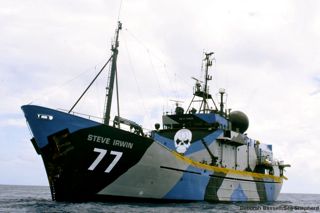
I have also stepped down as Captain of the Steve Irwin. Captain Siddharth Chakravarty of India is now in command of the Steve Irwin. The other three Captains are citizens of Sweden, France and Australia.

As a United States citizen, I will respect and comply with the ruling of the United States 9th District Court and will not violate the temporary injunction granted to the Institute for Cetacean Research.  I will participate as an observer within the boundaries established by the 9th Circuit Court of the United States.

Some people pick sides in the struggle between Japan's Institute of Cetacean Research and the Sea Sheperd Conservation Society. Don't be that guy, because the actual politics of either side of their issues have absolutely nothing to do with our interest in their disputes here at ID.

I have no idea how much money Japan's Institute of Cetacean Research is spending on their legal battle against the Sea Sheperd organization in the 9th Circuit court, but it is probably a lot. What have they accomplished? They basically turned Paul Watson into a living martyr, able to freely roam around the planet fundraising for more activities against Japanese whalers, but they haven't accomplished anything else.

And that is the key point here - Lawfare is going to be a fact of life for legitimate maritime NGOs that conduct any engaging activity at sea. However, I also expect that legitimate non-governmental organizations are going to be able shuffle resources around multiple countries under any number of Flags until they find a legal system supportive of their organizational goals - and by doing so avoid legal consequences solely by avoiding legal jurisdictions.

Until now Sea Sheperd has been the largest legitimate maritime NGO operating in the maritime shadow zones, but an even larger organization is about to step up and unlike the Sea Shepherd Conservation Society, these guys will be packing heat!
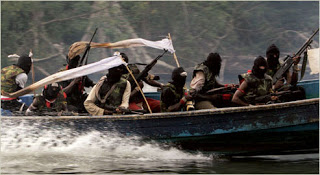
A private navy founded by businessmen, former marines, retired captains and soldiers will protect its first group of oil tankers and bulk carriers from pirates in the Indian Ocean in late March or April, according to Bloomberg Businessweek.

Typhon, a venture formed by a group of U.K. businessmen led by Glencore International’s Chairman Simon Murray, will recruit 240 former marines and sailors for its navy...

Typhon, the company behind the venture, is chaired by Simon Murray, a millionaire businessman who joined the French Foreign Legion as a teenager and walked unsupported to the South Pole aged 63.

Typhon has been set up because the Royal Navy, NATO and the European Union Naval Force lack the vessels to patrol an area of ocean that is as large as North America, said Anthony Sharp, chief executive. "They can't do the job because they haven't got the budget and deploying a billion-pound warship against six guys (pirates) with $500 of kit is not a very good use of the asset," he said.

Typhon said its aim is to deter pirates from attacking its convoys, rather than engaging in firefights.

The pirates will face former marines in armoured patrol boats capable of 40 knots and able to withstand incoming Kalashnikov fire. They will be armed with close-quarter battle weapons, such as the M4 carbine, and sniper rifles with a range of 2km.
Also worth noting this particular NGO is bringing it's own brand of political celebrity.
Other Typhon directors include Admiral Henry Ulrich, former commander of US Naval Forces Europe, General Sir Jack Deverell, former commander in chief Allied Forces Northern Europe, and Lord Dannatt, former chief of the general staff.
The last major commercial vessel hijacked off Somalia was MT Royal Grace, a Panama-flagged oil tanker owned by a UAE-based company that was hijacked on March 2, 2012.... 10 months ago! The last pirate attack on a commercial vessel came Saturday when a merchant vessel was able to repel an attack when USS Halyburton (FFG 40) responded and all pirates were rounded up by the French Frigate FS Surcouf (F 711).

Some are calling this a private Navy, but there is very little difference in modern international law between Typhon's private Navy and the Sea Shepherd Conservation Society. One organization is arming themselves with weapons like rancid butter and the other is using bullet proof fast boats armed with ex-Marines fielding M4s and sniper rifles.

But there is a big difference between Somali pirates and Japanese whalers, right? A more legitimate question is how different are Somali pirates and Somali fisherman?

There are a lot of people making a lot of money on the Japanese whaling industry. There are also a lot of people making a lot of money on the Somali piracy industry.

The Typhon private Navy is not something radical, although it also doesn't really have a lot in common with the 19th century articles of marque either, despite the appearance of similarities. Typhon represents the next evolution of a maritime NGO setting up shop in the worlds most popular ungoverned maritime shadow zone. Over the next few years and in response to increased resource competitions offshore in greater frequency and intensity, organizations like the Sea Shepherd Conservation Society that are engaged in political activism and organizations like Typhon that are engaged in armed maritime security are going to become more common as global naval power trends towards more expensive, less numerous high end capability combat platforms that will almost certainly leave huge gaps in global maritime naval coverage necessary for good governance at sea.

With no unified ruleset governing the laws of the maritime domain, we should only expect these early examples to be carried forward as precedents. What does an armed fishery protection NGO in the South China Sea look like five years from now, and could such an entity be the catalyst for a proxy war in the South China Sea? If I am the Japanese government and I'm looking for a way of disrupting Chinese fishing vessels operating in my EEZ, I'm not sure why I wouldn't be looking at exactly this type of low cost, unofficial solution. When naval power lacks the strength, authority, or interest to enforce maritime security, alternatives will and are emerging, and I do wonder if the ruleset we are allowing to be set forth by others is actually in our long term national interest. The maritime NGO was an issue easy to ignore when it was the Sea Sheperd hippies, but now we are seeing a well funded, armed maritime NGO with significant political ties to major maritime nations.

I have no idea how maritime NGOs will continue to evolve, but one thing I am sure of... I won't be surprised the day Henry Ulrich is specifically named in some lawsuit in a US court in the future related to the murder of an AK-47 wielding Somali fisherman off the coast of Somalia, because when it comes to legitimate maritime NGOs, Lawfare is one of many expected consequences.


Additional Notes:

Midrats will be having a three year anniversary special this Sunday. I look forward to it.
The legal troubles for Paul Watson are bigger than simply the 9th circuit ruling. If that topic interests you, this link probably will too (PDF).
More on the Sea Sheperd here and here.

Tuesday, May 17, 2024

No-Fly Zone Exceptions?

One thing I don't quite understand...
The territorial waters off Libya are a declared a no-fly zone by NATO, which means there will be a distinct absence of poaching surveillance in the region. NATO is not interested in illegal fishing operations, and no European Union or International Commission for the Conservation of Atlantic Tunas (ICCAT) inspectors will be allowed into the Libyan zone.

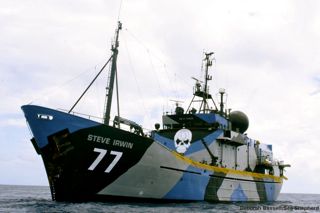
The Greenpeace Foundation is not conducting a bluefin tuna campaign, meaning that the only protection for the highly endangered bluefin tuna will be at the presence of two Sea Shepherd’s vessels: the flagship Steve Irwin and the soon to be renamed fast interceptor vessel. The only non-military aircraft in this zone will be Sea Shepherd’s helicopter the Nancy Burnet onboard the Steve Irwin.
If the UN no-fly zone extends of Libyan waters, and the Sea Shepherd Conservation Society is flying their helicopter, doesn't that make the helicopter in violation of the no-fly zone?

With all the littoral warfare we have seen in Libyan territorial waters, I think Sea Shepherd is in danger of getting in way over their heads. Not only is it a bad idea to stroll in unarmed during a gunfight, but how is it the Sea Shepherd Conversation Society can fly a helicopter in a UN mandated no-fly zone but no aircraft from the European Union or International Commission for the Conservation of Atlantic Tunas (ICCAT) inspectors will be allowed into the Libyan zone?

This sets up a awkward scenario where some hot shot pilot from Qatar or UAE starts an international incident with an air-to-air kill legal under the UN resolution.

Worth noting, a NGO is adding a new element to a modern maritime battlefield, and that element can be exploited tactically to kill people. The Sea Shepherd Conservation Society appears to be unaware of how the fog of war has a history of winning in the littoral, and no amount of new technology has changed that reality.

Wednesday, December 28, 2024

Open Source Maritime UAVs and the Evolution of a Non-State Navy


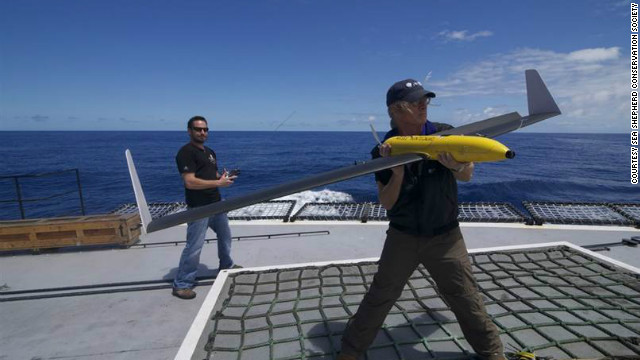
The Sea Shepherds continue their campaign against Japanese whaling “research” vessels this Antarctic summer. New this year are enhanced ISR capabilities,with the introduction of two hand-launched UAVs. One of the Osprey UAVs, named after the Jerseylicious daughter of the recycling mogul who donated it, has already been deployed successfully against the whaling fleet.

The UAVs, roughly modeled after the proven Scan Eagle design, were developed by a small company in Wichita, Kansas. Performance stats on this SUAS aren’t available, but a range estimate of less than 100 miles is likely, given indications of 1-2 hour endurance and 75 MPH speed on various websites. The system flies with a commercially available $2300 GPS-enabled autopilot, but video and telemetry transmission limitations probably result in a much shorter working range (only 10KM from the ship by one source), resulting in an overall range much less than Bob Barker’s embarked Hughes MD500 helo. Still, the increased sensor height greatly extends the ship’s ability to scout for the Japanese whalers when the helo isn’t flying due to crew rest or weather issues. The Ospreys provide the Sea Shepherds with full motion HD video or digital stills and the website’s reference to “detection equipment” may refer to some sort of SIGINT/radio detection payload. These sorts of smallish drones tend to crash frequently for various reasons, especially when flown by inexperienced operators, so we should expect this year’s use of UAVs to be short-lived unless additional spares become available.

The adoption of much more sophisticated (and expensive) ship-launched UAVs such as the Scan Eagle or Siebel S-100 would be needed to really take the Sea Shepherd’s airborne scouting capabilities to the next level. Though given readily available and inexpensive R/C aircraft turned open-source naval UAS such as the Osprey, other non-state maritime actors, many of which are less-benign in intent than the SSCS, may soon adopt UAVs as reconnaissance tools for terror attacks or to avoid navies conducting counter-smuggling operations.

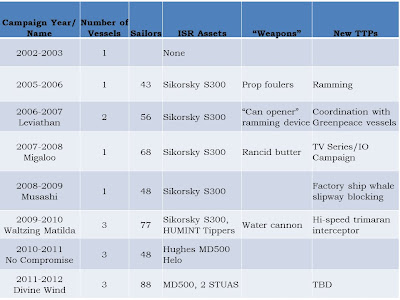
ISR improvements are just one component of the Sea Shepherd’s evolution. The table below (compiled from various web sources) is an attempt to illustrate the changing nature of Sea Shepherd’s capabilities over the past eight anti-whaling campaigns in the Southern Ocean. Note, SSCS’s history dates back much further from the 1970s, and the organization has been involved in many other sea-life defense campaigns, but the annual “Whale Wars” remain their most highly publicized effort.


Also noteworthy are the Japanese whalers' evolving tactics, which include smoke screens, stun grenades, ramming, water cannon, LRADs, and their own information operations campaign.

The opinions and views expressed in this post are those of the author alone and are presented in his personal capacity. They do not necessarily represent the views of U.S. Department of Defense, the US Navy, or any other agency.

Monday, July 29, 2024

Piracy, Privateering, and Para-Navies

Puntland’s pirate gangs have run out of luck lately with practically no successful attacks on the now well-defended merchants plying the Indian Ocean.  So like many of their free-booting predecessors who evolved by necessity when the hunting dried up, Somali pirates have shifted to the protection racket.  This opportunistic tactic has been part and parcel of pirates for hundreds of years. In the early 18th Century, pirates off America’s Gulf coast such as the Laffite brothers rotated frequently between piracy, smuggling, spying for profit, and privateering, sometimes playing states against each other while working multiple angles simultaneously depending what enterprise was most lucrative. 

Pirates, Para-Navy, or Activists?

Claude Berube and I recently wrote about another sort of maritime non-state actor which I’ve discussed here extensively - the Sea Shepherd Conservation Society (SSCS).  SSCS’s “direct action” fleet has slowly increased in ships and tonnage each of the past several years, earning the title among its supporters of “Neptune’s Navy.”  Interestingly, a component of SSCS' environmental portfolio includes a fisheries enforcement "out-sourcing" function, which has proven a successful in Ecuador.  While maybe not as aggressive as SSCS, other maritime non-profits such as ShadowView (run by a former SSCS sailor) have begun to outsource their services.  Are these models much different than privateers or their more modern equivalents, maritime private security companies?  The discussion on our article among the online environmental activism and commercial shipping communities rather predictably aligns with the two polar reactions many seem to have towards SSCS: either savior of world’s cetaceans or scourge of the seas.  Perhaps a more useful perspective, at least from the naval point of view, is to study SSCS as a model that future more nefarious groups will likely emulate.

Claude and I contend that as navies around the world - including the United States Navy - shrink, these non-state maritime actors, or “para-navies” will expand to fill the vacuum at sea.  In some cases, such as Sea Shepherd, motives of non-state actors will appear noble, while other para-navies will be driven by rebellion, ideology, or simply greed.  All of them will challenge state navies and coast guards for the monopoly of violence on the water.  Much like their land-based terror and insurgent counter-parts, these entrepreneurial, adaptive organizations tend to confound traditional naval analysts who are more comfortable studying orders of battle and tactics similar to their own modern navies.  Accordingly, as we recommend in the Small Wars Journal article, organizations such as Sea Shepherd can provide a better lens through which emerging para-navies can be understood.

The opinions and views expressed in this post are those of the author alone and are presented in his personal capacity.

Sunday, November 29, 2024

Public-Private Partnerships at Sea - in Fact & Fiction

Though we generally try to distill naval operations down to their simplest binary terms - fleet versus fleet - maritime operations in both peacetime and in war are more complex endeavors. Today and throughout history, contractors, mercenaries, and other non-governmental entities have played more of a role in maritime security on the high seas than most navalists would like to admit.  Some of these arrangements are contractual and sanctioned by legitimate government entities, some of them are ad hoc, and some operate on legally murky waters.  Some are based mutual economic benefits, but many are designed to enhance security.

Public-private partnerships, as they are sometimes called, are making a difference at sea across the globe.  Especially in Africa, there are numerous recent examples encompassing both for profit and non-profit organizations. In South Africa, Operation Phakisa brings together teams from government, business, academia and other sectors to accelerate the economic benefit stemming from marine transport and manufacturing, offshore oil and gas exploration, and aquaculture, while protecting marine resources.
In the Gulf of Guinea, the Nigerian Maritime Administration and Safety Agency (NIMASA) and the Nigerian Navy recently entered into a Public Private Partnership with a company for the supply, maintenance and bunkering of vessels. The vessels will be manned by the personnel of the Nigerian Navy on a Supply, Operate and Transfer (SOT) basis for a 10 year period after which ownership of the vessels will revert to NIMASA.   Also in the Eastern Atlantic, last year, the Sea Shepherd Conservation Society supplied a ship, fuel, and crew to conduct law enforcement patrols under the direction of the Government of Senegal’s Ministry of Fisheries.  Operation Sunu Gaal, as it was called, focused on investigating and intercepting vessels involved in illegal shark, tuna, and sword-fishing.
In the Mediterranean, the United Nations High Commissioner for Refugees has established a contact group with officials from Libya’s Coastguard, the Port Security Department, the Directorate for Combating Illegal Migration, the Red Crescent, the International Red Cross, the International Medical Corps, and the EU border management agency, to improve coordination and communication between the Libyans and international actors participating in maritime rescue.

On a related note, the success of the Migrant Offshore Aid Station’s rescue campaign in the Mediterranean has allowed the organization to secure the funds that it needs to become a global organization.  MOAS has rescued nearly 12,000 migrants at sea with its ship and state-of-the art unmanned air vehicles provided by a corporate donor and will expand into Southeast Asian waters. These pseudo-Coast Guards and Para-navies see themselves as filling a maritime security gap and that is exactly the way governments should view them.   

Claude Berube is one of the handful of experts who speaks from a position of knowledge on maritime non-state actors such as those discussed above.  Though he's written non-fiction works on how private security companies and emerging maritime activists are shaping today's maritime security arena, it's his novels, including the newly released Syren's Song, that give a glimpse of how future wars at sea might resurrect the chaotic 19th Century era of privateers and pirates.
Berube continues to perfect his craft in this novel, the second of his Connor Stark series.  The characters are deeper, and the settings more vivid than in The Aden Effect, but the non-stop action at sea continues. In the book, a resurgent off-shoot of the Tamil Tigers allies itself with a shadowy multinational corporation to threaten a motley assembly of U.S. Navy and private maritime security vessels.  The choice of antagonist is fitting, given that the Sea Tigers represent one of the most lethally effective insurgent naval branches in recent history.  
A critical plot enabler in the book is the letter of marque that the Sri Lankan government issues to Stark's security firm to investigate the Sea Tigers.  Though this arrangement may seem far-fetched or antiquated to some readers*, the reality is there are many contemporary examples of contractors performing similar roles for Western militaries.  Contractors fly manned and unmanned surveillance assets overland and at at sea, for several countries, including the United States. These arrangements are perfectly legitimate, but generally not well publicized and understood.

Syren's Song is an entertaining read for those who enjoy geopolitical thrillers.  The novel reinforces an important point: our adversaries exploit their own collaborative networks of commercial interests - both legal and illegal - to meet their objectives. Conversely, modern navies should recognize that public-private partnerships in their many forms are a tool that can augment and enhance their fleets while filling maritime security gaps in countries that have neither the will, nor capacity to police their own waters.

*Letters of Marque were generally outlawed in 1856 by the Declaration of Paris, but continued for some time, especially during the US. Civil War.

Sunday, August 5, 2024

Sea Shepherds’ Expanding Fleet and the Militarization of Maritime Eco-activism

Could this be the Sea Shepherd's new ship?
As their leader flees to an undisclosed location from his house arrest in Germany, the Sea Shepherds have begun fitting out a new addition to their fleet, courtesy of a generous donation from cartoon king, Sam Simon.    Captain Paul Watson notes that the identity of this new ship, a former German government-owned vessel is “classified,” although we know she will be named after her donor.  According to another article, the ship is a former German icebreaker.  From this source, the ship is likely the ex-East German Stephan Jantzen.  Although slow, the ship would bring the ice hardening and endurance to make it useful in Antarctic waters.  And with modifications, the ship could carry a second helicopter, which according to Watson, will enhance the fleet's scouting capabilities.  Another possible candidate - my guess - is this former North Sea search and research vessel, which features a helo deck, a stern ramp for rapid launch of a RHIB, and a powerful fighter fighting system for "offensive" use against the Japanese whalers. We will have to wait until the next Southern Ocean counter-whaling campaign kicks of to find out for sure.


Season 5 of Whale Wars, a key element of SSCS' clever media campaign, wrapped up earlier this summer.  I only watched a couple of episodes, but it seemed that the level of aggression and potential for injury had increased on both the side of the Shepherds and the Japanese.  This escalation is a natural progression in this sort of direct action campaign, and not only drives cable ratings (and donations to the cause), but results in each side innovating and improving their TTPs. 

Paul Watson isn't only conservationist busy this summer acquiring new vessels.  Former SSCS Ady Gil Skipper Pete Bethune is expanding his organization’s own portfolio and fleet.  What is most interesting from an irregular warfare perspective is the way that Bethune, who is currently in a legal kerfuffle with Watson, portrays his organization.  His website discusses their testing of a FLIR-equipped  "amphibious assault craft," a new UAV (see previous posts here on Sea Shepherd's pioneering use of unmanned aircraft), and the use of combat-experienced advisors.  Also note the crews sporting aquaflauge in the UAV test video below.


"Pete Bethune, who will captain ‘Sealegs’, brought in several members of his unit who have served in the US Navy Seals to help develop the craft. "These guys have been in many maritime combat situations, and they were invaluable in developing the vessel to make it tactically more effective. We changed the vessel layout, the masthead, the electronics, levels of redundancy. The result is a real beast that we believe sets a new benchmark for amphibious assault vessels."
These developments appear to reflect the growing militarization in language, tactics, and equipment, of maritime eco-activists.  By my count -- with Greenpeace, SSCS, and Earthrace -- three maritime conservation organizations are now involved with direct action.   In spite of their well-intentioned motivations, one of the many features these groups have in common with terrorist groups is that they adapt and often splinter-off from each other.  To wit, SSCS founder Paul Watson broke off from Greenpeace as he felt they weren't aggressive enough and now Bethune is taking Oceanrace in his own direction.  The line between these conservation organizations and non-state maritime actors with more malign intentions will likely continue to blur. 
The opinions and views expressed in this post are those of the author alone and are presented in his personal capacity. They do not necessarily represent the views of U.S. Department of Defense, the US Navy, or any other agency.

Friday, March 16, 2024

Sea Shepherds Wrap Another Successful Campaign

Sea Shepherd appears to have executed another successful anti-whaling campaign in the Southern Ocean. "Japan's Fisheries Agency said the fleet was on its way home from the Antarctic 'on schedule', but admitted that at 267 the catch was way down on expectations. Whalers killed 266 minke whales and one fin whale, the agency said, well below the approximately 900 they had been aiming for when they left Japan in December." The Agency official goes on to blame bad weather and "sabotage acts by activists," as the reason for the lower than expected haul.

At USNI's blog, LCDR Claude Berube, a Naval Academy professor and one of the subject matter experts on non-state maritime actors, has posted an interesting interview with former Navy Surface Warfare Officer and Sea Shepherd sailor, Jane Taylor. If you want to understand what motivates these activists to risk their lives for animals, the video is worth a watch.
A few weeks ago, I was privileged to have an opportunity to talk a bit about Sea Shepherds and other maritime IW issues with Claude's Capstone class and brief another group of bright Midshipmen and faculty at the Forum on Emerging and Irregular Warfare Studies. One of the students there asked me something along the lines of how the SSCS could continue to be so operationally incompetent. As we've discussed here before, their tactics are controversial and direct actions like throwing rancid butter might seem largely ineffective when viewed through the lens of Whale Wars. But my response to this Mid was basically to say that it is quite possible to fail at the tactical level while still meeting a campaign's operational or strategic objectives. Sea Shepherds have demonstrated that truism time after time. Of course in warfare, the opposite situation is also possible. In places like Afghanistan, our ground forces often execute brilliantly, but the results don't materialize because of strategic factors that are beyond the control of even the highest level military officers working the problems.

Regardless of what you think of their methods or motivation, SSCS provides the most transparent case study in non-state maritime actors today. As I told Claude's students, it is worthwhile to pursue an understanding of the way these NSMA's operate because many of them -- Al Qaeda, LeT, pirates, and narco-traffickers, to name a few -- have more nefarious motivations than saving the whales and pose direct risks to global security and the maritime economy.

The opinions and views expressed in this post are those of the author alone and are presented in his personal capacity. They do not necessarily represent the views of U.S. Department of Defense, the US Navy, or any other agency.

Friday, May 13, 2024

Sea Hippies Update

We've discussed them here several times before. Regardless of one's opinion on their cause or tactics, the Sea Shepards represent the 21st Century archetypical non-state maritime actor and their persistence and adaptability is admirable. In their own words, the Sea Shepards are rolling out “new campaigns, new ideas, new strategies, new tactics, and new colors. Sea Shepherd Conservation Society is constantly evolving and changing to address the changing issues and problems threatening our oceans.”

Steve Irwin sports a new dazzle style naval camouflage scheme which apparently helped them evade pirates off HOA. These colors would also seem to provide some value as they stalk sea poachers in future campaigns, including their upcoming adventure to stop tuna poachers off Libya (note: you might want to find a safer place to save the chicken of the sea given yesterday's MLRS launches against HMS Liverpool.)

Many naval officers and analysts discount (or just ignore) emerging non-state maritime actors to focus on the easier to understand and more traditional naval threats such as the PLAN. But to do so misses the fact that a large portion of the fleet is currently deployed fighting pirates, drug traffickers, and terrorists and will be for the foreseeable future. More importantly, writing off nascent irregular navies (Hamas, Hezbollah, and AMC, to name a few) who are rapidly learning the value of sea control and adaptability is a recipe for future disaster.


The opinions and views expressed in this post are those of the author alone and are presented in his personal capacity. They do not necessarily represent the views of U.S. Department of Defense, the US Navy, or any other agency.

Wednesday, June 8, 2024

Libya Maritime Updates

Libya ops continue to provide an interesting spectrum of maritime issues for discussion.

Continued Sea Denial Threats
Although ineffective, these rocket attacks are something that shouldn't be ignored. Regime small boat infiltrations warrant concern too and reveal NATO ISR gaps.

Hundreds Lost at Sea
In what is undoubtably the most underreported and ignored story of this conflict, an estimated 1,500 migrants have perished at sea fleeing Libya since March. These refugees present a challenge to the limited coalition naval forces involved which have a myriad of other issues to worry about. But given that a much smaller number civilian deaths ashore was the impetus for the bombing campaign driving these refugees afloat, it would seem that NATO is failing short in its mandate to protect the lives of innocents. And where is the IO campaign (as was done in Haiti during the earthquakes last year) to prevent refugees from taking to sea?

Sea Shepherd Campaign Blue Rage 2011
SS mixes it up with French purse seiners off of Tripoli. The coordination with NATO appears to be going well -- no blue on greenie incidents, at least -- and the campaign will continue until the tuna season ends in mid-June.

Rotary Wing Attacks Continue
What’s interesting here is the use of a naval helo for targeting support on the Sunday Brega attacks. “Two Apaches, with a Sea King 7 helicopter providing intelligence, destroyed a multi-barrelled rocket launcher mounted on a truck and placed in an abandoned building.” Are HSC det helos not allowed to play?

The opinions and views expressed in this post are those of the author alone and are presented in his personal capacity. They do not necessarily represent the views of U.S. Department of Defense, the US Navy, or any other agency.

Saturday, March 22, 2024

The SOFification of Maritime Activism

Claude Berube and I have written quite a bit about maritime non-state actors; in particular on Sea Shepherd Conservation Society’s growing para-navy.  Most non-state actors, be they maritime activists or Salafist jihadists, will undergo a rather predictable life cycle, where the level of violence in their operations continually escalates in order to compete with one another for attention and funding.  Eventually, the organizations will splinter, with more hard-core and entrepreneurial members going their own way to build an organization that reflects their level of energy or ideology.  The cycle has happened over and over in al Qaeda’s affiliates, from Iraq to the Maghreb.  And this sort of spin-off is exactly how SSCS was formed in 1977 when Captain Paul Watson broke away from Greenpeace.
Throughout history, but especially in the latter half of the 20th Century, various militaries around the world formed dedicated units who were selected, trained, and equipped at a higher standard than their conventional forces.  These elite teams are relied on to perform complex missions generally requiring discrete operational footprints to include surgical raids or special warfare.  Today, we’re seeing the same progression in maritime activism. Two spin-off groups from Sea Shepherd have recently demonstrated a rather remarkable evolution in eco-activism. In the trailer for his new television show, Pete Bethune, who is infamous for skippering the trimaran that was cut in half by a Japanese Whaler, leads his group of former military Earthrace Conservation volunteers performing “direct action” missions on behalf of wildlife around the world. 

 
Although I’m sure there is quite a bit of marketing hyperbole in the trailer, the way the team is kitted out, from the multi-cams to the use of small tactical unmanned air systems, rebreathers, and night vision demonstrates that they are attempting to emulate a naval special operations force. Now don’t get me wrong, a considerable gap in capability exists between Earthrace and say our own SEALs and Special Warfare Combatant Crewman. But they are clearly a more specialized and elite organization than SSCS which resembles a small state-sponsored naval fleet.

Perhaps an even more interesting development occurred 15 March, when former Dutch policeman and SSCS sailor Laurens de Groot’s Shadowview UAV operations team assisted rangers in Kruger National Park South Africa in tracking and killing a rhino poacher.  This type of operation is representative of the pinnacle of foreign internal defense missions to US special operators.  The exact same sort of high-end advise and assist missions where US technical assistance and ISR support enables our foreign partners to capture or kill terrorists are the ultimate objective of many of USSOCOM’s current activities.

What is driving this sort of sophisticated maritime activism? First, there is a vacuum in wildlife protection and law enforcement capability all over the world.  On the maritime side, illegal fishing is taking a huge toll not only in the marine ecosystem, but in the economies of coastal countries, especially in Africa. Africa’s coasts are, for the most part wild and ungoverned places.  Governments there are either too poor, too corrupt, or too complacent to police their own waters.  As an aside, there is an expanding nexus between wild-life poaching in Africa and violent extremist, insurgent, and criminal groups.  For example, it is fairly commonly accepted that Josephy Kony’s LRA guerrillas are sustained in some part by the ivory trade.  More specific to the marine environment are rumors of a trade-based money laundering scheme taking place between illegal shark-finners and narcotics precursors moving into Southern Africa from China.  Back on point, the emergence of specialized private activist groups to fill the gap or assist African countries in protecting their wildlife is as natural as the emergence of embarked armed private security contractors who were hired by shipping companies when multi-national naval forces failed to adequately neutralize Somali piracy. 
Approximately 73 million sharks are killed each year
exclusively for their fins. Photo: Gunther Deichmann

The second factor enabling a SOF-like capability in maritime non-state actors is simply the availability and affordability of dual-use technology. “Drones” providing an airborne reconnaissance capability that only a decade ago would have required manned aircraft and highly trained pilots costing hundreds of thousands of dollars are now available widely and cheaply online.  Regardless of the lower barriers of entry into military-quality surveillance tools, the skill and dedication of groups like Shadowview should not be over-looked and plays the lion’s share in their success. The same dynamics driving maritime activists to become more SOF-like will support the continued development of much more elite and dangerous violent extremists groups and transnational criminal organizations. We ignore them at our peril. 


The opinions in this post are the author's alone, and not representative of the US Navy or any other organization.

Sunday, February 3, 2024

Sea Shepherd's Southern Ocean Armada

The Sea Shepherd's 9th Southern Ocean Campaign - "Zero Tolerance" - is in full swing. To date, the reported highlights in this year's operations have only involved some strategic maneuver, a bit of deception, and lawfare.  Even so, the photograph above is fairly remarkable in that a non-state actor has privately assembled a maritime force of ocean-going ships, helicopters, and UAVs, sailed it once again into unforgiving Antarctic waters, and taken a photograph in a formation normally seen only with mainstream navies. Stay tuned.

The opinions and views expressed in this post are those of the author alone and are presented in his personal capacity. They do not necessarily represent the views of U.S. Department of Defense, the US Navy, or any other agency.

Sunday, December 2, 2024

The Most Wonderful Time of the Year

The air is crisp and the skies at night are aglow with millions of stars.  Spirits are high with anticipation for the coming season.  No, I'm not taking about the holidays, I'm referring to the impending kick-off of the Sea Shepherd Conservation Society's (SSCS) Southern Ocean counter-whaling season.  Many of those who follow the group see SSCS campaigns as not simply eco-activism, but as a living laboratory for the study of modern irregular warfare at sea.

This year's Antarctic campaign, dubbed "Operation Zero Tolerance," will be SSCS' largest ever in terms of fleet size and capability.  The fleet includes four ships, a helicopter, eight RHIB’s, three UAVs, and more than 120 international volunteer sailors.  SSCS has acquired a southern operating base at Seaworks, Williamstown near Melbourne, Australia.  Undoubtably, the campaign will also feature new tactics.

Guess #2 - Is this Sam Simon?
The Sea Shepherds have routinely integrated elements of operational and tactical deception to their campaigns.  Earlier this year, I made the mistake of taking SSCS press releases at face value and guessed that the new addition to their fleet was a former ice-breaker of German origin.  Rumors now abound that the SSCS were likely engaging in a disinformation dissemination campaign.  The new ship, named SSS Sam Simon, is likely actually the former KAIKO MARU NO. 8, a 56 meter survey vessel built in Japan in 1993 (see matching IMO numbers here).  In late November, the ship was renamed from "New Atlantis" and flagged to Tuvalu while inport Brisbane.   Reflagging and renaming ships has been a regular tactic of smugglers, pirates, and other groups trying to lay low at sea for as long as there have been ships.  This will be an interesting season to be sure.

MTF.

The opinions and views expressed in this post are those of the author alone and are presented in his personal capacity. They do not necessarily represent the views of U.S. Department of Defense, the US Navy, or any other agency.

Friday, December 30, 2024

More Sea Hippies and DIY UAVs

Bit of an update on the Sea Shepherds post. First, nix one high speed vessel from the fleet. Having a high speed intercept ship such as Brigitte Bardot or the former Ady Gil in the fleet makes a lot of operational sense, but running a 35 meter trimaran at speed in 6 meter seas, probably doesn’t so much.

Second, the post responses on this topic always amaze me. It is interesting how one non-governmental organization can be characterized in the comments by terms varying as widely as maritime eco-terrorist organization, vigilante group, hippies, and fishery enforcers.

Additionally, I’ve been corresponding with Jimmy Prouty, the creator of the Osprey UAS, who provided some corrections on my posted assumptions and additional information on his equipment. Some of the Osprey’s specs are competition sensitive and not readily available except to clients, but there are some interesting tidbits shown in the email excerpts below:


First, the Osprey is not at all modeled after the Scan Eagle. It is an optimized airframe with a high aspect ratio wing designed for maximum efficiency and range and it's similarity with the Scan Eagle is only that it has a long wing and round fuselage.


For the most part, all of our aircraft are designed as airframes that can be adapted to any number of uses. While videography and vertical photography are the most popular uses we also have them being employed in nuclear/biological/chemical detection system test that would detect those agent in the event of a spill/disaster.


We also do custom airframe development and are currently working on three new designs of various sizes and capabilities. The Osprey has proven to be a very capable airframe and has seen a great deal of use in various areas including the development of cooperative soaring where two aircraft search for thermal lift and communicate the conditions with each other. The Osprey’s design lets it turn off the motor and circle autonomously in lift, conserving the main battery and greatly extending its range. A good example of this in nature is the sand hill crane - it thermals up to high altitude and then glides off looking for its next thermal during its migration. [Ed note: I’m not sure if there are many thermals in the Southern Ocean, but this is certainly a useful capability for a STUAS]


We work with clients to get them the range that they desire as we did with the Sea Shepherd. Advancing technology in Power systems (batteries, motors, etc) is really letting is stretch our legs. Low cost, reliable autopilots such as the AttoPilot have matured and become extremely reliable to the point that we can duplicate flight paths within 1 square meter accuracy while still being able to reroute ourflightpath or call the plane home with the click of a mouse. EO payloads are also evolving rapidly and have a lot of great use.


Third, your assumption on the range of the video system are also off base. There are commercially available units that will provide excellent video reception well beyond the the 10km are reported in your article. There are several hobbyists that fly 25+ miles via video goggles and they don't have access to the higher end video equipment that can be deployed our airframes. The system can also provide geo referencing to give GPS location for any picture or video that is shot during the flight for later review which doesn't require a video downlink.


One of the biggest benefits of companies such as ours is that we can produce a high quality product for general use at a very affordable price with absolutely no cost to the taxpayer. The majority of the major UAS manufacturers rely on government funding (DARPA etc.) to develop their products and then turn around and sell them to the taxpayer at greatly inflated prices. We’ve proven that we (small business) can do it for a minimal investment, provide a high quality, safe product, and get the consumer exactly what they want.


Hangar 18 has an interesting concept and I wish them well in their effort to commercialize affordable, yet tactically useful UAVs. STUAS of all types, including rotary wing platforms capable of launching from a vessel as small as a CB-90, are rapidly improving in performance and capability and will soon proliferate throughout the world's navies (and non-state navies).

The opinions and views expressed in this post are those of the author alone and are presented in his personal capacity. They do not necessarily represent the views of U.S. Department of Defense, the US Navy, or any other agency.

Friday, July 8, 2024

Israeli Soft Power Crushing Free Gaza Movement

Have you heard from the Gaza flotilla much lately? Probably not, unless you are looking for information. Gaza is 1.5 million people denied legitimacy for self-governance who are basically caged in by what can be described as prison walls on all sides. One would think this is one group of people that could find sympathy, particularly when the oppressor is Israel.

Nope! Not with friends like the Free Gaza Movement. Israel is putting on a soft power clinic in dealing with non-governmental organizations attempting to make political splashes from the shadow zones, and the whole world would be wise to learn from the approach Israel has taken against the second flotilla. Israel has turned the Gaza flotilla into a flotilla flop in a remarkably systematic way. This summary of events posted by Melanie Phillips on June 29th is a MUST READ.
Already, the number of flotillistas has been whittled down from 1500 to 350, and the number of boats from 15 to ten. Most of the credit should surely go to the Israeli activist law firm Shurat haDin which believes in bankrupting terrorism through a creative use of the law. Here are some of the legal challenges to the flotilla which Shurat HaDin has initiated with seismic effect.
  • It sent letters to all the maritime insurance companies in Europe and Turkey, warning them that if they provided the flotilla boats with insurance (a necessary component in the effort to smuggle contraband to the terrorists) that they themselves would be legally liable for any future terrorist attacks perpetrated by Hamas.
  • It filed an unprecedented lawsuit to seize the flotilla boats. The lawsuit was filed on behalf of an American terror victim injured by a Palestinian suicide bomber.
  • It sent warning letters to a French insurance company warning it not to insure a boat that was to be launched from Marseilles. The company accordingly decided not to provide the French boat with insurance.
  • After the main Turkish boat the Mavi Marmara pulled out of the flotilla, the New York Times reported that one reason (along with political pressure) was the boat’s inability to obtain maritime insurance.
  • It sent warning letters to the UK and US based global satellite company INMARSAT, stating that it might be liable for massive damages and criminal prosecution if it provided communication services to ships used by suspected terror organizations in the flotilla. Then a resident of the southern Israeli town of Sderot filed a legal suit asserting that, under US law, Inmarsat was aiding and abetting terrorism by providing satellite services to the flotilla vessels.
  • This week the New York Times reported that Greek authorities had detained two of the ships docked in Greece, including an American vessel, after Shurat haDin complained to the Greek Coast Guard suggesting that seven of the ships might be lacking insurance or were improperly registered.
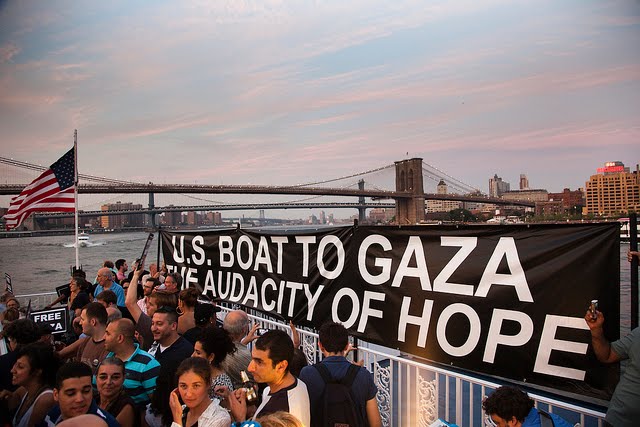
Since that post it has only steadily got worse for the flotilla as ship after ship has dropped out, including the US flagged Audacity of Hope which tried to leave port without permission and ended up with the vessels American Captain thrown into jail temporarily. Not surprisingly, the US State Department didn't help the flotilla folks when they ran into trouble in Greece.

Last year, on the same day that Israel took on the first flotilla directly with their hard power approach that ended in spectacular public political failure, LCDR Claude Berube published an article on the Small Wars Journal titled The Ship is the Visual, Even in the Shadow Zones. While the SWJ article focused on other non-governmental organizations like Sea Shepherd and Women on Waves (WoW), the article suggested a series of recommendations on how nations can confront non-state actors in the maritime domain to stay ahead of NGO political activities at sea. The article recommended an approach of Adapting, Adopting, and Adeptness.
First, opposition to these entities must mean adapting faster than them in operations and tactics. This will mean, in part, establishing ROEs that permit effective responses rather than restrict operations from achieving success... WoW, for example, encountered Dutch law when the government found that the license to carry the A-Portable did not mean that the organization had a license to convey abortion pills on a sailboat. Finding similar avenues for pirates or other entities might be as beneficial as remembering that the gangster Al Capone was not imprisoned for murder or violating prohibition laws - he was jailed for tax evasion.

Second, although U.S. interest groups may be averse to doing so, the Navy should adopt a more flexible and innovative force structure that, in addition to traditional warship might include less obvious commercial platforms...

Third, it must be adept in public relations at countering potential propaganda or challenges early and clearly. The battle plan, even in the maritime environment, must include the airwaves, or the 21st century equivalent. Winning the war of ideas will be as important for maritime incidents or potentially prolonged engagements in the littorals to get the message out.
Israel appears to have operationalized the Adapting, Adopting, and Adeptness model with the latest Gaza flotilla. As Melanie Phillips laid out, by targeting INMARSAT and maritime insurance companies with advisory letters ahead of the flotilla, Israel set the bar very high on the issue of compliance to law. Israel has essentially leveraged a lawfare model often effectively leveraged by NGOs against states back against the Free Gaza Movement. The media has frequently discussed the behind the scenes pressure by the United States and Israel, but they have been short on details regarding the pressure points. You see, the Israeli's and US are pressuring Europeans to rigidly enforce their own laws. That puts a lot of pressure on organizations like the Greek Coast Guard not to make any mistakes, and the resulting red tape is burying the flotilla every time a vessel makes port. Pardon me while I laugh that the most leveraged weapon by Israel against the flotilla so far is European government bureaucracy.

If you have been following the progress of the flotilla, you will note that every vessel in the flotilla has a tail. The Gaza flotilla folks are very smart to call those vessels "commando ships" and other usefully inciting terms, but in several cases they are glorified small yacht type vessels with Israeli monitors tracking the progress of each Free Gaza flotilla vessel. The US Navy could learn a lot from Israel in how to adopt a different force structure quickly to address low intensity threats to maritime security, like piracy. The international coalition can't afford enough warships to track all the pirate motherships while staying focused on other regional commitments, but the international coalition can afford much less expensive vessels that can perform the role of tracking motherships. Security forces that included Navy, Marines, and a CG representative could be spread around to provide defense for the many smaller vessels and would be more than sufficient security against pirates. The key point here is that Israel was willing to adopt a new force structure to meet the Free Gaza flotilla challenge. The US Navy has not, at any point in the 21st century that I can tell, demonstrated such nimble flexibility to make those kind of tactical adjustments to maritime security threats. Attention Congress - that IS a red flag.

Israel adeptness in the information domain is remarkable. On the diplomatic front, Israel has successfully made the case that at this time, there is no humanitarian "crisis" in Gaza - and this point has been reported in many media articles discussing the flotilla. Furthermore, Israel has publicly made clear that anyone who wants to provide supplies to Gaza can do so through Israeli and Egyptian land routes. Israel has emphasized the changes to the blockade policy made last year following the first flotilla, which is actually a clever approach because it suggests a public diplomacy message that Israel has already conceded to international demands on the blockade issue. Israel has also successfully framed the second flotilla as a provocation thanks to broad distribution of comments made by Adam Shapiro, co-founder of the International Solidarity Movement and a board member of the Free Gaza Movement. In the same article by Melanie Phillips quoted above, the video later in the article shows Mr. Shapiro saying this followed by applause.
Free Gaza is but one tactic of a larger strategy, to transform this conflict from one between Israel and the Palestinians, or Israel and the Arab world…to one between the rest of the world and Israel.
Adam Shapiro is clearly an idiot, because his comments have cleverly been used by those sympathetic to Israel to frame the perception of the second Gaza Flotilla as nothing more than a scam with alternative objectives to the stated objective of delivering humanitarian aid to Gaza. The Free Gaza flotilla isn't finding public sympathy except by people who are already sympathetic to Gaza, and only with new people actively engaged and sympathetic to the flotilla cause can the Free Gaza Movement win the media. Without gaining public support and sympathy high ground in the media, the Gaza flotilla is a failure.

The media coverage of the flotilla has been remarkably good in my opinion. As events unfolded, the media have been reporting on the activities of the Free Gaza movement, and because all of those activities have been setbacks to their objectives, there are no successes for the media to report. From the beginning, the objective of the flotilla as an action was the political message, and every message to date has made the Free Gaza movement look like clowns in a circus, and I think some of the frustration that is being posted online suggests that even people sympathetic to Gaza and opposed to the Israel blockade see the Free Gaza movement as clowns. The control by Israel of the information domain has been thoroughly demoralizing for the Free Gaza Movement, hitting their supporters harder and harder with each consecutive setback.

Consider how thoroughly Israel has whipped the Free Gaza movement... when the flotilla became a flop, many activists attempted a "Flytilla", which itself has been ineffective due to blocks by airline companies in Europe. What are the odds those airline companies have threatening letters from Israeli lawyers in hand? The "Flytilla" is such a flop on it's own that very few major newspapers have even bothered to report the stunt. Israel has so thoroughly dominated the Free Gaza Movements messaging that Israel now drives the narrative, and when Israel controls the narrative, that often means no broad media coverage for those competing in the information domain against Israel.

As information wars go, the humiliation of the Free Gaza movement by Israel has been a masterpiece of soft power strategic communications. There is a lot to learn here.

Tuesday, December 2, 2024

Send Them To Davy Jones... Maybe Not

Why don't we just arm up commercial ships and fight back? I've been reading several blogs associated with the maritime blogger community thinking maybe opinions are changing with all the piracy, but all indications are the idea of arming commercial ships remains unpopular despite all the piracy. For those armchair gunners who think putting force on ships is the answer, this is an interesting read.

Also interesting, Kennebec Captain notes that the incident the other day where the British security professionals abandoned ship when the Biscaglia was being taken by pirates has an interesting twist, the security folks were unarmed, but were using a LRAD. I guess it was not effective? LRAD is not a new system, it could be that pirates have adapted and it is losing its effectiveness

That really is part of the issue here. Firearms are not on commercial ships, and most captains don't want them on the ship because it can create more problems than it can solve. What happens when a ship fights back, kills someone, and pirates still hijack the ship? Will they seek revenge on a crew member? Think about all the legality issues here, if ships start fighting back, what happens when a Japanese whaler shoots someone from the Sea Shepherd Conservation Society during a TV scene? If I owned the Japanese Whaling Company under assault in that show, I'd sue both the organization and the Discovery channel itself for funding piracy, because the Discovery channel is clearly funding acts on that show that can be accurately described in Article 101 (PDF).

If pirates are now overcoming non-lethal means of piracy deterrence like LRAD, is arming up commercial shipping the next step? It is going to be very interesting to see what the EU does when their ships deploy, particularly with the Germans deploying so many troops, and it sure would be nice if we could get someone in the media to actually ask one of our elected officials about piracy.

It amazes me how so many political pundits in this country will spill ink discussing piracy, often without the slightest clue what the hell they are talking about, but these same folks don't seem to care our nations elected leaders have still not been required to answer a single question on the piracy issue, despite all the media attention. Am I the only person who thinks that is odd?