Showing posts with label Syria. Show all posts

Friday, April 7, 2024

Thoughts on Syrian Strike

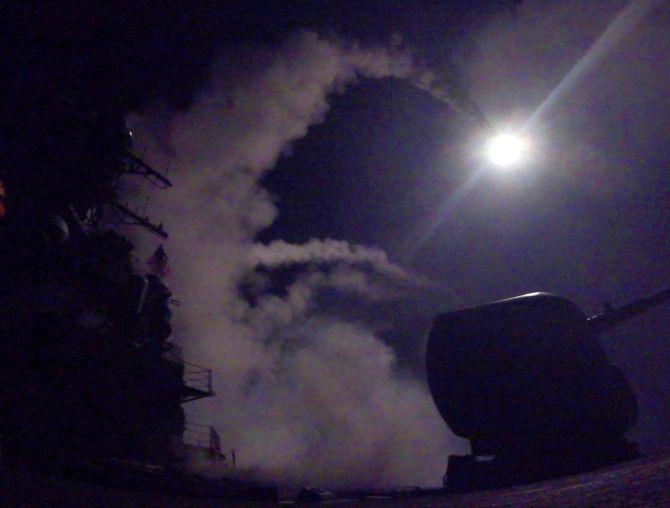
USS Porter launching cruise missiles towards Syria.

I watched Nikki Haley's speech in the UN on social media this morning, and I quickly realized two things:
  1. America was pissed off.
  2. The world was now aware America was pissed off.

If you haven't seen that video yet, the stare she gives the Russian ambassador makes it must see viewing. I was impressed.

When President Obama gave Syria a red line on chemical weapons back in 2013, and Assad crossed that red line, you may remember I was quite uncomfortable with how everything had gone down. I was uncomfortable with the President giving the red line, and I was uncomfortable with the idea the US would have to attack Syria. President Obama took a lot of criticism for addressing that incident in 2013 with diplomacy, but the United States ultimately removed a considerable amount of chemical weapons from Syria via MV Cape Ray and over time I came to appreciate the decision by President Obama. Until this past week, there had been no clear evidence of chemical weapons use by the Assad regime in Syria against civilians, including for the entire remainder of the Obama administration. In my mind, what President Obama did at the time was the right thing.

But when news broke about chemical weapons use in Syria this week, particularly in the context of what is happening on the Korean peninsula, in my mind President Trump had a very serious choice to make. He either attacked Syria for breaking their agreement with President Obama, or the United States retreated from the role as the leader of the global security construct the world has enjoyed since the end of the cold war.

Assad left Trump no choice, and actually gave the Trump administration exactly what they needed in many ways. The strike by the United States against Syria on Thursday checks multiple strategic boxes that needed to be checked given the checkered beginning of this Presidential administration. In one stroke, President Trump was able to:
  1. Support a policy championed by President Obama with a limited use of military force thereby proving that domestic political disagreements do not represent a weakness in US foreign policy.
  2. Send a clear signal of US resolve to the dictators globally like Bashar al-Assad and Kim Jong un that the US is not to be tested.
  3. Reassert US influence in a region of the world dominated by Russia at this point and time.
  4. Send a clear message to world powers like China, at a time Trump is meeting with Xi Jinping, that the US led by President Trump will use military force when forced to.
These are not small things. President Trump's action reinforces the security framework rule sets led by the United States that many, including myself, have been concerned that President Trump might not be willing to stand up for under his administration. I'm not really sure what actual tactical military impact 60 Tomahawk cruise missiles may or may not have had hitting some random targets in Syria, and my gut tells me the tactical impact is probably very little.

But sending 60 Tomahawks into Syria isn't about tactical effects, the way to measure this military action will be to observe strategic effects. I'm sure in the near future cable TV will find some political science mouth breather ready to do battle damage tactical assessments on use of Tomahawks as if the military action taken Thursday has something in common with trying to win some battle against Syria. Firing Tomahawks into Syria isn't about winning a battle though, it's about shaping the conduct of a war, which is a continuation of the policy set forth by President Obama specific to chemical weapons and a necessary escalation in response to Assad for challenging the agreement Syria made with the last administration.

Only time will tell if the strategic communication sent on Thursday was sufficient, or whether a new challenge to President Trump is forthcoming to test the US resolve on this issue.

As this event relates to naval strategic theory, I will be observing this event as an early test of the Trump administrations naval focused offshore balancing strategic theory. The ability to send an effective strategic communication with the execution of a tactical missile strike was a staple of both the Reagan and Clinton administrations, but both of those President's enjoyed a large US Navy capable of acting globally in massive force in response to any incident. Today's US Navy is significantly smaller than the Navy of those two Presidents, and while an Arleigh Burke class destroyer can send the initial volley of cruise missiles to send a strategic message, I am not as confident regarding how things might unfold if there was blow back from this type of military action.

Friday, September 27, 2024

Gunboat Diplomacy Prevails in Syria

RED SEA (Sept. 13, 2013) Ensign Timothy McDaniel prepares to anchor a ladder from the guided-missile destroyer USS Mason (DDG 87) to a rigid-hull inflatable boat during a visit from leadership of the guided-missile submarine USS Georgia (SSGN 729). Mason is deployed in support of maritime security operations and theater security cooperation efforts in the U.S. 5th Fleet area of responsibility. (U.S. Navy photo by Mass Communication Specialist 2nd Class Rob Aylward/Released)
Some pictures are worth a thousand words. This particular picture is worth more than a few thousand. But you have to combine the picture above with this picture to understand what it means.

These two pictures combined tell us something important: The President of the United States never intended to conduct military strikes against Syria in response to the chemical weapons attack that took place on August 21st. He was bluffing. The President was never playing chess, but he was never playing checkers either; President Obama was playing poker.

In early August, well before the chemical weapons incident on August 21st in the Ghouta suburb of Damascus, USS Georgia (SSGN 729) was conducting a crew swap in Diego Garcia. When the chemical weapons attack occurred in Syria, the guided missile submarine was back to sea underway for normal training and qualifications that typically occur right after the change out between blue/gold crews. As things heated up in Syria, the prevailing assumption at the time was that USS Georgia (SSGN 729) was likely sprinting around Africa on her way to the Mediterranean Sea.

The US Navy operates four Ohio class nuclear powered guided missile submarines that are, by any definition, the most powerful arsenals of stealth conventional warfare strike capabilities on the planet. Capable of launching over 150 Tomahawk cruise missiles, these incredible weapons of war are simultaneously one of the most difficult weapons in the US military to detect and from a range of over 900 miles away can launch over 300,000 pounds of explosives in about 6 minutes and hit a fixed target with precision no larger than 2 meters in diameter. As converted nuclear powered ballistic missile submarines, these enormous submarines - the size of World War II aircraft carriers - are extremely fast and extremely stealthy. By rounding the Cape of Good Horn a SSGN could depart Diego Garcia, circumvent Africa, and arrive off Cyprus in less than two weeks, and nobody in the world today besides us is postured to see the submarine coming.

Over the past few months, the Navy has been operating two SSGNs at sea ever since USS Flordia (SSGN 728) returned to Kings Bay, Ga in early July. USS Ohio (SSGN 726) has been at sea somewhere in the Pacific, while USS Michigan (SSGN 727) has been at home port over the late summer. That basically meant the only SSGN available for Syria was USS Georgia (SSGN 729), and the prevailing assumption in open source was that the submarines has been operating off the coast of Syria.

Apparently not.

The Invisible Arsenal Ship

In the news leading up to potential US strikes against Syria, a lot of reporting focused on the assembly of three, four, or five US destroyers operating at sea west of Cyprus. It is absolutely correct that these ships would have launched Tomahawk cruise missiles into Syria had a strike been ordered by the President, but they would likely not have fired the first shots. From an operational perspective, the US Navy has been facing a physics problem in regards to strikes against Syria, a physics problem that still exists today.

You can do this on pen and paper, or perhaps even design it out using a simulator like Command: Modern Air / Naval Operations, but consider a moment the physics of a naval strike against Syria by the US Navy that would have met the politically stated goals of meaningful action as put forth by the Obama administration when they were drumming up the likelihood of a military strike against Syria.

First, there can be no casualties or attrition, so all operations conducted must be done with prejudice in favor of protecting man and material. Second, target precision is critical to political success, so excess collateral damage would be avoided at all cost. Third, not only must targets be hit accurately, but quantity of force must be evident to make a political statement. Finally, military forces must conduct the strike while minimizing the potential for counterstrike.

This combination of factors meant several things. First, military analysts knew the US destroyers near Cyprus would need to participate in the strike, because their payload of Tomahawk cruise missiles would be required to add to the quantity of force necessary to make a political statement. However, to avoid counter attack by Syrian military forces, this combination of factors also informs us that the US destroyers would need to remain relatively near Cyprus for air defense purposes, meaning the destroyers would likely be positioned more than 300 nautical miles west of Damascus somewhere south or southwest of Cyprus. That makes the flight time of Tomahawk missiles to targets in Syria around 25-35 minutes depending upon flight path - longer if the flight path avoids Lebanon - which is plenty of time for Syria to put up an organized resistance against the cruise missile strike. It is a better than an average bet the Russians would know within seconds when the US destroyers launched their Tomahawks, giving them plenty of time to tip off the Syrians.

That is why the USS Georgia (SSGN 729) is so important to a small military campaign like the one that was being discussed for Syria. By design, the submarine can approach within a few miles of the Syrian coast by stealth, completely undetectable by Syria (and likely undetectable by all but one of the Russian warships offshore), and shower multiple targets with multiple cruise missiles in minutes that would actually be measured in seconds. In the first 10 minutes, a single US Navy SSGN like USS Georgia (SSGN 729) can, by design, put every ship of the Syrian Navy at the pier out of commission, destroy every fixed military radar on the Syrian coast, and put cruise missiles on every military runway south and west of Hamah. Having a SSGN on hand for a strike against Syria is the difference between the military of Syria having 120-600 seconds to defend the nation, and between 1500-2100 seconds to defend the nation. When communications are jammed, radars are going offline for no apparent reason, and the Russians start screaming "incoming" on the radio channels heard all over the region, the chaos created by a single SSGN can send a conscripted Army into panic.

Having a SSGN off Syria is, in my mind, the prerequisite for the American way of war when applied to the proposed Syrian military strike. Everyone assumed the SSGN was there. I wouldn't be surprised if even the Russians assumed the SSGN was there. What the picture at the top of this post tells us is that since the crew swap, USS Georgia (SSGN 729) has stayed in 5th Fleet, and has not at any time since the August 21 chemical attack been in the Mediterranean Sea. That means only two things, the President of the United States was bluffing on military strikes all along, and the decline of the US Navy is so astute right now the 6th Fleet is an empty shell and was never prepared for the war it was being asked to conduct.

In hindsight, it looks to me the political play in Syria was always a bluff, and yes we should also now admit to ourselves the 6th Fleet is an empty shell unprepared for even a strike against Syria.

Russian Chess vs Obama's Poker

Nothing about US political moves made any sense or conformed to any pattern, unless we evaluate what has happened in hindsight. President Obama has launched the United States into military operations in four different countries since becoming President, and his administration only announced one of those military operations ahead of time. When the US began conducting drone strikes in Pakistan, the Obama administration didn't tell anyone. The same is true for Yemen and Somalia. During the entire first term of his Presidency, when the Obama administration wanted  the opinion of Congress on the clandestine drone wars the administration was conducting, they basically told Congress what their opinion would be. They never asked, at least publicly. Libya was a different case, it was more a matter of supporting European allies than launching a new military campaign. The President never fully committed the US military to Libya in any way other than supporting allied objectives, and the results of Benghazi on 9/11/12 make it painfully obvious how little the US military was focused on Libya once military actions against Gaddafi concluded.

If the Obama administration is committed to using military force as a policy in dealing with another nation, history tells us they will not tell anyone about it until it has already happened.

Which is what makes the rhetoric regarding a strike against Syria curious. Not only did the US make it clear we intended to use military force, but Secretary of State John Kerry - America's top diplomat - was the primary warmonger in the press regarding the use of military force before the evidence supporting the use of military force was ever actually made public. That never made any sense to me at the time, but it makes sense in hindsight if diplomacy was always the political objective. In truth, military action of any kind never made any sense, because a combined cruise missile and airstrike by the US military supported by almost no allies, except France, was never likely to achieve a meaningful outcome, either tactically or strategically.

Even more odd, the President only went to Congress on Syria after Mr. Cameron was thoroughly defeated by the UK Parliament on the issue.

So in the moments before the diplomatic breakthrough with Russia, the United States had neither an aircraft carrier nor a SSGN in the Mediterranean Sea, meaning the United States was not positioned to attack Syria and was essentially conducting very loud, very threatening gunboat diplomacy with a very small force of US destroyers in the Mediterranean Sea. The President was trying very hard to get allies, like the UK, very serious about taking military action in Syria. That does make sense, because the UK actually has an aircraft carrier in the Mediterranean Sea. The President was even approaching Congress to impress upon the world his resolve for conducting a military strike against Syria.

Checkmate and a Pair of Deuces

Assuming the draft text of the UN resolution related to Syrian chemical weapons is the final wording in the resolution, and given the facts of the situation both in theater operationally and the political situation the President found himself in, the primary conclusion from recent events is that gunboat diplomacy worked, and worked quite well in fact.

The new UN resolution will correct a mistake made by the Obama administration, it does not issue a new invisible ink red line regarding the use of military force related to Syrian chemical weapons. The Obama administration, and by extension the United States, has been soundly defeated by the gunboat diplomacy of Russia. President Obama has been allowed to save face with a meaningless UN resolution that has no teeth at all, but given the circumstances the President was never in a position to expect more than this. The President's domestic policy agenda that has, in part, manifested in the form of sequestration of the Department of Defense, ultimately prevented the United States military from ever being able to assemble the necessary military force to achieve a meaningful tactical or strategic objective through military force in Syria, so the President never held anything better than a pair of deuces, and ultimately President Obama had little choice but to play the cards the President was dealt. I have to say, I think the President is getting more than I originally expected out of a pair of deuces.

As I have noted previously on the blog, the Russian naval force off Syria creates significant tactical and operational problems for the United States for using military force effectively in Syria. A launch of cruise missiles by destroyers at 300 nautical miles will be detected within seconds by the Russian naval force, and Syria will have nearly a half hour to defend against cruise missiles which really are not advanced enough to defeat a dedicated defense. The presence of the Russian Navy offshore makes the use of a SSGN close to Syria very dangerous, because within seconds of the first launch, there is nothing preventing Russia from telling the Syrian military exactly where the SSGN is. It is unclear if Syria could effectively detect much less successfully attack the US submarine, but the risk of successful detection and attack is significantly higher with the assistance of Russia.

On multiple occasions the Russians publicly admitted that they were sharing intelligence information with the military leadership in Syria. If Putin followed through and did exactly what they said they were going to do, and gave intelligence regarding the location of a US Navy submarine to Syria, and by some chance Syria was able to successfully sink a US submarine, President Obama would be politically sunk. There is a zero percent chance that the United States would go to war with Russia over Syria, no matter how extensive and compelling the evidence was that Russia had helped Syria cause the loss of life of a US submarine crew.

The forward presence of Russian naval forces in defense of Russian national interests has served for two years as a deterrence for military operations against Syria by Western powers, and in order for those conditions to change, a very large and capable multinational alliance with intent to use military force would need to be established for purposes of shifting the political risk balance of involvement against Russia. That very large and capable multinational alliance does not exist today.

I do not know what the political fall out will be. Whether the UN resolution on Syrian chemical weapons passes or not, the US still lacks a policy for how to deal with Syria. If we assume President Obama was always bluffing, and I do make that assumption, it would not appear he ever told Mr. Cameron. My sense is President Obama does not see Mr. Cameron as the same strong ally and friend that President Bush saw in Tony Blair. It is unclear if there will be a fallout between the two men, but the President never needs to reveal he was bluffing with a pair of deuces, even if it is obvious to anyone paying attention.

The inexperience of the Obama administration has been fully exposed by President Putin, and yet, I'm not sure the Russians knew that USS Georgia (SSGN 729) was not in the Mediterranean Sea. Putin could have guessed President Obama was bluffing about military strikes, but the fact that Russia was who ultimately reached out diplomatically suggests to me Putin was never truly convinced President Obama was bluffing. That is probably the smart move, after all, President Obama takes a very liberal approach when it comes to using US military force.

Finally, it is apparent to me that at some point very early on after the August 21st incident the President realized he was going to take a hit if he didn't conduct military strikes, and yet it is clear the President recognized that conducting military strikes against Assad was counter to US interests. Whether one assumes the President was bluffing or not, what we have learned is that President Obama ultimately chose to take a course of action in foreign policy that would serve US interests, regardless of the political consequences to him personally. The recent coalition of extremist forces in Syria among the rebel groups makes clear that until the moderate rebel organization is stronger, it is counter to US National Security interests for the Assad government to fall, even if that is a desired outcome.

Gunboat diplomacy was very effective for President Obama in avoiding an outright political disaster, and gunboat diplomacy ultimately, in my opinion, allowed Russia to achieve their strategic objectives through deterrence by protecting Syria from overt military intervention by western nations.

I have no idea if the Obama administration realizes that gunboat diplomacy, and naval diplomacy in general, is an effective way to conduct foreign policy in defense of national interests in the 21st century. It is unclear to me if the President even understands how gunboat diplomacy was so influential in this specific case. I assume nothing with this President anymore because one thing is very clear in the wake of the last month of foreign policy, the President's current national security team is inexperienced, lacks skill in the planning involved with statecraft, lacks the ability to develop long term strategic plans, and is prone to make mistakes. The President's national security team is populated with reactionaries, not visionaries.

I do, however, believe that President Putin understands very well the value of gunboat diplomacy and how it has helped Russia achieve a political victory with Syria. It is no accident Russia is now sending their Pacific Fleet flagship to the Gulf of Aden. This Russian naval deployment to the Middle East isn't about fighting pirates, it is about preparing the battlespace for the next round of political chess with the United States.

Chess > Poker.

Thursday, September 5, 2024

If It's Not "War," It Sounds Like Checkers


In his book On War, General Carl von Clausewitz explains that war "is controlled by its political object," which "will set its course, prescribe the scale of means and effort which is required, and makes its influence felt throughout down to the smallest operational detail." Over the last two days, John Kerry has insisted that "President Obama is not asking America to go to war." He even goes so far as to suggest that he, General Dempsey and Secretary of Defense Chuck Hagel "know the difference between going to war and what President Obama is requesting now."

Over the last two days John Kerry has made a terrible case for war against Syria to Congress. While seeking action by Congress under the War Powers act, John Kerry has argued forcefully that all definitions of war by experts of warfare throughout history are wrong, and his definition is right. Ryan Evans at War on the Rocks captured the moment when Kerry jumped the shark.
Later, a frustrated Kerry revealed the real logic behind his position: public opinion. He noted that no Americans wanted to go to war with Syria and insisted the White House was of the same mind. “We don’t want to go to war in Syria either!” he exclaimed.  “It’s not what we’re here to ask. The President is not asking you to go to war…He’s simply saying we need to take an action that can degrade the capacity of a man who has been willing to kill his own people by breaking a nearly hundred year-old prohibition [against chemical weapons].”

Then, turning to Dempsey, Kerry asked, “General, do you want to speak to that?”

Dempsey responded, “No, not really, Secretary, thank you for offering.” Why? Because General Dempsey knew that was nonsense.

Words matter, and when they are not allowed to matter in policy, we are not being honest with ourselves. Over the last two days John Kerry described the political object with Syria as "to deter, disrupt, prevent, and degrade the potential for, future uses of chemical weapons or other weapons of mass destruction" by the Assad regime in Syria. The Obama administration has apparently convinced itself that a Desert Fox Part II action in Syria will produce the desired result, apparently ignoring that Desert Fox was in part what led to the invasion of Iraq in 2003. I do not know any serious expert who believes the Obama administrations military approach to Syria will achieve a positive political object for the US.

The Obama administrations national security leadership, in Congressional testimony, is promoting a delusion regarding the act of war, and is incapable of admitting they are about to start a war. Most troubling, they are intentionally dismissing consequences and the gravity of such action under the assumption that military superiority translates to strategic success. The United States does not have a strategy that political leaders can articulate publicly on Syria, nor is the Obama administrations national security leadership publicly seeking meaningful military objectives of consequence to conditions in Syria. The United States does not have a coalition of support to provide legitimacy for military action, a coalition that protects the US from escalation or retaliation. John Kerry, in front of Congress, described those who believe it unwise for the US to inject our nation into another nations civil war uninvited, as armchair isolationists. No one knew for certain the intelligence cited by Colin Powell was wrong in 2003. Every human being educated on the definition of war knows John Kerry is wrong in 2013, and no one credible on the topic of war will ever be able to argue otherwise.

The arrogance of the Obama administration's national security team is a parade of red flags right through the halls of Congress. Secretary Kerry actually argues that if Assad is "arrogant" enough to defend himself that the US and our allies have ways to make him regret that decision, apparently without going to war. The arrogance of John Kerry implies the question to Congress, what could possibly go wrong? With no political policy or strategy that can be articulated publicly, no military objective of consequence, no coalition of consequence or authority, and by taking action that injects our nation into another nations civil war uninvited - my question is, how does this possibly end well?

The Obama administration is taking greater risk with Syria than their calculations suggest, and I truly believe the potential for a significant strategic defeat like nothing seen in at least a century is greater than the potential for success. The entire gambit by the Obama administration rests upon the starting assumption that Syria will do nothing and give the Obama administration exactly what they want. The other starting assumption is that Iran won't get involved or their involvement will be inconsequencial to our political objective. The problem with the first assumption is that John Kerry all but admitted in testimony over two days that while military strikes are not intended to achieve regime change, US policy is to build a working relationship over time with rebels for the intent of regime change. The problem with the second assumption is that Iran historically gets involved, and the chaos they created for Israel in 2006 and the chaos Iran created in Iraq and Afghanistan last decade was extremely effective in countering US political objectives. The starting assumption should be Assad will resist, because he should be well aware long term US policy is regime change, and that Iran will not only get involved but has a history of doing so successfully.


If the Obama administration takes authorization from Congress and moves directly towards military action against Syria, the lack of a coalition is a significant condition that increases the strategic risk to the United States. Iran and Syria will recognize that this may be the only opportunity they will ever have to take on the United States without a broader coalition of support, and as such see this as their best opportunity to strike. In stepping through Red Team's calculations, consider how exposed the US truly is.
1) The United States has no coalition, so a targeted, direct strike against the United States in "self defense" significantly limits the degree to which the international community will respond in support of the US. The UK vote highlights that politically, the rest of the world does not stand with a belligerent United States in a unilateral military action.

2) The United States is strategically and politically exposed and military forces throughout the region are spread thin. There are no troops in Iraq. Sequestration has significantly degraded the capacity of the US military across the entire Department of Defense towards fielding an effective reserve. Political cover by Russia and China will be available to Syria after the the US attacks.

3) Military objectives by Blue Team are not well defined, while military objectives by Red Team are well defined. All evidence suggests the leadership of the United States does not take seriously the threat of counterstrike. Russia has openly stated they will provide intelligence, surveillance, and reconnaissance to help Syria, and that presumably would also be for support of military action in counterstrike.

4) Successful counterstrike against the United States will be celebrated regionally, resulting in significant restrictions of movement within the region by US military forces and a collapse of US political credibility broadly. Local pressure can be exploited by red team on regional military installations to restrict movement of US assets in the region.

When I take the red team perspective of action unfolding in the Middle East, if I am Iran and Syria supported by Russia, my calculation is that I may never have a better opportunity to change the regional security conditions and balance of power in the Middle East than the opportunity being presented in this situation unfolding. By throwing every military asset possible in attack of the surface action group of 4 destroyers in the Mederterranian Sea, and throwing the entire armed forces of Iran against the Eisenhower Carrier Strike Group off the coast of Pakistan, the entire US policy for the Middle East would be dead in the water if Iran and Syrian attacks were to be successful. As red team, I would attack these targets specifically because they are sovereign US targets and don't inherently escalate tensions by giving any other nation a reason to join in.

Oh, you honestly believe - like John Kerry does - that the US would muster the military and muster allies around the world, and would start World War III in response to a tactical defeat at sea? Think again. The simple fact is the world would immediately stand in shock, and there is no evidence anywhere suggesting the Obama administration handles pressure well. The Middle East would explode in celebration of a public US tactical defeat, leaving the Nimitz Strike Group south of the Suez unable to cross north to help. Hu Jinping would shit a Great Wall when facing the possibility of a major war across the sea lines of communication throughout the Middle East, and would be with Russia in the UNSC within 24 hours shouting for a cease fire. Iran would immediately make clear that with the first sign of a US counterattack against Iran, Iran would unload their ballistic missiles into US bases across Afghanistan and potentially leverage other resources to broaden the conflict regionally.

Is Europe going to seriously come to the aid of a belligerent US who got smacked for attacking another nation without a coalition, any legitimate alliance, or a UNSC resolution? The NATO alliance clause doesn't protect the US under the scenario unfolding in Syria. Remember, gas prices across the world will triple - or more, in the first 24 hours on the threat of escalation, so the gravity of the situation will hit the wallet of an happy American population as well.  Where is the support for the US coming from? If you think the US has a reserve force ready to deploy in the US, you don't understand the impact of sequestration on the US military at all. It would take the US weeks, and in some cases months, to mobilize military forces in response to a major escalation. Does anyone honestly believe Asian nations are going to rise up and help the US after our military adventurism that went wrong? If the US Navy takes attrition across the Middle East and the Med, how does one think France - our only real coalition partner right now - will react? When bad ideas lead to things going badly, people don't take great risk in support of the foolish losers.

This isn't some impossible scenario, Syria does have the military capability to defeat 1 surface action group of 4 destroyers if committed to that tactical action, and Iran does have the capability to destroy a single Carrier Strike Group in a surprise attack less than 300 miles off the coast of Iran.

A successful counterstrike leaves the US with no one to turn to except Israel, whose assistance could send the entire region into chaos.

So if I am red team, if Obama goes from Congress directly to war, I attack. The Obama administration is playing a game of checkers, and it is impossible to suggest the absence of policy, strategy, objective, and coalition by the Obama administration is akin to a game of chess. If the enemy plays chess in response, we're screwed. At that point it would come down to US military forces winning tactical battles despite bad strategy to avoid humiliating strategic defeat, which honestly somewhat describes US policy for the last decade across the Middle East.

The Obama administration needs to go from Congress directly to the United Nations Security Council, and not directly to war. The Obama administration needs to build an international coalition to protect the United States from blowback, because without a coalition the US is strategically exposed giving a rare opportunity to Iran to take advantage of our isolation. With the worlds attention focused on Syria regarding chemical weapons, Syria is effectively deterred from using chemical weapons right now while the diplomatic process unfolds. The United States is effectively implementing the political object as laid out by John Kerry before Congress as long as the world's attention on Syria chemical weapons remains evident, so nothing is lost by the US committing to the long road of diplomacy as long as it is public and actively engaged.

Friday, August 30, 2024

Syria: Sitrep


The answer from the beginning has been made clear: Bomb Syria. Now what are your important, intelligent questions?

Why would the US bomb Syria?

It began when it was revealed that Syrian government military forces used chemical weapons in Damascus during a military operation on August 21, 2013. According to NGO sources, at least 100 people died in the initial attack, and many more have died since. The attack appears to have exposed between 300 - 1000 people to chemical agents (depending upon source), overwhelming NGO health organizations working in Syria. The UN has not officially confirmed the use of chemical weapons, and Syria has not exactly been cooperative in helping the UN teams assess the situation.

Both President Obama and Secretary Kerry describe the evidence in the hands of the US intelligence services proving the use of chemical weapons as conclusive, but the intelligence with the most credibility that is accessible to the average American came from the Violations Documentation Center in Syria. This outstanding Foreign Policy story tells their story.
Activist Razan Zaitouneh, who runs the Violations Documentation Center in Syria, tells FP that her team sped to the Damascus suburb of Zamalka immediately after a chemical weapons attack was reported there on Aug. 21. The media staff of Zamalka's local coordination committee, which is responsible for filming videos in the area and uploading them to the world, also sped to the scene. According to Zaitouneh, all but one of them paid with their lives.

"The chemical attacks, on the first day of the massacre, claimed the lives of many media activists in Zamalka coordination because they inhaled the chemical toxic gases," Murad Abu Bilal, the sole survivor, told Zaitouneh in an interview uploaded to -- what else -- YouTube. "[T]hey went out to shoot and collect information about the chemical attack, but none of them came back."

The videos quickly removed any doubt for U.S. intelligence analysts that chemical weapons were used in the Aug. 21 attack. They showed children with constricted pupils who were twitching and having trouble breathing -- classic signs of exposure to sarin gas. They also showed the remnants of the rockets reportedly used to deliver the gas, which were largely intact. If they had delivered conventional explosive munitions, more of the rocket would have been destroyed on impact.
What does the US hope to achieve by bombing Syria?

The objective, goal, or "ends" of strategy for Syria is where the Obama administration has detoured into a ditch, because apparently the use of military power isn't the way the Obama administration will execute strategy, using military power - as in the action of using of military force - is the "ends" of the strategy itself... at least according to the New York Times.
The goal of the cruise missile strikes the United States is planning to carry out in Syria is to restore the smudged “red line” that President Obama drew a year ago against the use of poison gas.

If carried out effectively, the strikes may also send a signal to Iran that the White House is prepared to back up its words, no small consideration for an administration that has proclaimed that the use of military force remains an option if the leadership in Iran insists on fielding a nuclear weapon.
The Obama administration apparently plans on using military power in Syria so they can set a precedent for using military power next time someone uses chemical weapons, with a focus on Iran. I have no problem with any President of the United States using military power to follow through on a threat to use military power when a red line is crossed. The credibility of the President of the United States in foreign policy is the same thing as the credibility of the United States.

With that said, there is no question the reaction so far by the White House to the events in Syria have been mismanaged by national security leadership. It is impossible for me to imagine Tom Donilan, Hillary Clinton, and Leon Panetta allowing this situation to unfold like what we have seen this week with Susan Rice, John Kerry, and Chuck Hagel. It is also impossible for me to believe that Donilan would ever go along with a plan like this.
But the military strategy that the Obama administration is considering is not linked to its larger diplomatic strategy of persuading President Bashar al-Assad of Syria to yield power and join in negotiations that would end the bloody civil war.

Only someone as strategically inept as Susan Rice would think this is a good idea. Democrats have defended Susan Rice when the evidence has been overwhelming she really isn't qualified to be top National Security advisor, and her inexperience outside her foggy bubble is on parade right now. Partisans in the US keep making the same mistakes. They get caught up listening to what their political opponents say and don't pay enough attention to what the career oriented professionals say. The line of non-partisan career national security professionals who have deep respect for Susan Rice for her intellectual capacity of national security affairs is very short, and today may be invisible.

When the UK Parliament voted down Prime Minister Cameron's military participation in Syria on Thursday, that was a blatant sign of war fatigue by civilians in the UK (which also exists in the US). The last time the UK Parliament voted down a Prime Minister on matters of war and peace in the UK was regarding the Crimean War in 1855, meaning the events of Thursday was a once in a lifetime event as a political failure. Lord Aberdeen resigned the next day! Before 1855 the previous time was in 1782, when Parliament voted against further war against America. Lord North, Prime Minister at the time, resigned 3 weeks later!

I believe Susan Rice is partly accountable. She put Prime Minister Cameron in an impossible position and never saw his opposition coming. She is responsible for managing the national security political processes in defense of US National Interests, but her first move was to put the act of taking military action in Syria ahead of the facts that make a case for military action in Syria. Process is one of her primary responsibilities for the administration, and she is doing a terrible job. The first casualty of our National Security Policy to address Syria using chemical weapons on civilians was America's closest ally.

How will the US strike Syria?

The United States intends to use a limited set of military resources to conduct a limited military operation against a limited set of targets, so expectations for successful action should be for a limited achievement of objectives. That's the real problem here, the plan has a very low ceiling for success, but if you think about it, the floor for failure makes limited military action as suggested to date incredibly risky.

Four or five destroyers of the United States Navy are projecting power offshore of Syria, a role historically associated with battleships. Should a military operation be executed, it is unlikely the majority of the cruise missiles will come from those surface ships. The real "battleship" per se off the coast of Syria is the Ohio class SSGN that has probably been operating for months off the Syrian coast. While the destroyers probably will shoot off Tomahawk cruise missiles if a strike is ordered, the majority of cruise missiles will come from submarines.

These destroyers and submarines constitute the 6th Fleet, which is a shadow of what was once the most important fleet for the United States Navy in the cold war. From the 1950s through the 1980s, the US Navy operated at least two, and often three aircraft carrier strike groups in the Mediterranean Sea at all times. Credit should be given to Admiral Stavridis, Secretary Panetta, and Admiral Greenert for moving to base destroyers in Rota, Spain by 2015, because those folks worked very hard and had the strategic foresight to recognize the need for a sustained US naval presence in the Mediterranean Sea.

The United States will likely still be able to use the UK air base in Cyprus, and presumably air bases in Turkey. This should be enough for basing Air Force capabilities in support of a limited military strike.

The coalition to date consists primarily of the United States, France, Canada, Australia, Greece, and Turkey. The smaller the coalition, the more resources the US will have to bring to the table, and that truly is a problem. Count me among those who does not see sequestration as a deep budget cut. As a budget number, I do not see the size of the cut to defense as the problem, but what I do see is the sequestration process Congress has put in place as a very broad cut across defense, making the process enforcing what is otherwise a historically modest budget cut one of the least well thought out plans executed in Congressional history (which is really saying something). Because the budget cut, by law as designed through sequestration, must in fact be spread out broadly across the defense budget, it impacts virtually everything.

The effects of the broad sequestration cut across the whole of defense in the context of Syria means the United States has virtually no ready reserve should things not go according to plan. The CNO has a plan that I do not agree with, it basically commits all resources in the Navy to the next deployment while the US Navy continues to sustain a robust operating tempo. What that means is the Navy is sending as many ships as they can on deployment, and those ships have the resources to be ready. The ships working up for the next deployment are also resourced well. However, everything at home not scheduled for the next deployment, which is about half the fleet, is hollowed out. Those ships are far from being a ready reserve, and would take a great deal of money to get ready quickly. If those ships are needed, savings from sequestration aren't going to be savings at all, because it's going to be expensive to fix the slow rot taking place across the fleet under the current high tempo and reduced maintenance model.

So what is the plan for Syria?

We know the objective of military force is not regime change nor is it to establish a no-fly zone. The military action is intentionally limited, so whether it includes manned or unmanned aircraft in addition to cruise missiles is irreverent because air power alone cannot achieve most strategic objectives that would otherwise be worth achieving in Syria - like destroying all the chemical weapons in Syria.

While it is safe to assume target lists would include some of the air defense command and control in Syria, and probably SCUD missile launchers, the real question is whether the target list will also include Al Qaeda forces working with the rebels. Do not be surprised if the US bombs both Syrian military targets and Al Qaeda targets aligned with the rebel insurgency.

The US plan is to successfully strike several targets in Syria. That's it. The plan is successful if the US military strikes targets in Syria without obscene collateral damage. The plan is not successful if there is obscene collateral damage, if there is attrition by US military forces, or if the military strike results in regional escalation resulting in a major attack against Israel. Short of one of those three things happening, the US achieves success in pursuit of the demonstration that the policy is seeking.

Sounds easy, what could go wrong?

What part of the US response to the initial reports of confirmed chemical weapons use feels right so far? Because the US announced intent to conduct military strikes in Syria, it is a safe bet that when US cruise missiles pound the hell out of something important, there will be plenty of human shields ready to die to American weapons. The US has made no secret it desires to keep military activity to a minimum, in fact the US strategic objective of limited military action is more proclaimed to date by Obama administration officials than any actual US strategic objective of military action inside Syria. The arrogance and casual expectation by the Obama administration that assumes Syria will simply roll over in the face of limited US military power disturbs me. No matter which way events unfold, administration people have said way too much and it is very dangerous to military personnel.

So far things don't have the feel of events going well, but the US has yet to reveal any actual evidence the intelligence services supposedly have to convince the American people war is necessary, and we have a lot more intelligence than what has been reported in the news so far. For example, there are widespread reports that the US has taped recordings of high ranking Syrian Army officers discussing the use of chemical weapons. But... there are also reports that US intelligence strongly suspects the movement of Syrian military forces around Damascus implies another large chemical weapon attack on rebel strong positions may be imminent. Nobody expects that to happen, and yet, that may actually happen... so let's be careful with our starting assumptions that predict how this might unfold.

We presume Syria will play the part of a completely rational actor, and by rational actor we presume Syria will do exactly what we want Syria to do to insure our limited military campaign is completely successful for us. The thing is, I've studied Putin since the late 90s, and the way he looks at Russia in the Mediterranean Sea isn't always compatible with what the US interprets as a rational viewpoint.

When Russia deploys a Cruiser and destroyer off Syria, it isn't to make headlines. The Syrians are going to know where our ships in the 6th fleet are. Russia will provide Syria with technical support, and that technical support will include filling gaps in Syrian ISR at sea.

The US forces cannot take attrition in a military attack against Syria without suffering significant strategic consequences, and the reserve options at sea for the US Navy are extremely limited. If US warships in the Med are successfully attacked, there is a zero percent chance the first thing the US Navy is going to do is send an aircraft carrier through the Suez canal, because I assure you the overwhelming explosion in the Middle East of "f u usa" chants following US Navy attrition, particularly in Egypt, is going to make a Suez canal crossing under those conditions impossible.

So any scenario where warships suffer attrition, even with 100% solid evidence the Russians helped empower a Syrian attack achieve that objective, is going to put US policy in free fall with the Obama administration scrambling under a domestic pressure cooker and the US Navy week(s) away from being able to field a reserve capable of fighting due to sequestration cuts. Short of a direct attack by Russia against US military forces (extremely unlikely), Russia is in no danger of being attacked by the US for helping Syria.

So yeah, the number of things that can go wrong, in my opinion, greatly exceed the number of things that can go right. Susan Rice does not give me any confidence at all this will end well for core US national interests. With everything going on surrounding Syria this week, my faith in process and execution is solely with the professionals in the military who are on the front lines. Unless there is a brilliant plan that nobody has leaked, which is unlikely given the number of leaks we are seeing right now, my sense is this will come down to the individuals on the front line to make something useful out of the rotten pile of nonsense they are being handed by the administration.


And I hope no one forgets the policy with strategic "ends" defined as "bombing Syria" is taking place on General Dempsey's watch. Wake me up if that guy ever steps up, because the only thing every new challenge facing the military does is make me miss Admiral Mullen's leadership as the CJCS that much more.

Sunday, May 5, 2024

Syria: Go Little, Go Big, or Stay on the Sidelines?

Calls for U.S. intrusion in the Syrian civil war seem to grow louder each day, especially from people in positions of authority within the polity.  This talk of no fly zones, providing lethal aid to rebels, etc. must be realized for what it is - a call for a U.S.-sponsored regime change.  Policy outcomes must be measured against the complex ramifications of choosing sides, taking a limited approach, or continuing to let events play themselves out.  Despite its noble origins in the Arab Spring fervor of 2011, fundamentally the war in Syria is now a proxy conflict between two of America's adversaries: al Qaeda's foreign jihadists on one side and Iran's surrogates on the other.  Why would the U.S. want to get stuck in the middle of that steaming mess? 

But Chris, Israel just entered the Syrian war with airstrikes in Damascus.  Haven't they made a decision to support the rebels against Assad and shouldn't the U.S. do likewise?  No, Israel just targeted a weapons facilitation node of one of its primary antagonists, Lebanese Hezbollah. Despite the "Allahu Akabars" from Sunni rebels, the world shouldn't believe that Israel's strikes represent a vote for one side or another in the fight, but should understand that they were conducted in a way that supports defense of Israeli territory by defanging LH's increasingly modern Iranian-provided arsenal.
Should America help these gentlemen?  If so, how? (AP Photo)
Unfortunately, history tells us that time and again decisions to go to war are often based on emotion, political expediency, or perception, rather than rational reasons founded on national interests such as the calculus demonstrated by Israel.  That being the case, if the U.S. inserts itself into this war, will half-measures such as up-arming the rebels be enough to finish the job and defeat Assad?  Recall that the U.S. intervention in Libya two years ago began with a no-fly zone notionally enacted to protect the population and ended with a targeted UAV strike on Gaddafi's convoy that enabled a Libyan kid in a NY Yankees cap to shoot the colonel-for-life in the face.  The lesson is that incremental approaches in war usually fail and mission creep in these sorts of interventions are more common than not.

Will a more comprehensive unconventional warfare plan be required to depose the Syrian regime?  Or does it even matter if any sort of kinetic action we undertake works if it meets the three "feel good" criteria above? Regardless of the reasons for an entry into the Syrian conflict, if this ill-advised road is taken, what's the best way to execute a regime change campaign these days? Here is my treatment of the subject in more detail, including the application of precision air and seapower to overthrow an onerous government.

The opinions and views expressed in this post are those of the author alone and are presented in his personal capacity. They do not necessarily represent the views of U.S. Department of Defense, the US Navy, or any other agency.

Friday, January 18, 2024

Russian Fleet Gathers in the Eastern Mediterranean Sea

Yaroslav Mudry
Despite the very interesting developments this week in Mali, I continue to keep one eye on events in Syria.

By now you may or may not have heard the rumor going around that Assad has relocated himself and his family to a naval vessel offshore. I do not believe this rumor, so stop sending me links. The thing is - this is the kind of thing that the US Navy is actually really good about tracking, and I am of the belief that if Assad was managing the government from a Russian naval vessel we would know, and it would be leaked to a CNN, ABC, or MSNBC Pentagon correspondent no matter how "secret" such information was supposed to be.

The event that I did see today and caught my attention was reported by Reuters and carried on the invaluable Al Jazeera Blog that is monitoring events in Syria. For those who watch too much Fox News, let me assure you it is passed time you revisit your evaluation of Al Jazeera, because in my opinion the quality of their professional journalism - including investigative journalism - is getting better while the quality of western professional journalism - particularly investigative journalism - is slowly decaying in value with heavy reliance on GoogleFu Wikipedia style fact checkers.

So this was reported today.
Two Russian ships heading for a naval exercise off Syria this month are picking up munitions to drop at the Syrian port of Tartous, news agencies reported on Thursday.

Russia has been Syrian President Bashar al-Assad's main foreign protector during a 22-month uprising against his rule and is its biggest arms supplier.

It leases a naval maintenance and supply facility at Tartous that is its only military base outside the former Soviet Union.

A Russian General Staff source told the Itar-Tass news agency that the landing ship Kaliningrad had docked at the Russian Black Sea port of Novorossiisk to pick up munitions and another landing ship, the Alexander Shabalin, was due there for the same purpose.

It was not clear who the munitions were for, however.
Kaliningrad and Alexander Shabalin are both Project 775 Ropucha I class LST type vessels. Both ships transited the Bosphorus Strait heading north on Monday. The Bosphorus Naval News blog (which is great btw, and can be followed on Twitter here) is doing a brilliant job providing open source intelligence tracking the Russian Black Sea Fleet:
The following warships are in the Eastern Mediterranean according to my tally:
Slava class cruiser Mosvka
Kashin class destroyer Smetliy
Alligator class landing ship Saratov
Amur class repair ship, PM-56
Boris Chilkin class tanker Ivan Bubnov.
Uda class tanker Lena
Neustrashimyy class frigate Yaroslav Mudryy
Sliva class tug SB-921

And this is the list of the warships recently returned to the Black Sea:
Ropucha class landing ship Azov
Ropucha class landing ship Novocherkassk
Alligator class landing ship Nikolay Filchenkov
Ropucha class landing ship Kaliningrad
Ropucha class landing ship Alexander Shabalin
Since that post the Ropucha class landing ship Azov has returned to the Mediterranean Sea heading towards Syria. Russia has been, for a few weeks now, using their Black Sea Fleet amphibious ships to move men and material to the Russian base at Tartous. Russia announced earlier this year they will be holding a large-scale naval drill in the Mediterranean and Black Seas in late January with warships from the Northern, Baltic, Black Sea, and Pacific Fleets.
“The Russian Navy’s drills of this scope will be held for the first time over the past few decades and are designed to improve control, ensure and practice multiservice force interaction of the fleets in the far-off maritime zones,” the press office said...

The drills will also simulate operations to load marine troops and paratroopers from the rough coast of the North Caucasus onto amphibious ships and will help the Navy’s personnel acquire necessary marine practice skills during the performance of “combat training missions in the Black and Mediterranean Seas,” the press office said.
Is Russia arming the Syrians? I do not think the Russians are doing so with these men and munitions being reported by Reuters or with these ships that are carrying all kinds of equipment to Tartous for the upcoming major exercise. Earlier this week Russian Deputy Defense Minister Anatoly Antonov dismissed media reports that the Black Sea ships are carrying commando units and military equipment for use in Syria on the amphibious ships, and to be honest I tend to believe him.

Make no mistake, Russia is almost certainly providing military support to the Syrian military as Assad tries to beat back rebel forces, but they are doing so in ways that create political deniability, because that is how every nation - including the US - does shady business when supplying arms to conflict zones. While we don't hear about it, the CIA does a pretty good job tracking vessels and aircraft smuggling arms into Syria, although the identification process is usually an after the fact process, not a 'catch them in the act' process.

Russia really can't afford to cancel this enormous exercise that has probably been in planning for a long time - potentially even predating the Syrian rebellion. It is a pretty big deal for the Russian Navy to coordinate deployments of over a dozen ships in all four fleets, not to mention all the ground personnel and equipment, and have them converge on a single location at a specific point in time. As Americans we tend to take that type of global operational planning for granted because it is how the US military has operated for decades, but it really is a big deal for everyone else in the world.

This article has a list of ships from all four fleets that will be participating in the upcoming exercise near Syria.

Thursday, December 20, 2024

Whither the Free Syrian Navy?

Rob & Dan’s conversation below provides a nice segue to a post I’ve been working… Russia has been watching the conflict in Syria closely and just announced the deployment of five ships to the Mediterranean in the event a non-combatant evacuation of Russian citizens is required.  In addition to preparing for this contingency, this deployment signals waning Russian support for the Assad regime. Elsewhere on the naval front in Syria, since I posted this, both the web and more official sources have been scant on additional information on the Syrian rebel fight at sea. More about that in a minute. But first, a bit about the nature of this civil war.

It must be understood that the ongoing fighting in the Levant isn’t simply a rebellion by people who have been oppressed by the minority Alawite regime; though, certainly desire for liberty is an integral component of the conflict. Rather, the context of this fight is a complex sectarian proxy war between Salafists Sunnis on one side and the Iranians on the other. In military doctrinal terms, for the Iranians, the war represents a foreign internal defense effort to prop up one of their sole remaining allies in the region, while for the Salafists, Syria is an unconventional warfare effort to overthrow an Iranian proxy state. There is no love lost ideologically between the Shia Persians and Assad's Alawites, who basically are considered apostates by other Shia. But Iran is willing to overlook those religious differences to maintain this important strategic partnership, and has expended considerable military, financial, and political resources to support Assad.  Also interesting is that the Kurdish Worker's Party (PKK), has received recognition from both Assad and Iran.  PKK has joined the fray against rebelling Sunni co-religionists; clearly seeking to take advantage of the chaos to better position itself against their arch-enemy Turkey. 
 On the other side, a Sunni majority population is supported by the likes of Qatar and other Gulf states who see the fight as an opportunity to give a more powerful Iran a black eye.  The leaders of the Syrian National Council (SNC) - who are now endorsed by western powers - are viewed as little more than “suits” by the Syrian population and more importantly, the jihadist fighters that make up the heart of the insurgency.  The strongest faction of these rebels is known as the al-Nusra Front (ANF). While ANF might only represent 10-20% of the total  resistance, they are the most effective, most violent fighters, and equipped with the most firepower. More importantly, ANF's ideology, rhetoric, and objectives make them essentially al Qaeda by another nameAlong with the hard core ANF, Syria has become the foreign jihadi sponge du jourand is becoming a magnet for militants from Europe, Africa, and Asia.  In this sectarian stew, the SNC would likely be incapable of governing a post-Assad regime with a rival like ANF vying for political and military power.  Finally, as with any sectarian war, thousands of innocent civilians and minority groups are caught in the middle and bearing the brunt of the violence.
 I won't speculate as to Assad's staying power here (listen to Dan's points in the video).  Many arguments - some better than others - have been put forth on whether or not the US or other Western countries should intervene militarily in this fight. Deliberations for any sort of Western intervention should seriously consider these dynamics and recall that the last time the US was directly involved in a raging sectarian conflict of this scope was Iraq circa 2004-2007.  That said, if for whatever reason the US finds itself embroiled in this mess, ANF leadership must be part of the target deck.  While bombs were being dropped liberally in Libya last spring, we failed to neutralize known al Qaeda elements, and four Americans paid for that mistake with their lives earlier this year.
Back to the Navy side: In August, a video of another Syrian Navy Colonel defecting and denouncing Assad appeared on Youtube. The video is of Muhammad Mikhbaht, of the Navy Staff Recon Division.  He opens with obligatory Quran verses and well wishes for all the wounded and the martyred civilians. After announcing his defection, he denounces the Syrian Army for attacking the unarmed civilians. He calls for all the officers in every Syrian military division to denounce the Syrian regime and join the civilian revolution. He ends the video with something along the lines of "long live free Syria and victory is definitely coming soon Allah willing." By my unofficial count, this is the third naval officer to publically defect since the revolution began. Undoubtedly, there are many others. Whether or not these defectors are currently active in the resistence in more than than a social media figurehead role is unknown.
Ethnic Demographics are against the formation of a FSN

As to the “Free Syrian Navy,” after months of silence, a new post appeared on their completely unofficial blog last week.  Notice that the new appeal to fishermen and boat owners to take up arms and form a coastal assault force is now directed to Lebanon.  As I mentioned in the previous post, there are a number of missions where such a maritime capability would be valuable. So why haven't earlier efforts to form a Free Syrian Navy borne fruit?  

It appears that coastal demographics are tilted against the formation of a viable naval resistance.  The most likely reason the rebels haven’t had success is that the Alawite strongholds on the coast - those populations most likely to have some sort of fishing/sea-going experience - are aligned with the regime.  Were Assad to fall, the populations here would be fighting for their lives, not just to remain in political power.  They have no incentive to fight against him now.  Hence the FSN request to Sunnis in Lebanon to join the naval fight.  The efforts to organize an FSN are probably futile, especially given a full naval order of battle remains intact on the regime side. 
 
The opinions and views expressed in this post are those of the author alone and are presented in his personal capacity. They do not necessarily represent the views of U.S. Department of Defense, the US Navy, or any other agency. 

Tuesday, July 31, 2024

Free Syria’s Nascent Navy


Whilst the world’s eyes focus on the fighting in Aleppo, the questionable security of Syria’s large WMD inventory, and Assad’s staying power, a group of rebels have formed a maritime force* to oppose the regime at sea. Like the Free Syrian Army writ large, the exact composition of the FSN is sketchy, but appears to be a combination of defected naval personnel and interested rebels with boats. Of note, last August, a Syrian Naval Colonel defected publically. Besides a social media campaign, the FSN appears to be developing several lines of operation:

Logistics support: FSN is urging participants to catch fish which will be used to supply hungry FSA fighters. Likely other missions will include coastal smuggling of weapons and fighters for the FSA.  This sort of maritime facilitation occured during Libya's revolution last year and is a key component of practically every insurgent movement in coastal areas.

Maritime Interdiction: The FSN wants to equip fishing and other small craft with armor plating and heavy weapons to take on Syrian patrol boats and stop incoming weapons shipments.  Boldly, the FSA has established some naval infantry composed of Syrian navy defectors, with intentions to threaten Russia's Naval presence at Tartus. "Many of our men used to work in the port of Tartous and they know it well," said Captain Walid, a former officer in the Syrian Navy."

Amphibious Operations: The FSN wants a fleet to support a “unified strike on Latakia to drive regime troops away from Aleppo.” Last August Assad's navy indiscriminately shelled Latakia, killing dozens.  Also interestingly, on 7 October, 1973, the seas off Latakia were the site of the world's first surface-to-surface naval missile exchanges during the Yom Kippur War.

As a point of reference, Syria’s naval order of battle is comprised of older Soviet-era fast attack and patrol craft, minesweepers, and some more modern ASCM’s, based at Latakia, Minat al-Baida, and Tartus.  In a possible attempt towards deterring against NATO intervention, earlier in July Assad's Navy publicized naval and coastal defense exercises (or at least some stock video of their weapons launches).
For those interested in irregular warfare at sea, the FSN should be an interesting case study. Stay tuned.

*Note, I have no idea if the linked blog is actually representative of the FSN, or made up from some guy wanting to fill out his paypal account, so would-be donors, beware.

The opinions and views expressed in this post are those of the author alone and are presented in his personal capacity. They do not necessarily represent the views of U.S. Department of Defense, the US Navy, or any other agency.

Monday, March 26, 2024

Thought of the Day

In many ways, the role Russia is playing in Syria today is very similar to the role the US played in Bahrain last year. In many ways, the role Iran is playing in Syria today is not unlike the role Saudi Arabia played in Bahrain last year, just less overt.

Monday, November 28, 2024

An Influence Squadron!

Exciting:
Russia is sending a flotilla of warships to its naval base in Syria in a show of force which suggests Moscow is willing to defend its interests in the strife-torn country as international pressure mounts on President Bashar al-Assad's government.

Arab League sanctions and French calls for the establishment of humanitarian zones in Syria have increased international pressure on Assad to end bloodshed that the United Nations says has killed 3,500 people during nine months of protests against his rule.

Russia, which has a naval maintenance base in Syria and whose weapons trade with Damascus is worth millions of dollars annually, joined China last month to veto a Western-backed U.N. Security Council resolution condemning Assad's government.

Izvestia newspaper reported on Monday, citing retired Russian Admiral Viktor Kravchenko, that Russia plans to send its flagship aircraft carrier the "Admiral Kuznetsov" along with a patrol ship, an anti-submarine craft and other vessels.

"Having any military force apart from NATO is very beneficial for the region as it prevents the outbreak of armed conflict," Kravchenko, who was navy chief of staff from 1998-2005, was quoted as saying by Izvestia.

An indication that Russia continues to support the regime, and also that any multilateral effort to conduct a no fly zone regime change would have to go through a venue other than the United Nations Security Council. Still, it's a risky move, because if Assad falls, the new regime will likely remember the visit of the Kuznetsov for just as long as the Indians remembered the deployment of the USS Enterprise into the Bay of Bengal in 1971. You have to wonder about the decision-making procedures in the Kremlin; how much information do the Russians have about the foundations of the regime, and how much of this is generated by anti-NATO animus as opposed to an effort to engage in regional influence?

Friday, November 18, 2024

On Syria and Turkey

The Arab League is starting to look west as they struggle to influence Assad in Syria, which means the world appears to be moving in the direction of escalation. I do not see military intervention in Syria in the short term, but do not dismiss it as a long term possibility.

One aspect of the Arab uprisings of 2011 that has caught my attention is the genuine interest by nations in the Arab world to attempt to take some responsibility for political problems within that region by leveraging the frameworks of established international institutions like the Arab League, United Nations, and in the case of Libya - NATO. I don't want to overstate that as an important event, even if it is important; because it is a relatively new development for a region that last century largely conducted foreign policy with leaders standing at a podium shouting threats and waving a gun.

Even a nuanced political change is change.

While I'll agree we are observing very weak data points, collective political action by regional partners through established institutions like the Arab League (and even African Union in Somalia to some extent) does suggest that international institutions are showing signs of gaining some strength in addressing some types of international political problems, even if the process is still incredibly ugly to watch and the success of action through those institutions is still yet to be determined.

The latest news regarding the Syrian uprising is that the Arab League is reaching out the UK and France for some guidance and leadership on ways to move forward effectively. What caught my attention was a Reuters report that some folks associated with Syrian politics believe that a Turkish military intervention would be received well in Syria. Part of me thinks this comes from the Middle Eastern School of Dick Chaney Diplomacy or perhaps even a Middle Eastern version of Sun Tzu that looks to others to do the dirty work, but I don't have the expertise and understanding regarding the internal politics of Syria to know if this is legitimate or not. Either way, it is worth consideration... here is the Reuters report:
A leader of Syria's outlawed Muslim Brotherhood said on Thursday the Syrian people would accept military intervention by Turkey, rather than Western countries, to protect them from President Bashar al-Assad's security forces.

Mohammad Riad Shaqfa, who lives in exile in Saudi Arabia, told a news conference in Istanbul the international community should isolate Assad's government to encourage people in their struggle to end more than four decades of Assad family rule.

Hundreds of people have been killed this month, one of the bloodiest periods in the revolt that began in March. The United Nations says more than 3,500 people have died in the unrest.

If Assad's government refused to halt its repression, Shaqfa said Turkish intervention would be acceptable.
I understand a lot of folks get immediately skeptical when they read "Muslim Brotherhood," but it is a fact of life that the Muslim Brotherhood is a political entity in the Middle East and North Africa that will have to be dealt with by the US directly on a diplomatic and political level for years to come - and all indications are that will be especially true for Egypt. While there are obviously differences, the Muslim Brotherhood of 2011 reminds me of the Ba'ath Party rise in the 60s. I have a feeling the US will take a similar political approach with the Muslim Brotherhood as we did with the Ba'ath Party - we don't like them, we don't trust them, and we'll find a way to work with them anyway.

Commentators and opinionators in the US seem to believe the US has full control over whether military action takes place against Syria. This New York Times Op-Ed, for example, contemplates military action against Syria and encourages the US to avoid military intervention. It is an interesting Op-Ed, but it reads like a political narrative from the first decade of the 21st century, not a narrative compatible with the adjustments guiding use of military power in the second decade of the 21st century. When discussing Syria and military intervention, there is only one key player who will decide when military intervention is necessary in Syria, and it isn't the United States, UK, or France - military action related to Syria begins and ends in Ankara.

For all the talk that trouble might break out between Turkey and Israel or Turkey and Greece or Turkey and Cyprus; for example, how flotilla's from Turkey might create an international political incident with Israel or how energy competition between Turkey and Cyprus could spark a conflict; all that heat has led to exactly zero smoke. Today, Turkey remains a strong ally of the US and one of our most important partners in the region. The news the US intends to set up BMD capabilities in Turkey suggests the political relationship between the US and Turkey is still being looked at in the context of long term commitments, not in the context of short term adjustments.

Because the relationship between the US and Turkey is and will remain strong long term, one question we should be asking is what happens when Turkey reaches a red line with Syria and Assad? It is still very possible that Turkey will approach NATO and say - this emerging Syrian civil war issue is a legitimate threat and we want NATO to help us intervene. Events in Syria could easily unfold in ways very similar to how events unfolded in Bosnia and Herzegovina, and if you recall, Bosnia and Herzegovina evolved from a UN political intervention into a NATO military intervention. With the Arab League and Turkey, it isn't impossible to see a similar scenario unfold regarding Syria.

As both France and the UK get more involved behind the scenes in helping the Syrian opposition movement, and as Turkey becomes more frustrated with the current Syrian government, a lot is yet to happen. While first steps in Syria do not appear to be military in nature, the militarization of policy can unfold over time, and events can unfold in predictable and unpredictable ways that can expedite the militarization of policy. One possible scenario that could emerge from the political fog is a limited Turkish led NATO military mission to deal with Syria, and that potential scenario alone suggests the US cannot rule out supporting military activities related to unfolding events in Syria. Calling for US military restraint is wise, but recognizing the potential for legitimate US support for military intervention in Syria is also wise.

I do not necessarily see Syria unfolding towards military intervention, but I also do not believe we have seen the last domino fall as it relates to the political uprisings that began earlier this year in the Middle East and North Africa. I also do not believe we have seen the last military intervention as a result of the ongoing unrest in the region.

The uprisings in Syria are starting to get more attention politically, and that uprising isn't going away anytime soon. Sanctions and other international pressures will only increase the stakes for the Assad government, which suggests to me the situation is approaching a policy change moment for the United States who in the words of some will assert power through the "lead" from behind model. Whether it's lead from behind or lead as part of a front, US leadership on the issue appears to be inevitable - but the US will "lead" only after Turkey asks us to.

Friday, May 20, 2024

Thud

This is the transcript of the President's speech yesterday about the Middle East and North Africa.

I thought the speech was too long and poorly crammed two different issues into one speech, and the speech never really found a way to link the different issues effectively.

The Arab Spring is a unique event, and the White House needs to be smarter and understand that it is a big enough event that it doesn't need to tie into Israel and Palestine. Had these two issues been treated separately, the President would have resonated with more people on each issue. Instead I believe the message intended got lost.

The President tried to spread it around too much, and my sense by the reactions I have read by those in the Middle East and North Africa, this speech hit with a resounding thud of 'ho-hum' to many target audiences while leaving the President exposed politically on Israel.

I find some of the Israel related political criticism by the Presidents political opponents very legitimate, and I believe that criticism could have been avoided. It is hard to be Presidential in credibility when the President issues hollow warnings of possible UN sanctions to government leaders in Yemen, Bahrain, and Syria regarding the killing and imprisonment of their own civilians when the only real substantial action advised to Middle Eastern nations by the President was his instruction to Israel to concede land for peace.

Threatening governments with possible UN sanctions that may not even be attainable politically is hardly the stuff of a bully pulpit by the President of the United States in the defense of people seeking freedom and liberty from tyrannical regimes, and yet that was the substance of the speech to the Middle Eastern government leaders dealing with the Arab Spring by killing or rounding up their own people. I was underwhelmed.

There were so many mixed messages in the President's speech that it is difficult to believe the message communicated was the same message delivered. What exactly is the message to the Middle East when on one hand the President asks Arabs to quit blaming Israel for their problems, and on the other hand the President tells Israel the path towards peace with a neighbor that rejects the existence of Israel as a starting point is land concessions of major population centers?

Everyone knows Israel must make concessions for peace, but if the policy of the United States in addressing the issue doesn't begin with the concession by Palestine for 2-state, peaceful mutual existence with Israel as a starting point - then any US policy related to Palestine and Israel is going nowhere.

While I think the part of the speech that focused on Egypt and Tunisia was very well done, I'm not sure the rest of the speech did much to forward American foreign policy objectives in the Middle East or North Africa, nor did much to build American credibility with the various folks engaged in the Arab Spring movements throughout the Middle East. I wouldn't call the speech a strike out, but with that speech the President never made it to first base.