

Recent evidence would seem to indicate that both political parties would
like to increase the physical number of ships. How many ships does the U.S.
Navy need to fulfill its global requirements whilst remaining within reasonable budget limitations? Economist and McNamara “whiz kid”
Dr. Alan Enthoven posed a general version of this question in his 1971 book
with K Wayne Smith entitled How Much is
Enough; a volume that provides much of the background behind Defense
Secretary Robert S. McNamara’s revolutionary changes at the Pentagon during the
Kennedy and Johnson administrations. Dr. David S.C. Chiu and Kenneth J. Krieg
suggests in the 2005 forward to Enthoven and Smith’s book that McNamara’s
general assumptions were that the Secretary of the Defense, not the services, “should
control the evaluation of military needs and should choose among alternatives
for meeting those needs.”[1]
Furthermore, “definition of the
objective,” rather than “calculations of precise quantities” and “the
most cost-effective means for achieving the objective” should govern all
aspects of defense acquisition.[2] This
system, the Planning, Programming and Budgeting System (PPBS) (now know as the
Planning, Programming, Budgeting and Execution System PPBE), remains much as it
was when conceived by Mr. McNamara and his associates in the early 1960’s
despite frequent calls for its more substantive reform in the 2nd
decade of the 21st century.
Those advocating an expanded fleet
must effectively manipulate the levers of this system so that its complex gears
produce a larger, or perhaps more effective fleet as a final product. Past
examples of fleet expansion offer a guide as to how this product could be
achieved. What role do geography and current/future threats play in determining
the appropriate size of the U.S. Navy? Finally, the current deployment posture
of the U.S. Navy could be changed to make the present fleet seem larger. PPBE responds better to capabilities requests rather than specific numbers of ships. Those advocating a larger fleet ought to couch their requests in terms of capabilities they want to create or increase rather than suggest specific numbers of ships supportable by a given budget.
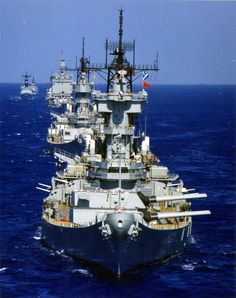 |
| 1980's era US Warships |
The experience of the 600 ship navy, first conceived in the early 1970’s as one of a series of fleet strengths necessary to confront the rising Soviet Navy, represents one course of action for those interested in promoting a larger fleet. Then Chief of Naval Operations Admiral James Holloway authorized studies of 500 to 800 ship fleets and how well each would perform against a global Soviet threat. Holloway eventually focused on the 600 ship fleet as a good, intermediate goal that slightly expanded the current 5 year defense plan, and “met the very basic requirements, though without flexibility.[3] The 600 ship force also had geographical, political, and carrier force structure roots. An initial survey of the naval requirements of the regional commanders in chief (CINC’s) in 1982 by members of the CNO’s staff suggested that 600 ships was approximately the right number of ships to meet their combined needs. Future Navy Secretary John Lehman came to a similar conclusion when writing his 1978 book Aircraft Carriers, The Real Choices that 600 ships represented the right size force structure to support a 15 carrier fleet engaged in peacetime presence operations. Finally, the Republican Party had seized on the 600 ship figure as a useful and achievable goal in the 1980 Presidential election, and Lehman, a skillful advocate of his service’s priorities, melded the concept of the 600 ship Navy with that of the emerging Maritime Strategy to form a marketable strategy and attendant, achievable force structure. Well supported by intelligence studies, the work of the CNO’s own personal think tank, the Strategic Studies Group (SSG), and frequently updated to reflect improvements, the Maritime Strategy and its attendant 600 ship goal were a remarkable success story and endured up to the beginning of the collapse of its Soviet opponent in1989. The combination of smart strategy and associated force structure supported by intelligence, analysis, and an aggressive public relations campaign by naval leadership (civilian and military), as exemplified by the 1980’s era Maritime Strategy, is an excellent course of action to increase the size of the fleet.
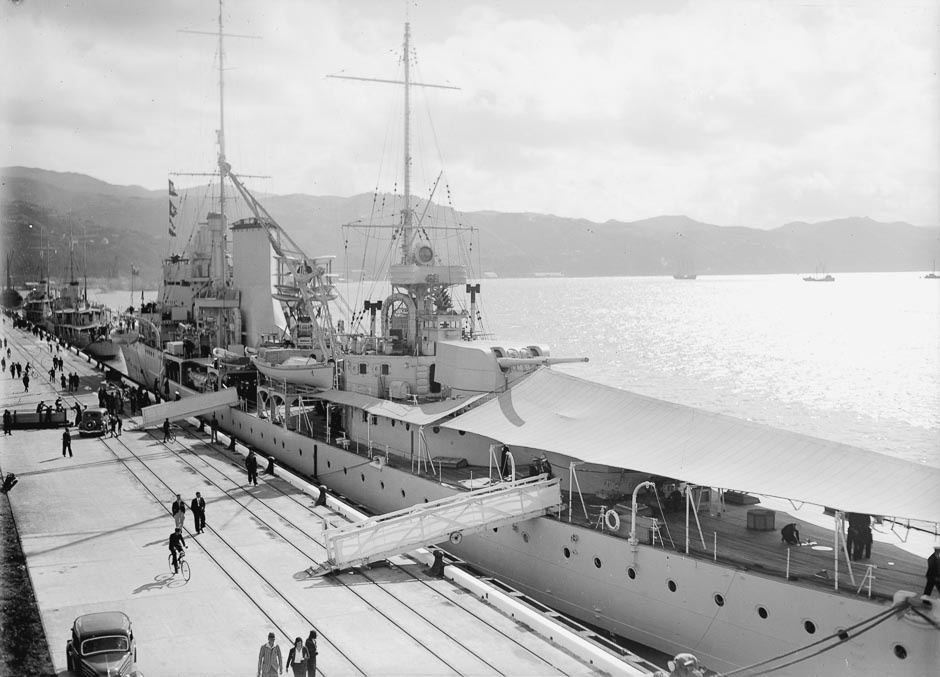 |
| HMZS Achilles, 1930's era British cruiser |
Geography can also be effectively mobilized to support a larger fleet. Armies and Air Forces largely remain in garrison, or at a limited number of forward deployed sites during peacetime. Armies are governed by operational geography in individual areas of operation. Air Forces conduct global operations, but are also strongly tied to regional support of ground formations. Naval forces, by contrast, confront a global oceanic operating space where every potential battlespace is connected to others. A navy with global requirements must take into account the logistics required to support such a force over vast global distances and the forces needed to secure that supply chain. Great Britain’s Royal Navy (RN) made the policing of vast ocean spaces the centerpiece of its strategy for increasing its forces in the financially challenging and treaty constrained interwar period (1919-1939). The British required a significant force of cruisers (upwards of 60) for both fleet operations and defense of trade against surface raiders such as had been seen in the First World War. The RN consistently campaigned in support of this requirement in Parliament and was generally successful in obtaining support (within the limited available funds at that time), from both main political parties of that period (Conservative and Labour).[4]
 |
| U.S. Warships based in Yokosuka, Japan |
Not all solutions suggest a physically larger force. The present deployment pattern of U.S. Navy warships, which dates from 1948, could be altered so that fewer warships based overseas at higher standards of readiness might better serve the nation’s global interest than rotating deployments from the United States. Congressional Budget Office (CBO) naval analyst Dr. Eric Labs suggests such a solution in a 2015 paper entitled “Preserving the Navy’s Forward Presence with a Smaller Fleet”. Labs asserts that longer deployments, basing more ships overseas and rotating multiple crews on one ship to extend deployments might allow the U.S. to reduce the overall size of the fleet whilst maintaining the same forward presence. Labs admits that some aspects of this plan could cause additional costs, notably that longer deployments mean shorter ship service lives, and additional costs in replacement force structure. A May 2015 General Accounting Office (GAO) report on Naval Force Structure states that equipment casualty reports (CASREP’s) on naval vessels based overseas have “doubled in the last five years and that the material condition of these ships has decreased slightly faster than their U.S. homeported counterparts.”[5] Forward deployed U.S. warships are at sea more often and tend to have less dedicated maintenance time than do their U.S. counterparts, which may explain some of the GAO findings. Both reports, however, suggest that a smaller force could be maintained and meet the same present requirements despite additional costs in maintenance and force renewal. Additional requirements in different geographic areas could stress a more forward deployed force. Each of these examples eventually supported specific capabilities that were met by a designated number of ships, rather than the ship count in the absence of an objective. Basing such requirements on specific threats, known geographic features or obstacles, or on operations and/or maintenance requirements represent a firm foundation on which to request more physical units. A larger fleet would, however, mitigate many concerns regarding deployability, maintenance of equipment and crew morale. CNO Admiral Frank Kelso said as much in 1991 when he argued in support for a larger naval component for the post Cold War “Base Force” created by then Chairman of the Joint Chiefs of Staff General Colin Powell.[6] The Navy requirement in 1991 of a 450 ship fleet could be justified in the present, given the navy’s expanded roles and missions since the end of the Cold War.
Advocates of a larger fleet need more than comparisons to the naval forces of 1912, or 1939 to justify the need for an expanded United States Navy. The example of the 600 ship navy of the 1980s suggests that a sound strategy, supported by accurate intelligence and threat assessments, and combined with an aggressive public relations campaign can result in the attainment of a force structure that was not thought possible in the proceeding decade. The Royal Navy’s campaign for its 60 cruiser force in the interwar period shows that geography and associated national interests in preserving control of specific maritime spaces are powerful tools in influencing legislative support. Finally, other solutions such as status quo, or smaller fleet, operating more ships forward at higher conditions of readiness can sometimes substitute for a larger force, albeit with some additional force replacement costs. This new fleet size or concept must speak in terms of what capabilities the new force or deployment structure will offer in support of specific requirements in order to pass muster within PPBE. Requirements and capabilities are the lingua franca of both DoD and Congress. Larger numbers alone will not pass muster.
[1]
Alain Enthoven and K Wayne Smith, How
Much is Enough; Shaping the Defense Program; 1961-1969, Santa Monica, CA,
RAND Corporation re-published volume, 2005, p. ix.
[2]
Ibid, p. xi.
[3]
John Hattendorf, The Evolution of the
U.S. Navy’s Maritime Strategy, 1977-1986, Newport, RI, The Naval War
College Press, The Newport Papers Series, 2003, pp. 10- 12.
[4]
Christopher Bell, The Royal Navy,
Seapower and Strategy Between the Wars, Stanford, CA, Stanford University
Press, 2000, pp 21, 22.
[5]
United States Government, “Navy Force Structure: Sustainable Plan and Comprehensive
Assessment Needed to Mitigate Long Term Risks to Ships Assigned to Overseas
Homeports”, Washington D.C., U.S. Government Accounting Office, Report to
Congressional Committees, GAO 15-329, May 2015, p. i.
[6]
Frank Kelso and Paul Stillwell, The
Reminiscences of Admiral Frank B. Kelso II, U.S. Navy (Retired), Annapolis,
Md, United States Naval Institute Press, 2009, pp. 668-670.

No comments:
Post a Comment