
 |
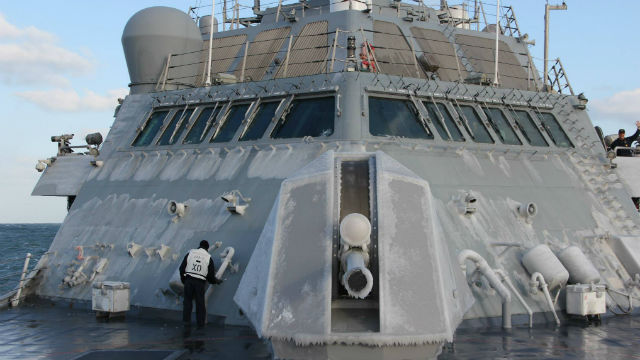
| USS Freedom 57mm gun |
Most
Littoral Combat Ship (LCS) critics remain fixated on the ships’ past
incarnations and problems going back to its origin in 2003. The “gold standard”
in the history of the program in that era is Deputy Defense Secretary Bob
Work’s Naval War College occasional paper on the subject.[1]
Work readily acknowledges the faults associated with the program that nearly
brought about its demise in 2007, but also remains convinced that the ship in
its two forms (Freedom and Independence variants) represents the
ideal small surface combatant for the U.S. Navy moving forward into the mid 21st
century. This author agrees and plots potential one possible evolution of the class’
concepts of operation moving forward into the next decade.
LCS began life as a very low
capability combatant designed to “mop up” any opposition remnants that survived
the withering joint assault of aircraft and missiles from a variety of naval
and non-naval sources. Nearly all operations in the early 2000’s were
envisioned as repeats of the successful 1991 Desert Shield/Storm where Combined Joint forces would intervene
from the sea to secure some failed or rouge state on the Eurasian littoral.
That operational geography, however, has radically changed due to the emergence
of major regional rivals with large scale economic, military, and technological
capabilities. These powers have since deployed battle space denial systems to further those
interests. The U.S. again contemplates high end combat on the high seas and
every ship in the force architecture from carrier to patrol boat must play a
part. Given the overall shortfall in U.S. surface forces, LCS will be employed within
existing battle networks in support of this new strategic and operational
construct.
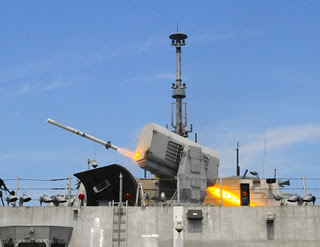 | |
| Freedom Rolling Airframe Missile (RAM) test (inert rounds) |
The LCS
will operate in a spectrum of conflict up to and including open warfare. The LCS squadron of four to six ships can
conduct a variety of peacetime engagement operations in its baseline
configuration. Its transition from peacetime to war footing, however, will
require careful prepositioning of multiple mission modules, ammunition, fuel
and other supplies for both LCS types and their frigate variants. Such items
will need to be dispersed throughout potential regions of conflict in order to
allow the ship to quickly assume its wartime tasks. All four variants will
remain dependent on existing battle networks when operating in close proximity
with other battle force units or when dispersed in order to make the most of
its installed and modular capabilities. Neither the baseline LCS nor its
frigate variant is expected to support a robust air and missile defense system.
Ship and shore-based aviation assets can provide this, and the installation of
AEGIS ashore facilities at key geographic points (if political and diplomatic conditions permit) can provide further defensive
and offensive support.
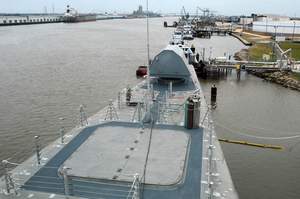 |
| Forward Mission Module Space (LCS 2 variant) |
LCS combat
missions may include antisubmarine warfare (ASW) escort missions in littoral
regions where the U.S. and allies have air superiority and general ASW escort
of tactical groups.[2] An LCS
squadron may secure key sea lines of communication (SLOCS’s) through important
chokepoints in low to medium threat environments. LCS and/or frigate units
armed with medium range surface to surface missiles also have the potential to
contribute to the Distributed Lethality concept at some stage in a campaign by
threatening enemy surface formations. The LCS’ size and rotary wing aviation
facilities allow a greater degree of independent operations as opposed to
single mission small combatants when battle network connectivity is degraded or
lost. Manned helicopter and unmanned rotary wing vehicles can provide
surveillance, be network connectivity nodes, and provide limited air strike
against weak or damaged enemy units. LCS is not a destroyer or a high-end
European frigate and is not a substitute for the more robust offensive and
defensive capabilities inherent in those larger ships. It can, however, conduct
presence operations, replace larger battle force units in low and medium threat
environments, and provide additional offensive and defensive capability in
support of conventional naval formations.[3]
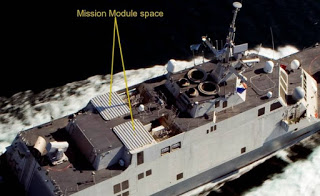 |
| LCS Mission Module space available for additional armament |
Sadly, most LCS
critics to date are focused on the problems and issues of the past vice those
of the present and future. There is a long list of past issues, and progress to ameliorate them is sometimes slow. The Navy grossly underestimated the sea frames' cost in the early 2000's, but recent
purchases are well below the most recent Congressional cost cap of $538 million.[4]
The ship took a long time to get into active, deployed service and has not met
all of its Key Performance Parameters (KPP’s) as fast as many critics demand.
The mission modules are still undergoing testing, and require a complete,
additional re-test each time a piece of equipment, however minor, is added. Test
and Evaluation assessors cannot seem to accept the fact that ships smaller than
4000 tons and less than 425 feet in length are just not as physically
survivable as its larger cousins, if for no other reason than having a shower floodable length and less reserve buoyancy. This situation will not change regardless of
how many additional systems or superfluous armor is crammed aboard. The speed
requirements from 2001 cut into weight that might otherwise be given to fuel
and additional installed systems, but redesign of propulsion plants is
expensive, and high operational speeds may allow for rapid sprints toward
targets and away from potential threats.[5] The
ship relies on non-ship’s force personnel for significant amounts of its
maintenance, but even this is not a new and haphazard concept that must be
replaced by a “relearning” of the maintenance practices of larger ships as some
critics suggest.[6] The
patrol gunboats of Vietnam vintage; the patrol hydrofoils (PHM’s) of the Cold
War[7]
and the Post-Cold War Cyclone class
patrol coastal ships were all supported by deployable maintenance teams during periods
of their service lives.[8]
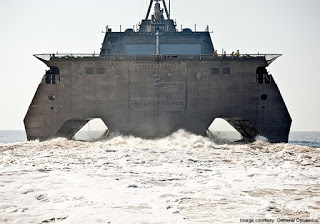 Naval force
structures change over time, and what worked well in the Cold War or in the
last 20+ years of the immediate post-Cold War era is not sufficient in the
middle of the 2nd decade of the 21st century. The world
in which the LCS was created and where Joint and Combined operations against
weak opponents along the Eurasian littoral were the most likely operation has
changed. The cruise and ballistic missile threat has increased to the point
where medium sized combatants like the retiring Oliver Hazard Perry class and large European frigates cannot mount
enough defensive weapons to survive repeated salvos of such weapons. Such big
frigates are also too expensive in comparison to the limited combat capability
they provide in comparison with larger combatants such as the Arleigh Burke class destroyers. The new
surface navy world is one of large, high end combatants capable of offensive
and defensive warfare, and small combatants like LCS that provide support to
larger units, and conduct operations in low and medium threat environments. The
Littoral Combat Ship is being built in significant numbers. Its modular design
allows for great flexibility in what payloads it carries to the battle. It is
time for LCS critics to let go of problems associated with past concepts of LCS
and focus their talents on the ships’ future employment in the networked battle
force.
Naval force
structures change over time, and what worked well in the Cold War or in the
last 20+ years of the immediate post-Cold War era is not sufficient in the
middle of the 2nd decade of the 21st century. The world
in which the LCS was created and where Joint and Combined operations against
weak opponents along the Eurasian littoral were the most likely operation has
changed. The cruise and ballistic missile threat has increased to the point
where medium sized combatants like the retiring Oliver Hazard Perry class and large European frigates cannot mount
enough defensive weapons to survive repeated salvos of such weapons. Such big
frigates are also too expensive in comparison to the limited combat capability
they provide in comparison with larger combatants such as the Arleigh Burke class destroyers. The new
surface navy world is one of large, high end combatants capable of offensive
and defensive warfare, and small combatants like LCS that provide support to
larger units, and conduct operations in low and medium threat environments. The
Littoral Combat Ship is being built in significant numbers. Its modular design
allows for great flexibility in what payloads it carries to the battle. It is
time for LCS critics to let go of problems associated with past concepts of LCS
and focus their talents on the ships’ future employment in the networked battle
force.
[1]
http://awin.aviationweek.com/Portals/AWeek/Ares/work%20white%20paper.PDF
[2]
http://www.navy.mil/navydata/fact_display.asp?cid=2100&tid=412&ct=2
[3]
http://breakingdefense.com/2015/01/the-case-for-lcs-searching-for-the-airasia-plane/
[4]
Ronald O’Rourke, “Navy Littoral Combat Ship (LCS)/Frigate Program; Background
and Issues for Congress”, Washington D.C., Congressional Research Service (CRS)
Report, 12 June 2015, p. 8.
[6]
http://nationalinterest.org/feature/littoral-combat-vessel-the-us-navys-great-relearning-13262
[8]
http://www.janes.com/article/42058/us-fifth-fleet-s-cyclone-inventory-reaches-full-force

No comments:
Post a Comment