
 |
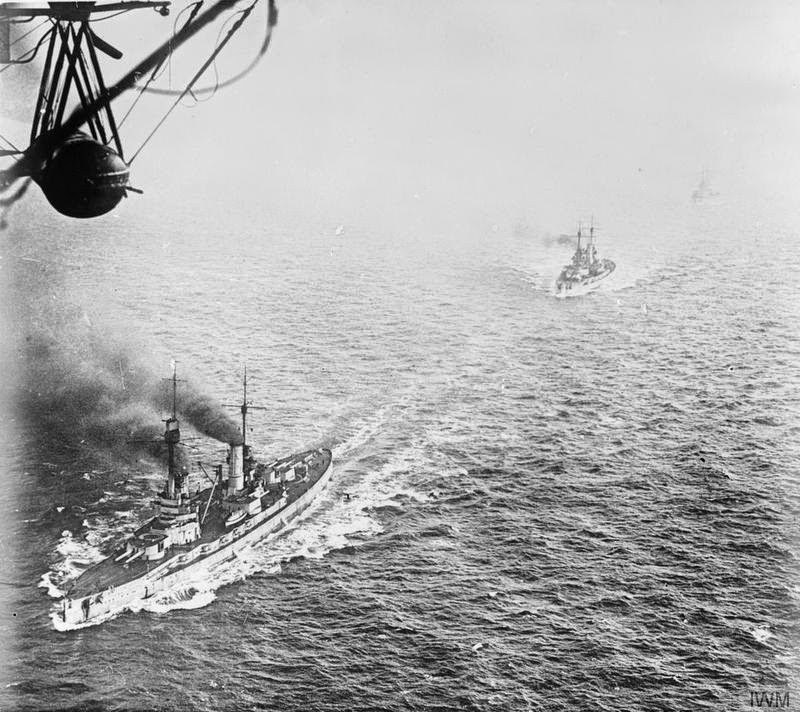
| German Fleet on its way to surrender in 1918 |
On
21 November 2024 Great Britain’s Royal Navy (RN) stood at the pinnacle of naval
power and success. Its greatest and most dangerous opponent to date, the German
Empire’s High Seas Fleet, sailed to Scapa Flow to surrender and be interned
pending armistice negotiations. Grand Fleet Commander Admiral Sir David Beatty
declared “the German flag will be hauled down at sunset and is not to be
hoisted again without permission”. No nation on earth had ever assembled a larger
and more technologically advanced fleet. The Grand Fleet boasted 35
battleships, 11 battlecruisers, the world’s only operational aircraft carriers,
and steam-driven, high speed submarines capable of operations with the battle
fleet. It had overcome deficiencies in
its heavy ordnance and tactical doctrine that were evident in the loss of three
battlecruisers at the May 1916 Battle of Jutland, and the failure to inflict
more damage on the German battlefleet. No one would doubt that the Royal Navy
continued to rule the waves as it had unconditionally done since the defeat of
Napoleon’s naval forces at Trafalgar in October 1805. In just 20 years,
however, the mighty RN was significantly behind the other great powers in naval
technological innovation. Britain had failed to keep pace in both the
extraordinary, and in the mundane features of naval innovation. The mundane
features, in particular, proved costly. They put the Royal Navy at considerable
disadvantage throughout World War Two and forced additional costs on the
service that hobbled its attempts to create a post-World War 2 force. The
following three failures in naval innovation were particularly crippling.
1) Naval propulsion equipment. The Royal Navy
led the world in the development of naval propulsion technology from the 1860’s
into the second decade of the 20th century. Its achievements
included the introduction of fuel oil for propulsion and the turbine engine. By
1915, however, this lead had begun to slip. The U.S. Navy, rather than the RN,
introduced turbo-electric drive for warships and had begun significant work on
improving warship fuel economy. This trend continued in the interwar period. By
the late 1930’s, British propulsion machinery was leaky, heavier, more bulky,
and decidedly less fuel efficient than comparable American marine propulsion
installations. Standard Royal Navy boilers, for example, had to be cleaned
every 750 hours of operating time, as compared with 2000 hours for comparable
U.S. boilers.[i] The British Naval
Constructor and Historian David K. Brown attributed this to the U.S. use of
boiler water chemicals to prevent scale buildup in water tube installations.
Senior British naval leadership, who in most cases had little no engineering
background or experience, refused to allow the use of such chemicals in Royal Navy
vessels. The British Pacific Fleet engineers, after seeing U.S. use of these
chemicals in 1945, disobeyed official instructions to use them. The fleet
engineer was threatened with court martial for disobeying orders, but improved
performance trumped traditional naval justice and he was later promoted.[ii]
In addition, British fuel oil nozzles were specially configured to burn the
very “sweet” oil purchased from the Persian Gulf. When supplied with U.S. oil,
RN boilers made more smoke and were less efficient.[iii]
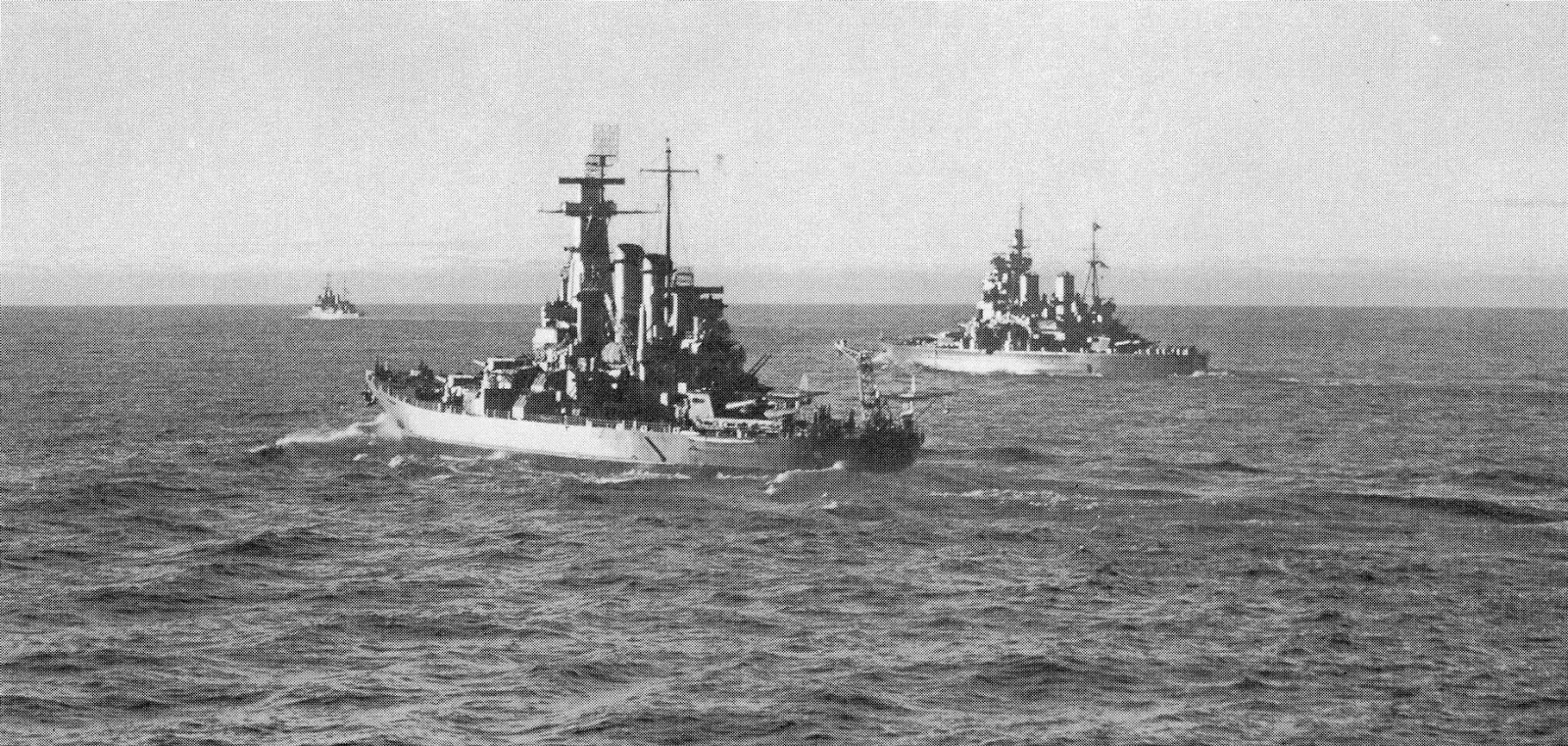 | ||
| USS Washington (foreground) with HMS King George V |
These faults significantly reduced the
fuel economy of British warships in comparison with their American
counterparts. The American battleship USS
Washington initially operated with the British home fleet in 1942 before
her transfer to the Pacific. Washington
had 39% less fuel consumption at standard bell speed than the comparable
British battleship HMS King George V.
Washington’s fuel efficiency was even
better at speeds above 15 knots and in practice had double the endurance of her
British counterpart.[iv]
2) Failure to Adopt Alternating Current (A/C)
for Warship Electrical Systems: As with
main propulsion machinery, the Royal Navy was a pioneer in the installation of
electrical equipment on board its warships. The first electric searchlights
were installed on the battleship HMS Minotaur
in 1876. The first fatality from electric shock aboard a warship occurred on HMS Inflexible in 1881. The British
continued to advance electrical development throughout the 19th and
early 20th centuries. It developed the “ring main” system, the
forerunner to the modern electrical distribution system aboard current
warships, in 1904. This advance allowed for electric power for large shipboard
equipment, such as the electrically-trained main gun turrets of the Invincible class battlecruisers of 1906.
These warships also set a new standard of development in their introduction of
the 220 volt direct current (DC) system, which would be an RN standard for the
next 40+ years.[v]
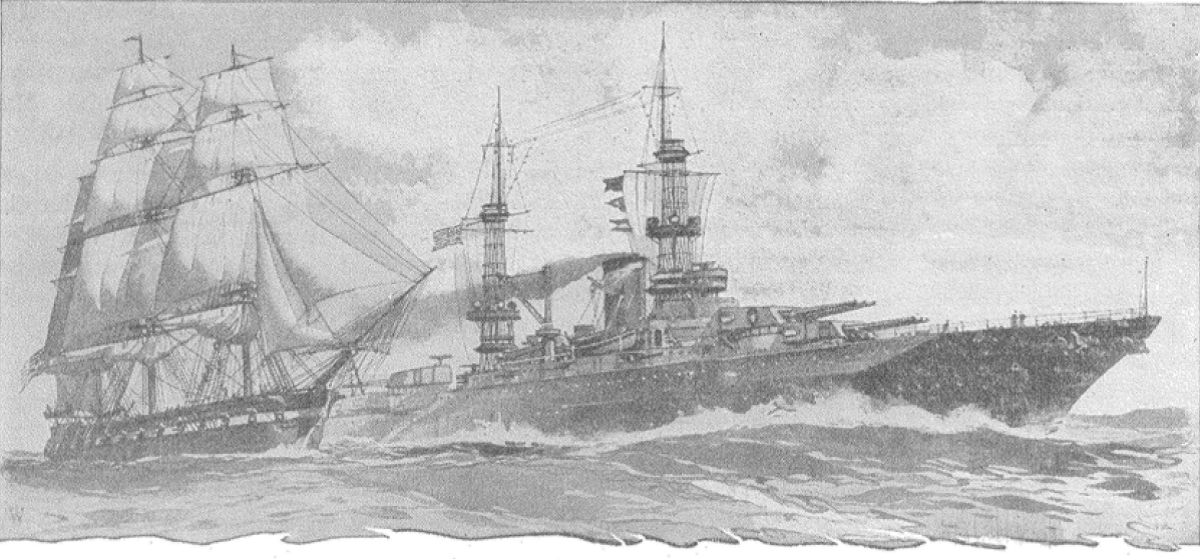 | ||
| 1920's General Electric Ad for the turbo-electric battleship |
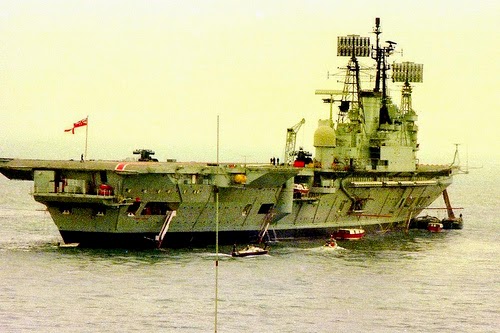 |
| HMS Ark Royal |
As in propulsion equipment, British
development of shipboard electrical systems also lagged during the interwar
period. The U.S. Navy, by contrast, adopted the alternating current (A/C)
system in 1932 and attendant small circuit breakers later in the decade. A/C
systems proved to be much lighter and more efficient than their D/C
counterparts. This advancement allowed smaller ships to support more electric
equipment. The Royal Navy, by contrast, lagged in the installation of A/C
systems until the end of the Second World War, and did not fully adopt them
until the mid 1950’s for larger warships. Given the significant electrical
requirements of postwar naval equipment such as radars (search and fire
control), sonar, computers and communications gear, this failure to adopt the
A/C power system put the British at considerable disadvantage in equipping
their warships in the postwar era. D.K Brown cited the limited capabilities of
D/C power afloat as one of the most costly elements in keeping Great Britain’s
last fixed-wing aircraft carrier, HMS Ark
Royal, in commission into the 1970’s.[vi]
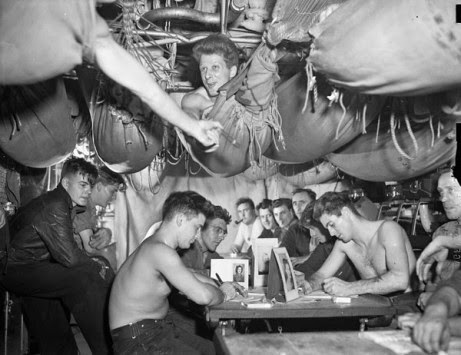 |
| Mess Deck HMCS Iroquois, 1944 |
3) Habitability on board Warships: D.K. Brown
noted that a sailor from the time of Lord Nelson would still feel at home on a
British warship of the 1930’s and 1940’s with regard to the levels of
habitability. The naval author Nichols Monserrat noted the stark differences
between the British and U.S. destroyer escorts he commanded in his 1946 book HM Frigate. British ships still sent
food from the galley to individual “messes” in or near sailors’ living spaces.
Food often spilled or became cold enroute to these mess locations. British
ships still retained hammocks for sleeping accommodation well into the 1940’s
after other nations had long since discarded these elements of the age of sail.
Ventilation and insulation remained poor on British warships in comparison with
other navies as well. The famous Royal Navy antisubmarine Flower class corvettes fighting in the North Atlantic lacked heat
and insulation which made their sailors susceptible to Tuberculosis.[vii] Some
senior Royal Navy commanders dismissed such concerns and suggested that the
additional of additional comforts for sailors would make them “soft”.
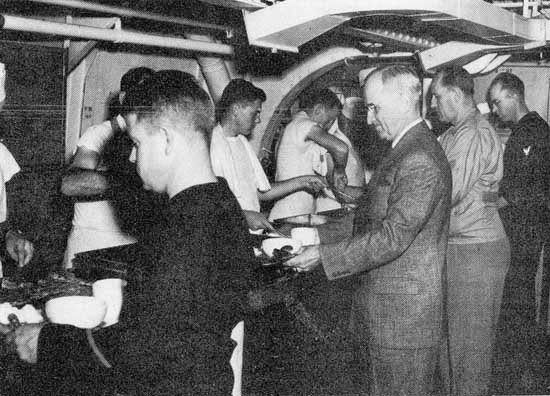 |
| President Truman enjoys cafeteria messing, 1945 |
The U.S. Navy, by contrast, had adopted cafeteria-style, centralized “mess
decks”, shipboard laundry services, bunks for sleeping accommodation, ice water
in each mess space, potato peelers, good insulation and ventilation, and an
excellent internal communication system a whole decade before the RN considered
these advancements. In addition, American sailors had access to other comforts
their British counterparts did not, including electric ice cream machines that
were in use on U.S. warships as early as 1916.[viii]
Monserrat
noted all of these features and concluded by saying, “no one would consider
U.S. sailors of World War 2 as soft”.
While failure to immediately embrace
innovative advances in propulsion machinery, electrical capacity, and
habitability did not prevent The Royal Navy from achieving victory over its
German and Italian opponents during the Second World War, it certainly made the
effort more costly. Money spent to fuel inefficient engines could have bought
more ships, or improved the ability to service its existing order of battle.
More advanced electrical plants might have allowed the Royal Navy to preserve
more of its war-built force after 1945, especially its aircraft carriers.
Finally, habitability matters in that “the combat efficiency of the crew is
increased if they are well fed and can rest properly when off duty.”[ix]
To their great credit, however, Royal Navy
senior leaders, engineers and warship designers rebounded smartly from these
problems in the post-World War 2 era. They did their best to belatedly adopt
A/C electrical systems, but also devised some of the most important new naval
systems in postwar combatants and were the first to take gas turbine
engineering, fin stabilizers, and helicopters to sea on small warships.
How does the RN’s failure to adopt new
supporting technologies affect the present U.S. Navy? Sometimes the innovations
in systems other than armament, sensors, and communications have significant
impacts on the development of a ship’s combat systems. Sometimes those
developments are long and costly. Electric drive warship development in the
form of the DDG 1000 has been slow and time consuming, but will likely lead to
fuel savings, better internal ship subdivision, and the ability to deploy directed
energy weapons. The modularity of the Littoral Combat Ship may take time to
reach full operational capability, but it offers the promise of future,
reconfigurable warships with multiple mission combinations on a common hull. The
reconfiguration of living space aboard ship toward much less cramped
conditions, dedicated exercise facilities, and improved access to internet
aboard ship have gone a long way toward improving the individual sailor’s lot
whilst at sea. These advances, while difficult and perhaps not as flashy as new
weapons and sensors sometimes make a significant difference both in the next
war, and what comes after the guns fall silent.
[i]
David K. Brown, Nelson to Vanguard,
Warship Design and Development, 1923-1945, Annapolis, MD, Naval Institute
Press, 2000, p. 101.
[ii]
Rear Admiral Lewis Le Bailly, Fisher to the Falklands, London,
Institute of Marine Engineers, 1991, pp 71-73.
[iii]
Le Baily, pp. 71-73.
[iv]
Brown, p. 33.
[v]
John M. Maber, “Electrical Supply in Warships, A Brief History”, Crown
Copyright/MoD (1980).
[vi]
David K. Brown, Rebuilding the Royal Navy,
Annapolis, MD, Naval Institute Press, 2005, p. x
[vii]
Brown, Nelson to Vanguard, p. 134.
[viii]
Ronald Spector, “The U.S. Navy’s Sea Change”, Military History Quarterly, 01
February 2010.
[ix]
Brown, Nelson to Vanguard. P. 134.

No comments:
Post a Comment