
 |
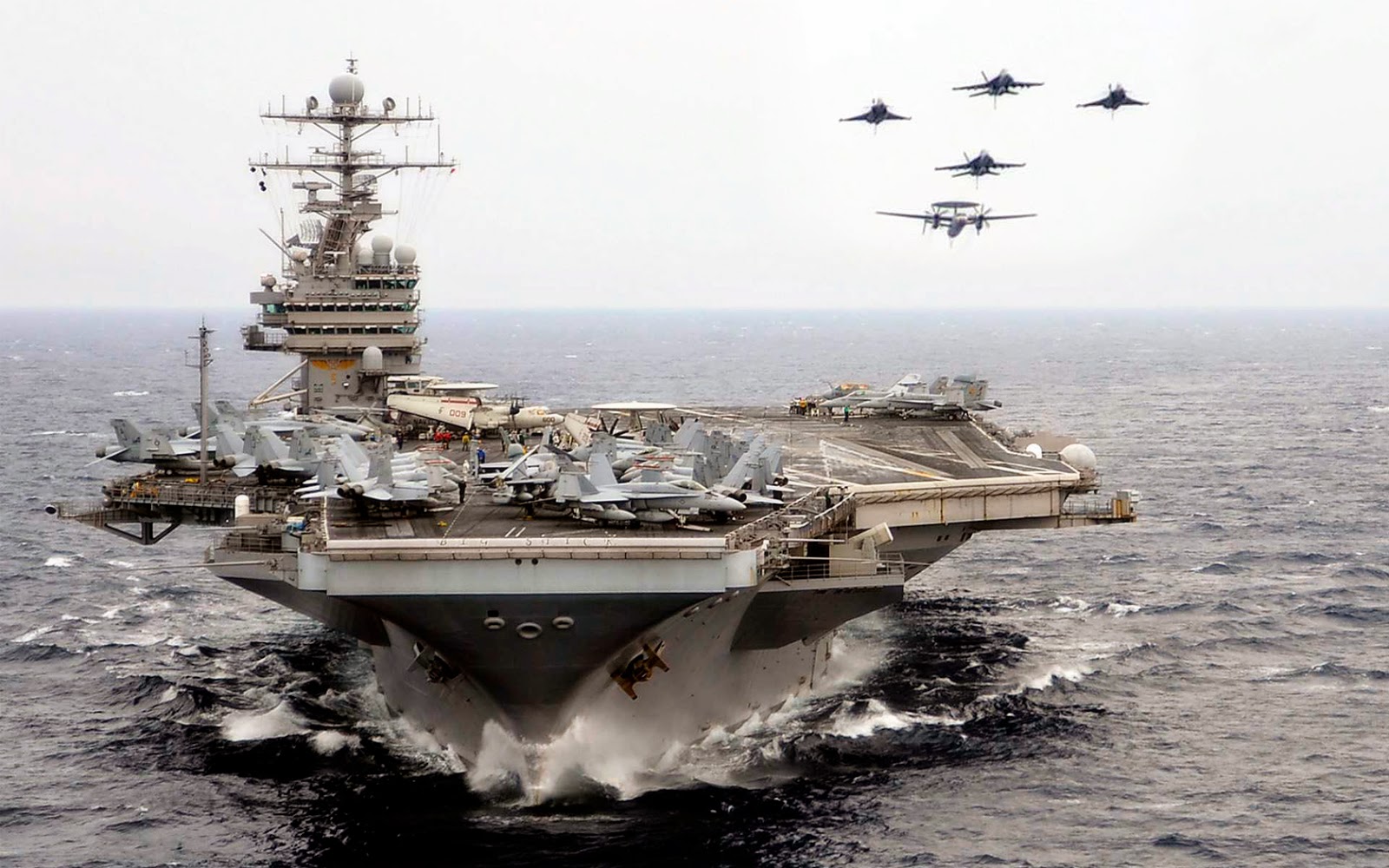
| USS Theodore Roosevelt |
It is the man-made and manned instrument of American strategic policy that has helped influence relative peace for mankind over the last 70 years and shapes the decisions of world leaders today.
Nailed it on the first response. At least I think so, because the topic of aircraft carriers is much bigger than engineering, organizing, and deploying naval military hardware. For the last 70+ years, the aircraft carrier has been one of only a handful of instruments credibly used by world leaders to shape the world we lived in. The aircraft carrier has a proven track record and unquestionable tangible political value today, and yet it is completely legitimate to say it also has a very uncertain future.
I believe the United States Navy is the most influential strategic organization in shaping the geopolitical decisions of all nations around the globe. I believe the forward presence of the United States Navy represents the insurance policy that enables access to the opportunities of human inter-connectivity, the network from which all opportunities and endeavors involving human interaction in the 21st century flow. The United States Navy is not the first such organization to perform the global security function for the global system of an era, indeed the United States Navy inherited this role from the Royal Navy in 1945 following World War II after England had performed this global function for more than two centuries. Today, just like in all times of human history, the nation that serves as the global security facilitator enjoys several advantages in security, commerce, and access to resources.
It is unclear how long the United States will serve as the leader for global national security, as the future is always uncertain. What is clear to me, however, is that the United States will bear that responsibility unchallenged for only as long as the United States Navy remains forward deployed and capable of credibly influencing the political decisions of all nations around the globe. Our global leadership responsibility in security enables our economic advantages, which thus enables the export of our nations ideologies; most of which are founded in desires of inclusion, tolerance, and inter-connectivity for mankind. These ideologies center around fundamental principles like individual Freedom and Liberty that form the foundation of America, and those values are not shared around the world. I believe those values are critical toward efforts in making the world a better, safer place, but most importantly securing the people of the United States and our friends and allies. Could evolutions in military technology related to sea, air, and/or space one day replace how the United States Navy serves that function today? Potentially, absolutely, and it is also entirely possible that technological revolution elevates another nation into providing the global security role.
But that day is not here yet.
In 2015 the United States faces several challenges towards maintaining our role as the global security provider, and those challenges are both internal and external. In my opinion the biggest challenge facing the United States is not ideological, nor is it external, rather it is fundamental to whether the United States Navy can remain the most influential strategic organization in shaping the geopolitical decisions of all nations around the globe when dealing with the exponential curve of technological change and how it influences the security environment as it exists today. I have faith that our national political leaders will make the right choices during crisis to protect the American people, but where I lack faith is in the domestic system that produces the future choices of leaders - both organizational within the Pentagon and broader across the way the US government functions today - towards insuring the right resources are available in those critical moments that enable the best decisions for our political leaders during future crisis.
In my opinion, this topic regarding the future of the United States aircraft carrier that Bryan McGrath and Jerry Hendrix will debate Friday night in Annapolis (watch online here) is part of the most important discussion in our time towards shaping the security role the United States will have in the first half of the 21st century. I strongly believe the outcomes of the aircraft carrier issue must insure that the United States Navy will remain the most influential strategic organization in shaping the political decisions of all nations around the globe.
The US Navy aircraft carrier is the single most influential strategic tool actively used on planet Earth today, and in that role it significantly influences strategic decisions related to United States foreign policy made not only by us, but also nations who stand opposed to our interests and values. The aircraft carrier is so central to how the US Navy organizes, operates, and fights in war that just about every decision throughout the rest of the US Navy organization is influenced by it's role as the centerpiece of the force. The aircraft carrier also has significant consequences for other critical aspects of national security, including - for example, how large our nations nuclear deterrent needs to be.
I have long been convinced that the large deck nuclear powered aircraft carrier is a good value for projecting naval power today, but only as long as the Air Wing that operates from the large deck nuclear powered aircraft carrier is a good value. With that said, I am still unconvinced the large deck nuclear powered aircraft carrier is the best value for projecting naval power in the future. In 2015 I am completely unconvinced that the future Carrier Air Wing of the United States Navy, as it is currently being designed for the first half of the 21st century, is a good value, and with all due respect to some people... I honestly think you sound silly when describing how big the oceans 'really' are, because it is past time for you to recognize that technology is making the world - including the oceans - a much smaller place every day. That technological curve shrinking the world isn't linear, it is an exponential curve... and the clock is ticking.
I am unconvinced and unimpressed by the articulated arguments of naval aviation leaders like Admiral Winnefeld, Admiral Gortney, and other leaders within the Naval Aviation community regarding the future Air Wing of the US Navy. I am not suggesting I think what they say is wrong, rather I am saying naval aviation leadership has lost credibility with me over the last few years as critics have made strong, data supported arguments counter to their statements. In other words, I'm simply struggling to believe what Naval Aviation leaders say is right, because they do not articulate a vision I believe in.
With this as the backdrop, I personally look forward to attending the discussion and debate between Bryan McGrath and Jerry Hendrix on Friday night in Annapolis, because I come with an open mind in hopes of learning many new things. I will be searching for that very illusive "something to believe in" that convinces me the outcome of the aircraft carrier issue will insure that the United States Navy is positioned to sustained our nations leadership in global national security.
We know the aircraft carrier has performed it's function in that role since 1945, and can still do it in 2015, but the clock is ticking... and some of the top Admirals today articulate arguments that sound a lot like the arguments of the Battleship Admirals of the 1930s - which was a very smart group of our nations best Navy leaders who simply didn't recognize the exponential curve of technological change taking place in their time.

No comments:
Post a Comment