Many
distinguished scholars, journalists, and strategic analysts have provided
compelling visions of why and how the People's Republic of China (PRC) would conduct a naval and
military campaign in the Indo-Pacific basin. Several viable U.S. responses to
such a Chinese operation have been articulated. These include a blockade-based
“offshore control strategy” to deprive China of resources and trade, and the
“Air/Sea battle” operational concept involving a joint U.S. naval and air power
effort to directly combat Chinese forces in the Western Pacific littoral. Both
visions suggest allied participation and perhaps can be combined into an
overall military strategy. Before moving further however, it is useful to
examine current and evolving Chinese strategic “centers of gravity” and look at
how the People’s Republic of China (PRC) has conducted recent military actions.
Past Chinese conflicts may not provide a complete picture for U.S. leaders, but perhaps offer a window into how the PRC thinks about its military
activity.
Changing Centers of Gravity
 |
| Tiananmen Square Protests, 1989 |
The
most important center of gravity for post-revolutionary China has been the
survival of Communist party authority over the state. The definition of the
Chinese Communist party however has changed since the official Party program of
“Modernization and Stability” began in the wake of the Tiananmen Square
massacre of 1989. While the rest of the Communist world collapsed in the face
of the perceived superiority of the Capitalist system, the Chinese party was able
to adroitly turn the Communist system on its head and adopt the best practices
of its Western opposite number. The “modernized” China now resembles a large
corporation rather than the revolutionary state of Chairman Mao Zedong. Its
Politburo, with orderly successions of authority, and Party Congresses filled
with departmental representatives reporting on modernization efforts are
similar to a Corporate Board of Directors reporting to a meeting of
shareholders. The economic model fits well as the Chinese party essentially
“purchased” the loyalty and support of its citizenry. The exchange of
traditional Marxist patterns of life including poor quality consumer goods,
overt repression, and little or no upward mobility for economic
growth, security and prosperity has served to insulate the Chinese Communist
leadership from pre-1989 style criticisms. One wonders if Mikhail S. Gorbachev
lays awake at night wondering why he did not attempt the Chinese method for the
Soviet Union. While the Party itself remains the principle Chinese center of
gravity, the continuing prosperity and support for the party from the PRC
citizenry is nearly equal in importance to that of the party itself since both are mutually
dependent on each other's support.
 |
Leaders of a fictional "corporate state" from the 1975 movie "Rollerball"
"And now, our Corporate Anthem!" |
The growing
prosperity of the average Chinese citizen is supported in large part by the
vast system of ocean-going trade that fuels “Wang Q. Public’s” accelerated
standard of living. Heritage Foundation analyst Dean Cheng has stated that as
of 2010, 85% of all Chinese trade moves via ocean routes. The upward trend in
the percentage of China’s maritime trade as part of overall Chinese economic
activity shows no sign of abating as Chinese citizens now expect and demand a
higher standard of living. Any disruption in this seaborne trading system for a
significant length of time could call into question the Communist Party’s
ability to deliver its promise of better living standards. A maritime blockade
of China, either from distant chokepoints like the Strait of Hormuz or from
closer locations such as the Malacca Strait could over time seriously reduce
confidence in the Chinese Communist Party’s ability to deliver prosperity.
China appreciates
these challenges and has sought to minimize disruptions, especially in the
supply of petroleum products to its hungry industries. In recent years the
Chinese have invested large sums of money in Pakistan. Just last July the
Chinese signed an agreement with the Pakistanis to build an 1200 mile long “economic
corridor” from the port city of Gwadar on the Indian Ocean to the Chinese city
of Kashgar, first by road and later by rail. China would like to avoid having
to send so much valuable economic traffic by vulnerable sea routes and this
connection would alleviate some of their concerns.
How Has the PRC Fought Past Wars?
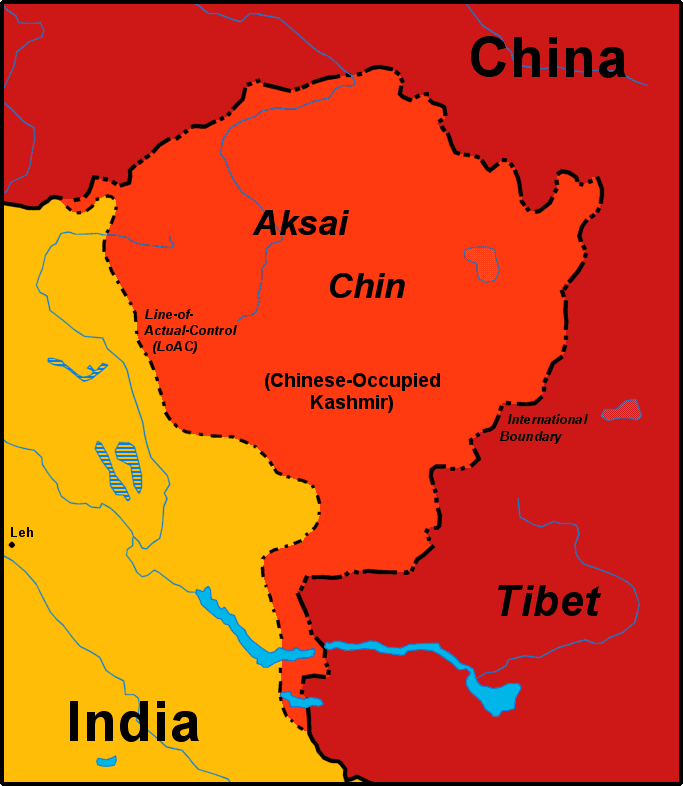 |
Disputed area of Kashmir occupied
by China in the 1962 Sino-Indian
War |
China
has fought four significant military conflicts since becoming a Communist state
in 1949. Two distinct strategic concepts figure in all four wars. China first
“covered its six” by ensuring it was potentially angering only one of the
superpowers by its actions. China also sought to contain each war as a limited
conflict, but dispatched more than enough forces to ensure victory and/or
attainment of its objectives. In addition, the Chinese state was willing to endure
significant military casualties in pursuit of strategic objectives. In China’s
Korean War intervention, Chinese leader Mao Zedong first confirmed support from
then Soviet dictator Joseph Stalin before undertaking action against United
Nations (U.N.) forces in Korea in October 1950. The Chinese military effort did
not destroy U.N. forces but its action met Chinese objectives by preserving the North
Korean state. Some U.S. figures suggest the Chinese suffered over 400,000 dead
in the course of the Korean War.
 |
Time magazine cover from the
period of the 1979 Sino-Vietnamese
War |
China has fought
three additional short “border wars” since 1953 against India, its former
Soviet ally and its sister Communist state of Vietnam. In the October 1962
Sino-Indian conflict fought over disputed territory on India’s Northwest
frontier, the two superpowers were occupied in the standoff over Soviet missiles
in Cuba and did not play a role in the conflict. Casualties on both sides were
light but the Chinese took all of the Indian border territory of
Aksai Chin. The 1969 Sino-Soviet conflict over an island in the Amur River
claimed by both states was relatively minor compared with the fighting on the
Indian border. The Chinese, however, fought fiercely and suffered heavy
casualties in order to capture a disabled prototype Soviet T-62 tank. The
Chinese supported reconciliation attempts made by the United States during the
increasingly poor Sino-Soviet relations that followed the Amur River incident
and allowed Secretary of State Henry Kissinger to visit in 1971, beginning the
U.S. rapprochement with the People’s Republic. Finally in its 1979 “punitive
expedition” against Vietnam, the Chinese sought to prevent the Soviets and their
Vietnamese allies from altering the Cambodian-Vietnamese border. They committed a large
force to invade Vietnam and threaten its capital of Hanoi. The Soviets were too
distant to support the Vietnamese war effort and the United States was courting
Chinese favor and acceptance of its Cold War aims against the Soviets. The
battle-hardened Vietnamese Army fought well, but was pushed back, as the Chinese
desired, after a fierce four week campaign. The Chinese then pulled back to avoid
a wider conflict. The Cambodian border issue remained unresolved until the end
of the Cold War and China suffered somewhere between 8000 and 28,000 soldiers
killed in action.
The
People’s Republic of China is well aware of its strategic centers of gravity,
and is actively working to mitigate risks to their security. These changes
include continued growth in standards of living for the average citizen, moving
petroleum product supply lines to inland routes, and the modernization of military forces to avoid potential heavy casualties such as those suffered in conflicts from
1950-1980. These losses might not be as supportable by the present Chinese
population accustomed to continued growth and prosperity vice war and potential
rationing. China continues to secure its land borders and thus has promoted
favorable relations with Russia. It also supports Pakistan as a counterweight
to India. Careful observation of these elements of Chinese strategy is most
useful in determining the PRC's next geopolitical move on the chessboard.


No comments:
Post a Comment