
 |
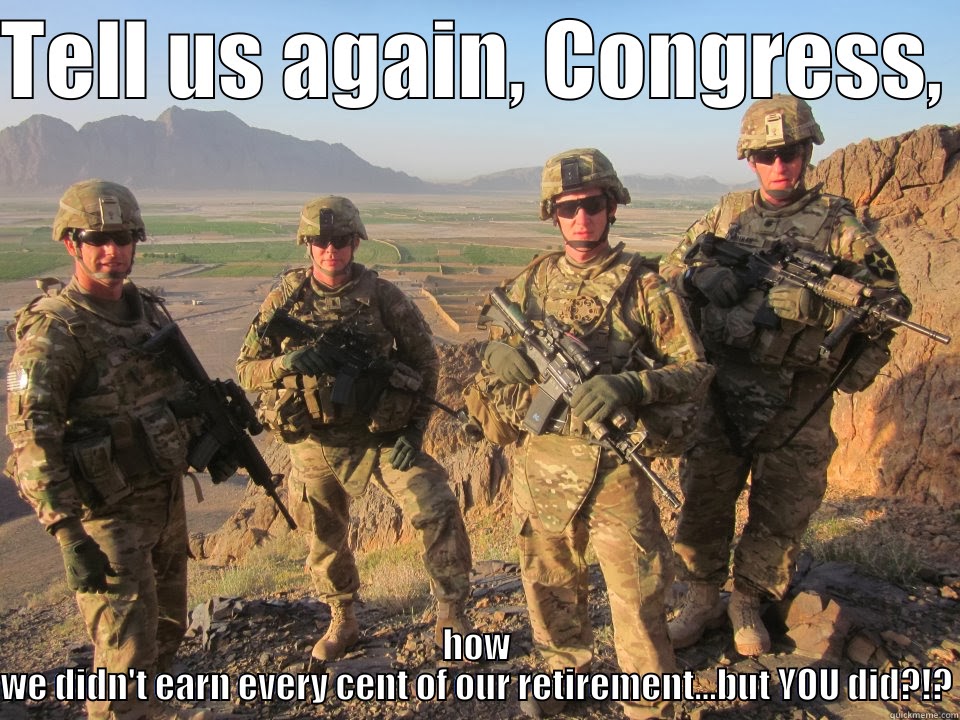
| Popular Internet Meme |
What does the Ryan/Murray agreement do? "Under the Ryan-Murray deal, active-duty personnel and retired veterans younger than 62 would be forced into a new pension plan. Traditional veterans received a yearly cost-of-living adjustment on their pension equal to inflation. Under Ryan-Murray, however, veterans will now receive inflation, minus 1%. In other words, their yearly pension payment will be below the increase in the cost of living. When a veteran reaches the age of 62, the cost-of-living adjustment would again be equal to inflation."
Following the debate and the reaction in the broader media, one would be hard-pressed not to conclude that military retirement--like the one I earned (and yes, I believe I earned it)--is going to be CUT, as in, I would receive less money the month after the law passed than I did the month before. This is of course, not true. What the law will do (if passed) is cut the rate at which the retirement pay INCREASES. Formerly, only in Washington was such a thing referred to as a "cut"--it now appears that within the diaspora of the retiree community and the would-be retiree community, the language wielded by the left to protect spending in social programs is now applied to the rate at which military retirements increase. The irony of the language used is notable.
"Well, Mister Smarty Pants Consultant, if the pension doesn't keep up with the cost of living, the buying power of retirees will erode and their quality of living will decrease." And I would say to that, yes, I agree, it would. In the case of those military retirees between the ages of 38 and 62 with no other form of income, this would be the case. Presumably though, retirees in this group are capable of other work and if not, are more than likely drawing some kind of other disability related compensation. And at the age of 62, their retirement pay would then return to the previous inflation indexing scheme.
Ultimately, if this country is going to have any hope of getting its fiscal house in order, two things are going to have to happen. The economy is going to have to grow and "non-discretionary" federal spending is going to have to grow at a slower pace. Some believe additional revenues are required too. Military retirements are part of this non-discretionary category, which includes all manner of other programs, including healthcare and social programs whose increases are indexed in the laws that spawned them. At the end of the day, SOMEONE HAS TO GO FIRST. Someone's benefits are going to have to grow more slowly. Someone is going to have to sacrifice, to the extent that a cut in the increase in a benefit can be seen as a sacrifice.
Who understands sacrifice better than America's military retirees, each of whom invested at least twenty years of sweat equity in the country before they could receive a dime in retirement pay? Do we really have ANY expectation that other large interest groups in this country who represent those receiving inflation indexed federal benefits are going to come forward and say, "we know what has to be done, we'll go first?" The suggestion is ridiculous.
Some may say, "back that truck up...we've already sacrificed...it's time for someone else to do so". Who? Who would you look to? My answer to you would be "yes, they too. But you first. You know what is at stake, and you got up every morning for at least twenty years with no other job but to ensure that it continues."
America is like a giant, ever renewing start-up, which has been the source of much of its greatness and growth. It has lost some of that edge, and it is time for its investors, its stakeholders, its owners--as it were--to do what is necessary to get it back on track. Military retirees are those owners.
Bryan McGrath

No comments:
Post a Comment