
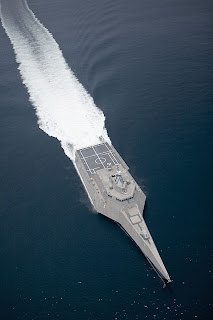
There's nothing wrong with LCS 2... I believe the fleet introduction of these ships is very important. When it comes to these ships, nobody cares like I care... LCS, in the press, has kind of gone sinker, and maybe we shouldn't have let that happen.Nearly 3 months since the interview where Rear Adm. Murdoch simply noted the absence of official LCS news, we are finally getting some official LCS news, including on Fort Smith which should start doing trials this week. Let's review the reporting around the Internet starting with Michael Fabey at Aviation Week.
Rear Adm. James Murdoch - LCS PEO
“We’ve done a good job fixing problems we saw in the first two ships,” he says.Rhetorical question? It shouldn't be...
Water-jet propulsion systems drive corrosion concerns on both ship types. What the Navy has sought, according to Murdoch, was a “more robust design in shaft seals.”
He also has been paying particular attention to the ships’ waterborne mission area, “the heart of the operations’ package.”
For example, with LCS-1, built by a team lead by Lockheed Martin, the stern doors open and a ramp comes down with “waves washing in and out,” he says, inviting salt-water corrosion. When operations are done and the doors close, he says, what’s needed is a “tight seal and a dry space.”
Another improvement the Navy would like is the ability to deploy longer boats than the 5-meter vessels slated for LCS ships, he says. But the service has to always be concerned with weight — every pound added cuts into ship speed. “Either you want a ship to go 40 knots or you don’t,” Murdoch says
We pick up the discussion on the Austal version of LCS with George Altman of the Alabama Press-Register.
"What the Navy has to do, first and foremost, to maintain confidence in Congress and with the taxpayer, is to demonstrate that we can get better and better," Murdoch said.LCS-1 changes are already being discussed, as noted in the Green Bay Press Gazette.
Part of that effort will entail addressing rust and corrosion problems in the first two LCS. Murdoch said changes to paint coatings, pipes and even air conditioning units were being made to minimize future corrosion.
The USS Independence — the first LCS built in Mobile — required "too many labor hours" to build Murdoch said, so the construction process for future ships is being tweaked to be more efficient.
"I give credit to Bath (Iron Works) and particularly Austal for using better modular construction techniques," he said.
"With that longer underwater hull, the ship is a little more efficient, and just operating on the diesel engine alone, she's about a knot faster … than USS Freedom," he said. "And we're probably one to two knots faster on the gas turbine (engines) alone than Freedom was."Carlo Munoz has two articles for AOL Defense discussing modules, sortof. This one discusses the Griffin missile that will not be fielded until sometime after 2014, and the Navy intends to replace anyway because it lacks range. Also it appears Marines and SOF are interested in LCS, at least according to Murdoch who also notes there is no actual program for supporting a Marine/SOF mission module that he is discussing.
LCS 3's underwater hull structure has been lengthened compared with the USS Freedom, increasing fuel capacity by 10 percent and enhancing performance.
Analysis
Rear Adm. Murdoch is the ship guy, and we get stories that mostly concentrate on a status update of the shipbuilding. All seems OK, but few details to address the big questions - like whether there are any increases to crew sizes. A little bit of efficiency appears to be gained in the Lockheed Martin version, but nothing similar to report on the Austal version. Overall, construction progresses.
The rhetorical question asked by Murdoch appears to be one of the best questions here - “Either you want a ship to go 40 knots or you don’t.” What is traded for 40+ knots? What is lost besides speed? At this point, isn't that the question heading into any future contract beyond the current contract for 20?
What is not reported is perhaps as interesting as what is reported. For example, it is unclear if Rear Adm Murdoch made a case for the Littoral Combat Ship, but what is clear is that the case made wasn't compelling enough to the reporters to end up in the stories written. Rear Adm Murdoch mentions the Griffin missile, but notes it's very serious limitations. That raises the question, why would the Navy spend money on a missile that it doesn't like? Aren't defense budgets too tight to invest in a system that has a limited future and undesirable metrics for range? Yes, LCS needs a missile, but an unmodified Griffin sounds like a waste of money to me.
As for the utility of Marines and SOF, it's too early to examine. LCS has utility as a basic function of the design, but with such limited armaments a module for Marines or SOF makes less sense up front than a module that supports the Coast Guard, for example, that can be leveraged in either maritime security operations or forward security assistance training. The ability to support the USCG for, drug related ASW or terrorist specific MIW, would appear to be more aligned with both role and mission of LCS in the specific maritime environment issues related to the wars we are in today than supporting Marines or SOF from offshore. It is likely the USCG doesn't have the resources to partner with the Navy on a LCS module though, which is a different - more political - issue than partnering with Marines or SOF.
Bottom line for LCS - improving the existing ship designs and keeping the ship portion of the program on cost and schedule is good, but the success of the LCS program now rests on the outcome of module development and investment.

No comments:
Post a Comment