
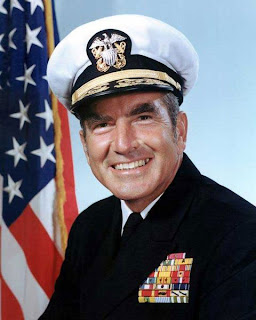
"I'd rather make ten major decisions a day and later have to reverse three, than to study issues to exhaustion and make one decision a week—often too late."Last month, by popular demand (and a bit of lobbying), CNA posted CNA Research Memorandum 93-22, On His Watch: Admiral Zumwalt's Efforts To Institutionalize Strategic Change (PDF), by Jeffery I. Sands, Jul 1993 on the CNA website. If you haven't read it, it is worth the time to read in full.
- ADM Elmo Zumwalt
The study is too comprehensive to list all the various pieces of goodness, but the analysis does discuss the various concrete steps that can be taken in policy-making to institutionalize strategic decisions - and looks at it from a CNO perspective (Zumwalt's). It examines four basic stages in the decision-making process:
- Initiation, the first formulation of a proposal (or an agenda) to respond to and deal with a new need or problem
- Persuasion, the effort to build support for the proposal and formulate options to carry it out
- Decision, the phase where options are examined, approved, or vetoed by those with the authority to do so
- Execution, the phase in which policies blessed with legitimacy are carried out and sometimes adapted or distorted.
History of course cannot be used as a sole guide to the future. But if Adm. Zumwalt's style led to the results discussed, the lessons for today are clear, even given the different context of strategic and conventional force threats, economic and political conditions, and bureaucratic interplay.
InitiationADM Greenert is off to a fast start. I have nothing but praise for the CNO Tenets already discussed, and I noticed the CNO's second move was his speech at the 20th International Seapower Symposium (PDF) to the international community. It is my sense that the next speech is going to be very important.
Be bold
Change can be evolutionary or revolutionary. To be institutionalized during a single four-year term in office, however, vectors of change have to be more revolutionary than evolutionary in nature. Otherwise, one's efforts could be overcome relatively easily by those opposed to the idea of change itself. Being bold is neither a necessary nor a sufficient condition for successful institutionalization. That is, evolutionary changes can become institutionalized, and revolutionary changes can fail, not only on military-technical grounds. But boldness can help ensure high-level consideration and thereby influence outcomes.
Be quick
Because four years is a short time, it is better to enter office with a clear idea of where one wants to go. Hence, the more one formulates ideas before becoming CNO, the more time there is to implement them. This is especially critical for new CNOs in their first few months in office as the Navy bureaucracy and leadership expects and probably is more supportive of a new agenda.
Be specific
If vectors of change are too vague or ambiguous to permit them to become a ready basis of task definition, the precise tasks are likely to be shaped by the incentives of those tasked rather than by the preferences of those doing the tasking. Hence, the greater the task specificity embodied in the change vector articulated, the greater the possible influence of the decision-maker over outcomes. Again, task specificity is neither a necessary nor a sufficient condition for institutionalization, but it can influence outcomes.
PersuasionThis was where ADM Roughead was weak relative to his counterparts in other services. Part of ADM Roughead's challenge was that his external message was crafted for him in the form of The Cooperative Strategy for 21st Century Seapower. Another problem ADM Roughead had was that he never developed a base of support outside the Navy that was willing and committed to working with him, while other services were busy building that support and finding allies among institutions like the think tank community, academia (See how the Army advanced COIN doctrine discussions into the public by leveraging academia), and established internet communities (consistent submissions to the Small Wars Journal, GO feedback to Foreign Policy blogs like Tom Ricks, etc).
Get a mandate from above
A mandate from above is essential if broad change is to succeed. This includes more than support from Congress and the civilian chain of command from SecNav through SecDef to the White House. Because of Goldwater-Nichols, support from the Joint Staff, and especially the GJCS, may also be critical. The same may also be true of the Unified CINCs given their evolving role in setting requirements. The exact means of doing this will vary with the personality of the CNO and the senior naval leadership, but it needs to be done nonetheless. Direct, targeted personal attention by the CNO is an important part of any marketing strategy.
Find a hammer, and use it effectively
With the introduction of the CPPG/CPAM process, supported by the green-striper follow-up process, OP-96 became a critical element of Adm. Zumwalt's cross-mission, cross-platform prioritization process. Putting the responsibility for the process of internal analytic give and take under the direction of close allies in key decision nodes was critical to Adm. Zumwalt's efforts to institutionalize his agenda internally given the intra-service bureaucratic process. The responsibility for carrying out internal creative friction must be given to a trusted, independent body divorced to the fullest extent possible from parochial considerations.
Use a common language, especially one in vogue with OSD
It helped that Adm. Zumwalt's hammer was adapted from the process Secretary of Defense Laird was pushing from a DOD perspective. This helped ensure connectivity between the Navy and the larger DOD decision-making process. Given the emergence of a former systems analyst as SecDef, an "OP-96-like" capability may be important as much for external as well as internal strategy. More broadly, because the new SecDef is reshaping OSD, the Navy must be prepared to emulate whatever OSD process emerges and use whatever language emerges. Given Goldwater-Nichols, the same may also be true with respect to that of the Joint Staff.
Keep the focus clear and consistent
In sales, product recognition can be critical. Similarly, a clear moniker and consistent message can be critical to successful strategy institutionalization. Like in sales, trying to send too many messages at any one time can diffuse each discrete message and confuse the audience. Hence, narrowing one's focus can help strengthen the signal one is trying to send, thereby enhancing the prospects that it will be received, understood, and—by minimizing the possibility of misunderstanding or undermining—accepted.
Work the problem outside the Navy
Adm. Zumwalt spent a large amount of his own time - while he was CNO and since - trying to persuade people outside the Navy of the wisdom of his changes. Institutionalizing change will be far easier given — and far more difficult if internal opponents can gain - external allies.
ADM Greenert has an opportunity to change that. For example, does CNO Greenert know who Mike Few is? He and the Commandant should be briefed, and then they should call up various folks from shops like N3/N5, the NWC, NPS, and USNA and ask "Who do you have consistently writing for USNI?"
DecisionIt appears, based on limited reporting, the CNO is already doing some reorganization in OPNAV (and actually may have started this process while VCNO). A lot of ink could be spilled in comment on this topic, but I'll save my ink in quiet observation, for now.
Balance top-down and participatory management
Getting a ball to roll can take a strong push—depending on the strength of the opposing force (s). Overcoming inertia alone, however, does not guarantee that the ball will travel as far as or in the direction that is desired. In a dynamic environment, ensuring that the ball comes to rest near a desired destination requires an understanding of the environment and how it may respond to intervention. It also requires an understanding of how the intervention itself may change the environment through which the ball travels. In other words, changing the strategic focus of the Navy may require not only top-down intervention coupled with an understanding of the Navy bureaucracy, but also anticipation of how the bureaucracy might respond to that intervention. This requires consensus building and continued attention to the evolution of your initiative.
Reorganize: half empty or half full?
Organization theorists have long argued that institutional changes are almost always required to make strategy shifts by large organizations more concrete. Adm. Zumwalt quite deliberately sought to vest the sea-control agenda into the OPNAV organizational structure. Further, he intentionally "de-linked" both the barons and the czars from leadership roles in the assessment process. But it was not until the July 1992 OPNAV reorganization that Adm. Zumwalt's preferred philosophical approach—deemphasizing the warfare communities and giving prominence to mission areas—began to be realized. Yet this reorganization preceded final publication of ...From the Sea. To ensure future success, the assessment process subsequently established in the fall of 1992 may have to be more fully "institutionalized"— that is, more fully integrated into the OPNAV organizational structure by de-linking those with remaining community responsibilities from leadership positions of the individual joint mission assessments.
Establish an independent review body
Further, it is not clear that an independent review by those not involved in the process is used today. Adm. Zumwalt had used the CEP and CNA to provide ongoing independent review before making major decisions, thus obviating the need for a post-decision review. The current process should include some external review of major decisions, be it pre- or post-decision.
ExecutionThe budget process underway in Washington DC is an agent of change that is coming whether folks like it or not, so part of the challenge the CNO faces is how to deal with change forced externally on the Navy vice forcing change internally himself.
Get a watchdog and follow up
Without sufficient intervention by an agent of change from outside—outside and above—the prior experiences and professional norms of rank-and-file bureaucrats resistant to change can lead them to hinder or otherwise misdirect vectors of change. This could occur even in the absence of dedicated opponents moved by honest belief or interested solely in the maintenance of things as they are with which they have become identified. Without such assistance from outside, decision-makers need to establish independent watchdog agencies with the power—directly or indirectly through referral—to enforce compliance.
Encourage innovation
Change requires agents of change; radical change requires risktaking. Perhaps the greatest challenge of all, therefore, is to encourage innovative thinking without unduly prejudicing career incentives. To the degree possible, innovation should be encouraged by rewarding those who dare try something different, even if the effort ultimately proves unsuccessful. This could be done, for example, through the SecNav instructions to promotion boards, or by encouraging experimental innovation such as the Mod Squad and Project Lawrence.
With that said, one of the reasons I have studied ADM Zumwalt so much recently is that he dealt with many of the same issues CNO Greenert and the Navy faces today. ADM Zumwalt became CNO during the last years of a long land war in Asia (Vietnam) and civilian leaders in Washington were making very large defense cuts. The Navy was also facing a unique challenge at the time, a rising maritime power (in early 70s was a rebirth period for the Soviet Navy). Sound familiar?
Zumwalt developed a maritime strategy based primarily around the Nixon Doctrine in effect at the time, and the result was increased budget priority for the Navy. It wasn't enough money to prevent a post-Vietnam decline by the US Navy, but Zumwalt did drive a process by which a maritime strategy was developed conceptually, and later that strategy was adopted but significantly adjusted by John Lehman leading to the 600 ship Navy goal in the 1980s.
"He would rather shoot 1,000 arrows at the target and have ten hit than only shoot two and the two hit"Funny thing about innovation... it looks great on PowerPoint, but is hard because it involves the risk of not succeeding. Innovation rarely works on first effort, and lack of success today in the Navy too frequently translates into failure. Perception of failure impacts promotions in an officer community that is likely downsizing and is already competitive. I'd love to see more innovation in the US Navy, but I don't think the US Navy is organized in a way today that encourages innovation - rather it is my impression the promotion system is biased, even if only slightly in some cases, towards rigid consistency to pattern - not innovating new processes.
I don't want to imply that innovation doesn't exist in the US Navy, because it absolutely does - but I do believe it is fair to say the US Navy is not an organization that fosters and promotes innovation within their leadership community. I note that most stories involving innovation in the Navy begin in the enlisted community, and more than one person has noted that this is probably the case because folks in the enlisted community have less to lose from making mistakes.

No comments:
Post a Comment