
 I think this is worth highlighting. From the GW Facebook page:
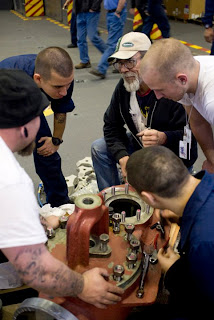
PACIFIC OCEAN (March 29, 2024) -Aviation Boatswain’s Mates (Fuel) aboard the aircraft carrier USS George Washington (CVN 73) accomplished an unprecedented undertaking at sea by moving a massive fuel purifier seven decks below with help from Puget Sound Naval Shipyard workers, March 29.The first thing I thought of when I read this story was how much work is being accomplished at sea vs at port. Japan isn't a war zone, but it looks like one, and while the USS George Washington (CVN 73) isn't exactly a causality of war... given the work being done on her, she might look like one.
The 4,000 lbs. jet propellant five (JP-5) fuel purifier being moved is responsible for separating the usable, raw fuel from water and sediment. JP-5 is repeatedly refined via the purifier to remove contaminants that have accumulated while the fuel sits in storage containers for later use.
The JP-5 fuel is extremely important to the functionality of an aircraft carrier. The fuel is used to perform a variety of functions including controlling the ship’s balance; fueling the fighter jets on the flight deck and the tractors that move stage them; and running the emergency diesel engines and auxiliary generators.
“We are replacing this critical piece of equipment while at sea because we did not have an opportunity to do it in port,” said Aviation Boatswain’s Mate (Fuel) 1st Class (AW/SW) Nelson Lubin, leading petty officer of George Washington’s Air Department, V4 division. “Under normal conditions, the unit would be replaced by qualified shipyard workers while the ship is in port. A large hole in the ship is generally cut to facilitate the installation of the unit—so us getting it done at sea, on our own, is an incredible feat.”
George Washington recently deployed from her homeport of Commander, Fleet Activities Yokosuka due to complex nature of the natural disaster that struck Japan on March 11. The turnaround time from under maintenance to fit for sea occurred in just five days. This resulted in some open projects and installations to be postponed until she was first safe and sea-worthy.
“I continue to be amazed each and every day we are at sea by what our Sailors and these civilian craftsmen are accomplishing,” said George Washington’s Commanding Officer, Capt. David A. Lausman. “They are working around the clock, putting their heart and soul into their work and I couldn’t be prouder to call them shipmates.”
The team of Sailors and their Shipyard counterparts successfully relocated the now-disassembled fuel purifying unit— similar in size to a Volkswagen Beetle—from the ship’s open hangar bay, down seven decks to a pump room via a ladderwell in less than eight hours time.
“I’m really proud of what our team did today. It might be the first time something like this has ever been attempted—at least for us it is,” said Aviation Boatswain’s Mate (Fuel) 3rd Class Richard Bell from Syracuse, N.Y.
“I really have to hand it to the civilian riggers. Without their help we would not have been able to accomplish this,” said Bell.
George Washington is the Navy’s only permanently forward-deployed aircraft carrier, ensuring security and stability across the western Pacific Ocean.
-GW-
I suppose I am wondering if what is being done on the USS George Washington (CVN 73) translates into a model for battle damage repair in the future. I don't see a scenario where battle damage can be done on an aircraft carrier at sea without civilian counterparts, so I do wonder if there are lessons here for developing an at sea battle damage recovery capability for our nuclear aircraft carriers.
Because quite honestly, in a major war where carriers are being damaged, I don't think the US is going to be in a position return a carrier to the US to put in dry dock for any length of time, and most battle damage will have to be repaired very quickly while the ship is avoiding the enemy at sea.

No comments:
Post a Comment