
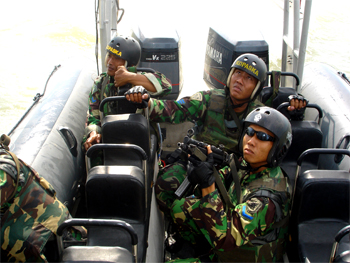
Building partner capacity is a key line of operation in our maritime strategy and the campaign to defeat terrorism globally. In addition to participating in numerous multi-lateral blue water exercises each year, the US Navy and other government agencies routinely support the development of partner naval, coast guard, and police forces to operate in the littorals. Combatant craft conduct a wide variety of irregular warfare operations including maritime security, special operations insert/extract, ISR, VBSS, riverine and coastal patrol. The US government’s capabilities to support the growing demand for small craft security force assistance is scattered throughout DOD and other agencies.
On the Naval Special Warfare side, NAVSCIATTS provides courses and Mobile Training Teams (MTTs) to international combatant craft professionals. The command recently took delivery of four Safeboat 25’ Defender Security Force Assistance Combat Craft (Small). These craft will support NAVSCIATTS’ new Patrol Craft Officer Coastal Course, which is designed “to provide the student with specialized training in the employment and operation of a Patrol Craft in littoral/coastal environments.” In addition to NAVSCIATTS, NSW Special Boat Team detachments routinely deploy for Joint Combined Exchange Training (JCETs) on combatant craft operations. Notionally, NSW SFA efforts are designed to train their maritime SOF counterparts on NSW-combatant craft specific missions, but some of the partner forces NAVSCIATTS trains with clearly don’t meet that threshold.
In NECC, MCAST SFA det delivers “maritime expeditionary core capability training and instruction in the areas of small boat operations, maritime interception, weapons, maritime expeditionary security, maintenance, professional development, and skill sets external to NECC.” While deployed on Iraq’s rivers and lakes, the RIVRONs supported the training of Iraq’s riverine forces, and as they withdraw from this mission, there are additional opportunities to support riverine FID in other areas. Additionally, MESF dets have played a role in maritime security training.
The US Coast Guard deploys MTTs globally, both ashore and embarked on naval platforms to support host nation maritime law enforcement training.
Finally, the Justice Department’s ICITAP supports international marine police unit training.
At first blush, the multitude of small craft training teams and courses may appear to be redundant or wasteful. Low-end capabilities like these may seem like low hanging fruit to budget cutters. However, when looking at the overall demand globally for small craft training - especially in Africa, the nation’s small craft SFA capacity seems about right. Yet there is clearly room for improvement and efficiencies in how these capacity building efforts are allocated and deployed across the COCOMs. Better coordination must occur across the Navy (especially between SOF and non-SOF staffs), interagency and with other partner nations who have similar SFA functions. This coordination responsibility falls on the shoulders of security cooperation planners in the geographic combatant commands, and their naval and special operations components.
The opinions and views expressed in this post are those of the author alone and are presented in his personal capacity. They do not necessarily represent the views of U.S. Department of Defense, the US Navy, or any other agency.

No comments:
Post a Comment