
 From the CNN blog.
[Update 8:38 p.m. Cairo, 1:38 p.m. ET] A team of heavily armed Marine Corps security personnel have been sent to the U.S. Embassy in Cairo to provide additional security for the facility, defense officials tell CNN. The small team of Marines, about a dozen according to one of the officials, are part of a Fleet Antiterrorism Security Team (FAST). The Marines are inside the embassy perimeter. Egyptian military and security forces continue to provide security outside the embassy, the officials said.The history of revolutions over dictatorships is not a bloodless story.
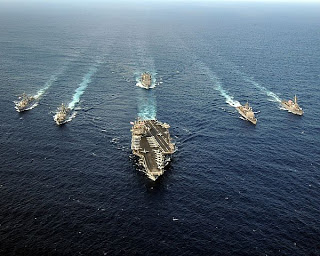
The USS Enterprise (CVN 65) and the rest of the carrier strike group have wrapped up their weekend visit to Portugal, and it's a safe bet the Big E is heading to Egypt.
The Suez canal, as a major global choke point, is reason enough to send an aircraft carrier strike group to monitor events in the eastern Mediterranean Sea - but we must also acknowledge that unfolding events are bigger than the Suez. Revolution is leading to instability and unknowns, and the interest of the US is rooted squarely in stability and predictability.
The strategic communication in Egypt is being well orchestrated to blame the US for allowing Egyptian President Hosni Mubarak to remain in power. How can the US influence this perception without blatantly tossing President Mubarak under the bus? What can the US Navy do to support stability in the region? Is there a role for the US Navy in the ongoing information war taking place in the region regarding the role of the US? Presence alone sends a message, so if we answer no to the last question, then I would argue we have not fully developed a clear and in-depth understanding of what impact presence has on strategic communications in the modern era of communications. Allowing others to interpret our signals for us should not be an option, so why we go where we go must be clearly stated - particularly when there are stresses to information and communication streams as there are today in Egypt.
For example, now would be a good time to ask the folks at Al Jazeera if they would like to put a camera crew and a reporter on the USS Enterprise (CVN 65). Seriously, one smart diplomat and a live broadcast from an American aircraft carrier on Al Jazeera might be all it takes to reshape the perception of America's role for Egypt right now.
This isn't just an information war though, while the Egyptian Army has already pledged they would not fire upon civilians, the Egyptian Air Force remains firmly in the control of the Mabarak government. Nothing is going to displease (or flat-out outrage) the American public more than watching F-16s bomb civilians on CNN who are revolting against a dictatorship in the name of democracy. I can't imagine a scenario where the US wants to intervene in Egypt, and yet, I'm sure someone else can...
Someone answer me this - what is the strategic communication of the United States sending a major naval armada like the Enterprise CSG through the Suez canal while Egyptians are protesting in Cairo? Not only do we need to know what that answer is before we send our ships through the canal, but we need to make sure we are aligned with that signal as we go.
It doesn't take a lot of imagination to see how the US Navy can make a positive, productive impact on unfolding events in the region. It also doesn't take a lot of imagination to see how current events can go to hell in a hurry. If aircraft carriers are strategic assets with strategic purpose, we must also insure that the strategic communication associated with the strategic presence of aircraft carriers is well aligned and well communicated as part of the mission.

No comments:
Post a Comment