
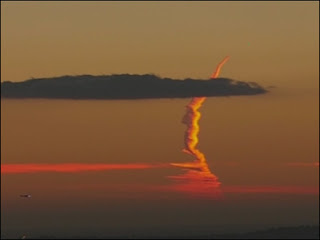
 The best quote of the day comes courtesy of the New York Times, quoting John Pike of Globalsecurity.org.
"The Air Force must ... understand how contrails are formed," he said. "Why they can't get some major out to belabor the obvious, I don't know."Exactly. When Twitter trends towards the topic "missile" and the Drudge Report goes front page with an event that requires a statement by the DoD - step one should be to engage the conversation. We live in an information age, and one could easily classify this the conversation phase of the information age given the way information is moved rapidly throughout various mediums in horizontal ways.
Today was an information mess in my opinion largely because there was no official information to work with. "I don't know" is a good answer during a math quiz, but doesn't fly when the topic is unexplained activity in US airspace off the coast of the nations second largest city. There are still questions on Wednesday morning because the official NORTHCOM statement does not rule out missile theories, nor does it confirm an aircraft created contrail theory.
It really was nothing but confusing inside the DoD system too though, which perpetuated the perception of confusion all day Tuesday. Even the folks in the information business weren't talking to each other inside the DoD because the Army, Navy, and Air Force information desks were sending phone requests to OSD - the wrong place - because OSD was sending all calls on the topic to NORTHCOM. I know this because I called the Navy first to go through this loop, only to call the Army and Air Force and get sent on similar wild goose chases.
In other words, everyone in the press making phone inquiries to official military information sources were probably getting the same run around I got. In the end, the editors picked headlines to 'mystery missile' stories that made the US military look clueless and confused - because the US military gave exactly that impression to the press making inquiries all day.
When the official information folks throughout the DoD demonstrate confusion, is it supposed to be surprising when NORAD can't officially confirm nor deny military activity 100% until after 15 hours or so? Noteworthy, 24 hours after the original event the DoD is still unwilling to call it an aircraft contrail with certainty, although I think most experts have settled on that as a valid explanation. The only question remaining, and potentially the issue that has the DoD reluctant to rule out the missile theory, is the perception the video gives regarding a corkscrew contrail - which would suggest it is a missile and not an aircraft.
This event has left me with the impression that even if all the early warning processes worked and the event itself was never a threat to national security, there is still a very serious national security concern revealed by the incident.
I have serious concerns regarding the system because it fails to communicate clearly to the public and truly opens up the system to potential exploitation through disinformation. If the government is unable to communicate during benign activity, why would anyone assume that during an actual emergency - or during a coordinated attack - the communication would be better? Noteworthy, it wasn't until there were media outlets reporting on the speculation of those in the Pentagon that the issue began to subside in terms of interest by the public.
As I was looking for official information that was nowhere to be found online, all I kept thinking about is how vulnerable the entire system is to a well coordinated cyber attack that could filter in bad, misleading, or misdirecting information during an event like this - particularly if it was coordinated at real-time. It is a good bet I wasn't the only person in the world who had that thought.
Ultimately, providing a menu of possible explanations that were nothing more than educated guesses to broadcast and cable TV journalists was ultimately proven to be a better information policy by the DoD than providing no information at all through NORTHCOM. Hopefully that lesson wasn't lost on the DoD. No information combined with no engagement with the community of information seekers is bad policy - and a strategic communications gap like that in the cyber age is begging to be exploited.
Two more quick takeaways:
- 20 years ago NASA would have been able to handle this whole matter in 5 minutes. Today, not so much.
- The Air Force still sucks. Do they have any experts on contrails or missiles that can look at a video and tell the difference? If they do, where are they? If they don't, they literally have their head in cyberspace and not in the sky where it should be.

No comments:
Post a Comment