
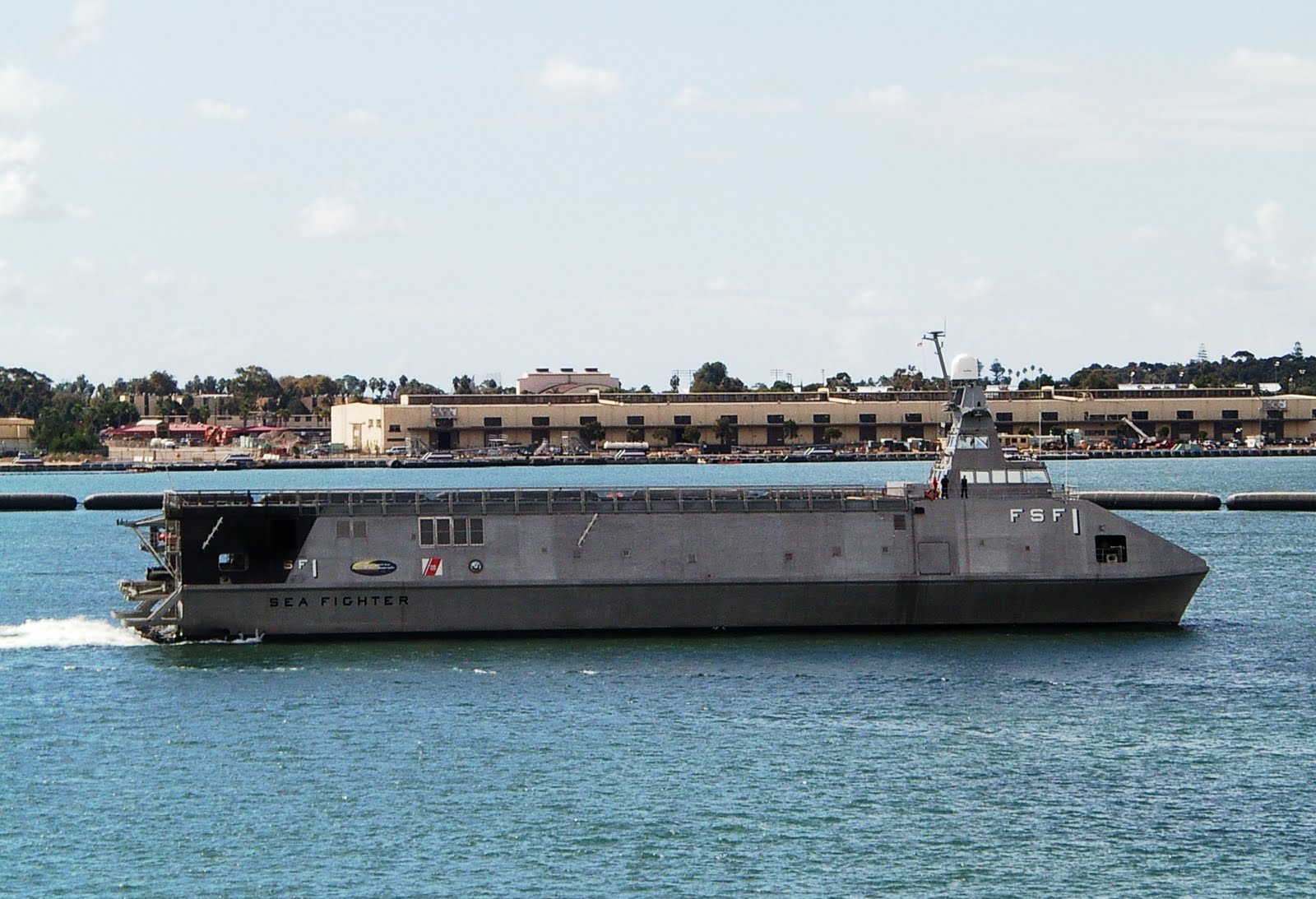
 In Defense News (subscription) earlier this week, Chris Cavas wrote an article discussing the future of Sea Fighter (FSF-1). It looks like the ship will never be more than a technology demonstrator, which is what it was designed to be. With that said, this part really annoyed me a bit.
The congressional provision in the 2007 defense authorization bill's conference report called for the Navy to "add weapons (offensive and defensive)" to the Sea Fighter.When the problems the fleet is actively dealing with at sea include simi-submersible submarines and skiffs used by pirates operating up to 1000 nautical miles from Somalia, the Navy looks outright silly with this line of reasoning. If the ship is better suited as a technology demonstrator, that makes sense. That a $3 million price gap is too much for the Navy to meet a Congressional mandate? Come on, that shouldn't fly with anyone.
The weapons capability would also mean the ship would have to operate as a commissioned, Navy-manned ship, as civilian-operated ships owned by the government do not have combatant capabilities.
But the Sea Fighter simply didn't make a very good warship, Kelly explained. "It's a very lightweight ship. It's a catamaran, not designed as a fully operational, all-weather platform. It is a test platform to prove technology," he said. "The ship was never de-signed to be an operationally deployable vessel."
Beyond that, there simply wasn't enough money, in the Navy's view, to turn the Sea Fighter into a fighter with a punch.
"Weapons have not been in-stalled due to Sea Fighter suitability issues for deployment, lack of funding, and restrictions associated with the civilian crew," Kelly said. "Based on the funding provided, the Navy is meeting the objective to improve Sea Fighter capability and upgrade aviation and damage control and firefighting capabilities."
Congress provided $23 million for the upgrades, but the refit will probably run closer to $26 million.
The key here is "operationally deployable vessel" which points to the idea of self deployment, a non-negotiable aspect of US Navy operations today. Never mind how this is a selectively applied mindset when it comes to minesweepers and PCs, and how a small vessel like Sea Fighter (FSF-1) should be given the same mindset. Hmmph.
The point of commissioning the Sea Fighter (FSF-1) was so that the Navy would take serious the opportunity to develop operations of small vessels outside traditional operational parameters. This was bigger than technology, this was about operations. The idea being to push the envelope of networked forces at sea in a new direction, and developing the logistics requirement for such operations, was never a popular idea. As Congress has consistently given the Navy a pass when they discard Congressional mandates the Navy doesn't like, it isn't much of a surprise the Navy discarded this Congressional mandate.
My question is what said here is valid?
- Does being a catamaran mean a ship is not designed a fully operational, all-weather platform?
- Are small ships incapable of being operationally deployable vessels?
- Are smaller ships nothing more than technology demonstrators?
- Is $3 million really a valid cost issue to refuse to install weapons?
- Is the civilian crew a critical component of Sea Fighter that cannot be filled by naval personnel?
- Are Congressional mandates selective, in other words, we can use the money for "this but not that?"
The rigid rejection of developing small platforms to meet the low end requirements will, in my opinion, long term be why the US Navy is exploited by smaller, flexible enemy forces at sea in the future. It will filter into everything, not only reducing the total number of ships the Navy has to operate, but influence the experience of Commanding Officers who for the most part will never know Command at Sea until after they have served 20 years. The lack of LT and LCDR Commands will be a factor during the next war, particularly if the adversary faced has officers experienced in Command earlier in their career. Given most potential adversaries are developing large quantities of smaller vessel networked organizations at sea, that last is a non-trivial issue.

No comments:
Post a Comment