
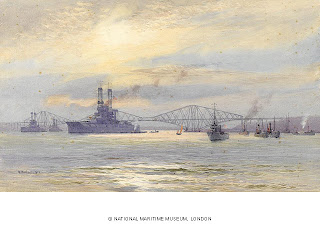
 Jerry Jones has a very interesting article in the Spring 2009 NWCR on the course of post-World War I naval negotiations between the United Kingdom and the United States. The RN and the USN emerged, with the internment of the German High Seas Fleet, as the two most powerful navies in the world. Dreadnoughts remained the most important currency of naval power, although the submarine had announced its presence with authority in the latter half of the war. The sticking points of the negotiations were the balance of power between the USN and the RN, and the disposition of the German High Seas Fleet. Wilson was initially in favor of returning some portion of the High Seas Fleet to Germany, in order to provide a counter to the Royal Navy. The British wanted the High Seas Fleet destroyed, while the French and others were in favor of distributing the German fleet (and the Austrian) among the Allied belligerents. These positions were essentially consistent with the war aims of the US and the UK; the United States favored the quick rehabilitation of a democratic Germany, while the UK (and France) favored the semi-permanent hobbling of German military power. The scuttling of the German fleet at Scapa Flow rendered the question largely moot, although a few German battleships survived.
Jones focuses on the posturing between the US and the UK over naval construction during the early part of negotiation. Having just fought and won a war against Germany in order to prevent naval parity, the British were unhappy to simply give it up to the United States. The United States remained displeased by the UK's wartime embargo against Germany, a wished in the future to have the capacity to force such a blockade. In spite of his idealistic vision of post-war international politics, Wilson was not immune to balance of power considerations. Although the United Kingdom's violation of US freedom of the seas wasn't as violent or egregious as the German, it still remained a difficult pill for the US to swallow. The notion of war, or even vigorous armed competition, between the US and the UK was not as absurd as it appears through hindsight; this was well before belief in the relevance of the Democratic Peace had taken hold. Both Britain and the US understood war to be a possibility, if not in the sense that it was immediately likely.
In my own research, I discovered several instances of USN admirals expressing concern over the idea of dispatching battleships to assist the Grand Fleet following US entry into WWI. At least one admiral argued that the Royal Navy would attempt to contrive some sort of confrontation between the USN and the High Seas Fleet, leaving the former in a weakened post-war state. It turned out, of course, that the battleships of the USN were largely irrelevant to the outcome of WWI, but that its destroyers would make a significant contribution to the First Battle of the Atlantic. The USN would eventually deploy a squadron of older coal-firing dreadnoughts to the Grand Fleet, as concerns about a lack of fuel oil prevented the dispatch of the USN's most modern units. I'm forced to wonder, however, whether anyone in the USN believed that USS Delaware was expendable, while USS Pennsylvania was not...
In any case, Jones draws several lessons from the episode, the most interesting of which is that diplomacy, naval power, and collective security are tightly tied together. Reaching a mutually agreeable settlement regarding the eventual balance between the United States and the United Kingdom was critical to efforts to create and maintain a viable post-war balance; uncontrolled competition between the two (and Japan) would, in all likelihood, have led to a much quicker degeneration of the post-war status quo, and might have created serious difficulties down the road for US-UK collaboration. As it was, the RN and the USN resented each other bitterly into the late 1930s, to the extent that political authorities had to pull teeth in order to create officer exchange and liaison programs. These difficulties slowed the development of ASW expertise in the USN. The situation might have been much worse if the RN and the USN had continued to take War Plan Red seriously. While the US almost certainly could have "won" a naval race with the UK in the 1920s, our overall security would have suffered, just as Germany was, on balance, weakened by its pre-war efforts to match the RN. In terms of modern naval construction, I think that the lesson would be that procurement cannot be conceived of separately from grand political strategy, alliances, and strategic doctrine. A robust conception of national security is required in order to provide a logic for naval procurement; the former should precede the latter, although in practice strategy is often forces to accomodate itself to force structure, rather than the other way around.


No comments:
Post a Comment