
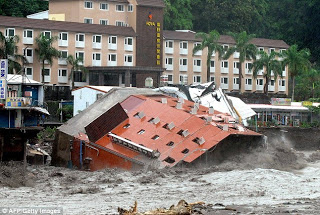
 When Typhoon Morakot slammed the Taiwan coast on Sunday, news reports suggested rain would be the primary cause of damage. Those reports have proven true, as a record 118 inches of rain has been suggested to fall in some places of Taiwan, burying villages and triggering massive mudslides. This storm has created a broad disaster on the island nation, but what is remarkable is how few people the storm has apparently killed relative to the amount of rain that has fallen. There is something to be said about the preparation efforts prior to the storm, and upon observation, there is also something to be said for the emergency response by the Taiwan military.
This is an older BBC report with some video of the damage, and this is another video. I quote from this is the latest AFP article that sets the discussion.
"We have found around 700 people alive in three villages last night and 26 more this morning. We are deploying 25 helicopters to evacuate them," said Major-General Richard Hu.The latest death toll is 66, with another 61 missing and 35 injured. Rescue operations to date have included over 17,000 troops using armored vehicles, marine landing craft, and RHIBs for rescue operations. In several southern villages, the roads have been washed out. The typhoon has caused at least $225 million US in agricultural damage, and 30,000 houses were still without power. AFP also reports that 750,000 homes are without water as of Wednesday.
Rescuers said Tuesday around 100 people in Hsiaolin were feared dead, while some media reports had speculated that up to 600 people had been killed in the landslide triggered by torrential rains brought by Typhoon Morakot.
As of late Tuesday, 219 people from Hsiaolin and several nearby villages had been airlifted to safety, Hu said.
"We believed that some were buried but it's not possible to estimate how many at this moment as almost 90 percent of the houses were buried," he said.
The storm has also moved into China, although now it is out to the Yellow Sea moving towards South Korea at much reduced strength. Among the damage reported, 6 apartment blocks collapsed due to the storm, and officials say they have managed to pull six people alive from the rubble in the town of Pengxi in Zhejiang province. The death count due to the current Tropical weather in Asia over the last week includes 23 in the Philippines due to Typhoon Morakot, 14 in Japan due to Typhoon Etau (16 have additionally been reported missing in Japan), and 6 in China due to Typhoon Morakot. To add to mother natures fury, Japan suffered from a 6.4 magnitude earthquake prompting the government to deploy 400 troops for disaster response.
What I find noteworthy though is how the USS George Washington (CVN 73) pulled into Manilla yesterday for a 4 day stay, and immediately Rear Admiral Kevin Donegan offered assistance to areas recently devastated by the Typhoon. In other words, in 2009 the forward deployed 7th fleet can get an aircraft carrier to the Philippines following a Typhoon faster than FEMA can get to the Superdome in New Orleans in 2005.
Storm season is approaching, and as it does weather is sure to be a topic of emerging interest on the blog this storm season as it has over the last few years. As is always the case, the maritime services almost always play a role not only in national response to disaster, but international response to emerging crisis following disaster in places less fortunate than the United States for resources managing crisis.
The Obama administration has made 'smart power' the emphasis of the new administrations foreign policy, and two legs of the smart power stool are humanitarian aid and disaster response. It is unclear if the DoD has been given any special political guidance beyond the Bush administration HA/DR policy in regards to these activities, but it is very clear from a political examination that HA/DR carries more emphasis as political policy for this administration, an emphasis sometimes inconsistent in the last administration. As climate change is also a major political position of this administration, it will be interesting to see if there is any noticeable activities by the maritime services in preparing for, or perhaps prepositioning for DR scenarios. After all, there is no question the 2004 Tsunami response was the major foreign policy achievement of the Bush administration, not only wiping out piracy in the Strait of Malacca but also creating a massive favorable, measurable shift in public opinion in several areas throughout Southeast Asia. That point is often overlooked, because the Bush State Department was so initially mediocre compared to the DoD in that effort.
With the George Washington arriving in Manilla just days after the Typhoon, clearly 7th Fleet gets it. It is about being in the right place, at the right time, with the right equipment. After all, according to this latest report in Science Daily, it was only last year the world saw the eighth deadliest cyclone recorded worldwide in history with a death toll that may have exceeded 138,000. Given the devastation of the 2004 Tsunami, Hurricane Katrina in 2005, and other recent Cyclones, Typhoons, and Hurricanes there will be few excuses for not being ready to respond to tragedy with prompt reassurance, - as outlined in maritime strategy.

No comments:
Post a Comment