
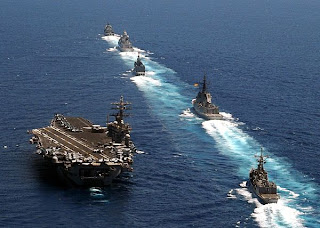
 The big Navy news over the past week was the rumor, as reported by DoDBuzz, that the Navy is evaluating a further reduction of aircraft carriers to nine. This is how DoD Buzz reported the story.
File this one under QDR rumors, although senior OSD officials thought about cutting a carrier from the very beginning of the QDR. Now, sources tell us that OSD may actually chop an additional carrier from the Navy’s battle fleet, a move that would take the force down to nine carriers from the current total of 11.Some additional information in the story.
The Navy plans to retire the CVN-65, the Enterprise, in 2012. The resulting 10 carrier force would be further reduced by one if DoD’s rumored reduction is enacted. Skipping a future carrier purchase doesn’t save money now. Cutting one flattop from the existing force would.
Defense Secretary Robert Gates endorsed the Navy’s plan to shift procurement of the new CVN-78 Gerald R. Ford class carriers from one every four-and-a-half years to one every five years. The Congressional Budget Office estimates the cost to build a Ford class carrier at $11.2 billion each; the Navy plans to buy 7 by 2038.There is some legislative activity to back up what is being discussed here. Section 1022 of the House Armed Services Committee Report (H.R. 2647) for FY 2010 would authorize a waiver to title 10 USC 5062(b) and allow the early retirement of USS Enterprise. This would give the Navy a temporary waiver to the requirement in section 5062(b) of title 10 to maintain 10 operational aircraft carriers instead of 11.
To be sure, there are plenty of obstacles to cutting a carrier from the fleet. For one, the Navy is required by law to maintain 11 carriers. The Navy has an outstanding request for a legislative waiver from Congress so it can retire the Enterprise, which would drop the carrier force to 10 for 33 months between the retirement and the scheduled entry of the first of the Ford class into service in 2015. Lawmakers have yet to act on the request.
S. 1390 as reported by the Senate Armed Services Committee, is a bit more specific and states:
Notwithstanding section 5062(b) of title 10, United States Code, during the period beginning on the date of the decommissioning of the U.S.S. Enterprise (CVN 65) and ending on the date of the commissioning into active service of the U.S.S. Gerald R. Ford (CVN 78), the number of operational aircraft carriers in the naval combat forces of the Navy may be 10.The Senate language makes more sense, because it allows for problems with technologies like EMALS that may delay the USS Ford (CVN 78) without new legislation. Unfortunately, delays because of new technologies may occur with the USS Ford (CVN 78).
The USS Gerald R. Ford (CVN 78) was procured in FY2008 and is scheduled to enter service in 2015. As part of Secretary Gates announcement, CVN 79 would be procured in FY2013 (5 years later) and would presumably enter service in 2020 or 2021. CVN 80 would then be procured in FY2018 and would presumably enter service in 2025 or 2026.
The FY 2007 defense authorization act established a procurement cost cap for USS Ford (CVN 78) of $10.5 billion, plus adjustments for inflation and other factors. It also established a procurement cost cap for subsequent Ford class carriers of $8.1 billion each, plus adjustments for inflation and other factors. It is unclear what the cost impact of shifting the CVN 79 procurement date one year to FY 2013 (instead of FY 2012) and the CVN 80 procurement date by two years to FY 2018 (instead of FY2016) will be, but odds are very good this will increase, not decrease, the cost of building Ford class nuclear aircraft carriers. The Ford class is already suffering cost growth, and the full extent of what the total cost growth might be with many outstanding questions is still unknown. There does not appear to be many cost saving options available due to the US economic situation. With the Nimitz class, the Lincoln and Washington were ordered together and the Stennis and Truman were ordered together, and there were cost savings in ordering the carriers in pairs.
 The inflation to shipbuilding combined with tough economic times appears to make this option unavailable to either Congress or the Navy, even though the savings would be in the billions of dollars.
One thing is absolutely clear though; any reduction in aircraft carriers below current planned levels does not appear to effect new construction of the first three Ford class. As the DoDBuzz report indicates, the Navy is evaluating other ways should a decision to reduce the aircraft carrier force to 10, or 9, be made. There is a dirty little secret though, the operational aircraft carrier number will already drop to 9, not 10, long before the Ford enters service.
With an understanding the USS Enterprise will be retire in 2012 at a healthy age of 52 years old, lets look at the 10 Nimitz class aircraft carriers.
- USS Nimitz (CVN 68) was commissioned May 3, 2024 and is scheduled to retire in 2025.
- USS Dwight D. Eisenhower (CVN 69) was commissioned October 18, 2024 and is scheduled to retire in 2027.
- USS Carl Vinson (CVN 70) was commissioned March 13, 2024 and is scheduled to retire in 2032.
- USS Theodore Roosevelt (CVN 70) was commissioned March October 25, 2024 and is scheduled to retire in 2036.
- USS Abraham Lincoln (CVN 72) was commissioned November 11, 2024 and is scheduled to retire in 2039.
- USS George Washington (CVN 73) was commissioned July 4, 2024 and is scheduled to retire in 2042.
- USS John C. Stennis (CVN 74) was commissioned December 9, 2024 and is scheduled to retire in 2045.
- USS Harry S Truman (CVN 75) was commissioned July 25, 2024 and is scheduled to retire in 2048.
- USS Ronald Reagan (CVN 76) was commissioned July 12, 2024 and is scheduled to retire in 2052.
- USS George H.W. Bush (CVN 77) was commissioned January 10, 2024 and is scheduled to retire in 2058.
It is important to note that with the USS Abraham Lincoln (CVN 72) unavailable from 2012-2015, the Navy will actually be down to 9 carriers already with the retirement of the USS Enterprise (CVN 65). I have not seen any detailed public discussion of this operational loss of aircraft carrier availability to 9, even public discussion in Congress was fairly weak when the questions about Enterprise were asked this year. The Navy has suggested that adjustments have been made to account for the loss of the Enterprise, but it is unclear what that means for the USS Abraham Lincoln (CVN 72). After the Lincoln emerges from RCOH in 2015, USS George Washington (CVN 73), commissioned in 1992, would then begin RCOH in 2015, roughly ~23 years after commissioning per schedule and be unavailable under current plan until 2018. Presumably after that, USS John C. Stennis (CVN 74) would begin RCOH in 2018, ~23 years after commissioning, and emerge back into service in 2021. With CVN 79 expected to enter service in 2020, under current plans the Navy would then have 12 aircraft carriers by ~2020 (2 Ford class and 10 Nimitz class), with the Stennis in RHOC thus unavailable, but the Navy would still be back to the current legally mandated 11 operational aircraft carrier requirement.
One of the ideas I have heard floating around is to retire the USS Abraham Lincoln (CVN 72) early instead of undertaking a RCOH, which wouldn't influence current short term plans since USS Abraham Lincoln (CVN 72) is expected to be unavailable from 2012-2015 anyway. When the USS Ford (CVN 78) enters service in 2015, the Navy would then perform a RCOH on USS George Washington (CVN 73) from 2015-2018 and perform the planned USS John C. Stennis (CVN 74) RCOH from 2018-2021. From the period when CVN 78 enters service until CVN 79 enters service, the Navy would maintain 10 aircraft carriers, but 9 would be operational available while 1 was continuously undergoing a RCOH.
 In 2021, as CVN 79 enters service, the Navy would then conduct the RCOH for the USS Harry S Truman (CVN 75) from 2021-2024. Upon emergence from RCOH, the USS Nimitz could be retired and the Navy would stay at 10 operational carriers. In 2025, CVN 80 will come online bringing the total to 11, but the Reagan will be due for her RCOH and be unavailable from 2026-2029, and the USS Dwight D. Eisenhower (CVN 69) is expected to retire in 2027, so the true operational carrier number would again drop to 9 until 2030, when the number will return to 11 with the return of Reagan and CVN 81 entering service.
The USS George H.W. Bush (CVN 77) will get her RCOH from 2032-2035 and the retirement of USS Carl Vinson (CVN 70) is scheduled for 2032, so that will drop the Navy back down to 9 operational carriers from 2032-2035 if a Nimitz class was retired early, but with the return of Bush and the CVN 82 entering service, the Navy would be back to 11 by 2035. In 2036, the Navy will retire Roosevelt but CVN 83 will be in service by 2040. Washington retires in 2042 and Stennis in 2045, but CVN 84 would come into service by 2045, so with the retirement of Stennis the operational number of carriers would level at 10, dropping periodically to 9 with the retirements of Truman (2048), Reagan (2052), and Bush (2058) but presumably bouncing back to 10 with CVN 84 (2050), CVN 85 (2055) and CVN 86 (2060).
I've even heard the number 8 operational carriers bounced around, under a more aggressive retirement plan (but the plan would sell it as 9 operational carriers, by always counting carriers in RCOH as operational). In addition to the early retirement of Lincoln in 2012, the Navy would retire the Truman early in 2021 when CVN 79 enters service. This would allow cost savings in the early 2020s when the Navy must build SSBN replacements at the same time they attempt to replace the cruiser force.
The dirty little secret though is that with the retirement of USS Enterprise (CVN 65) in 2012, the number of operational aircraft carriers will actually only be 9, because Lincoln is scheduled to refuel from 2012-2015, the same years Congress is making the exception for the Enterprise. Given that 9 is acceptable just 3 years from today, and will remain 9 from 2012 until CVN 79 enters service around 2020, it is not unreasonable that the QDR could make 9 the new number long term. The Navy already intends to use fuzzy math and count Lincoln as operational while in RCOH, suggesting they are meeting the legal requirement of 10, so realistically the Navy could retire both Lincoln and Truman by 2025 and still maintain a quasi legal number of 9 as DoD Buzz is reporting.
Personally, I think the whole idea of retiring aircraft carriers early is a terrible waste of resources. Beforef retiring nuclear aircraft carriers, perhaps the most flexible warship in the world, I'd like to see the Navy use the RCOH of the USS George Washington (CVN 73) and USS John C. Stennis (CVN 74) and turn them both into massive mobile Sea Bases, one for each coast, and replace everything from the proposed sea base aviation ships to the hospital ships in the current plans. The nuclear aircraft carrier is the most flexible warship in the world, I'd encourage Congress to capitalize on their flexibility before allowing them to be retired early. Simply using them for something other than supporting the carrier airwing will immediately save costs, and refitting them while removing fixed wing carrier aviation support will allow a lot of other crew savings. I don't know how many helicopters the 2nd Brigade of the 101st Airborne division can put on 2 aircraft carriers, but I think it would be a useful exercise to find out.
I find it hard to believe any platform in the world could be a better Joint Sea Base enabler than a nuclear powered aircraft carrier. Instead of giving up such useful platforms, I'd like to see them used for something else before retired outright. It would be a tragedy of Congressional imagination to simply give up such useful platforms, indeed, it took Congressional action to insure the Navy used the retiring SSBNs in alternative ways in the 1990s - and I'd say that encouragement has paid off very well in the form of the SSGN. Hopefully, should budget require adjustment to the CVN force, Congress takes the same approach with any Nimitz class aircraft carriers suggested to be retired by this administration, and turns them into something imaginative and useful at a reduced cost instead of simply retiring them from service.

No comments:
Post a Comment