
 Bill Gertz delivers interesting news from the recent meeting by Army Chief of Staff Gen. George W. Casey Jr. in China with this weeks Inside the Ring.
Army officials are trying to put the best face on the less-than-friendly reception given to Army Chief of Staff Gen. George W. Casey Jr., who got an earful of criticism from two Chinese generals during a visit to China last week.We have seen this kind of behavior before. There are many stories where US General and Flag officers will sit down for a cozy chat with PLA leadership and fireworks will go off. I particularly enjoyed when my fellow blogger Bryan McGrath told a story about current Director of National Intelligence Dennis Blair and his friendly chat with the PLA back in his days as CINCPAC.
On Aug. 20 in Beijing, Gen. Ge Zhenfeng, deputy chief of the general staff of the People's Liberation Army, accused the United States of failing to respect China's interests, triggering an argument and rebuttal from the Army four-star, according to defense officials familiar with the exchange.
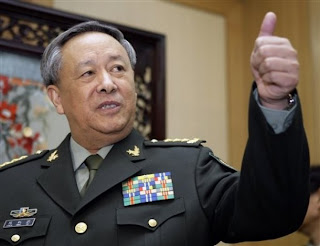
Then during a second meeting the same day, Gen. Chen Bingde, the PLA chief of staff, took the unusual step of allowing foreign news reporters to listen in during a photo session before the meeting when he told Gen. Casey that the United States was "challenging and violating our core national interests, and we have to react."
What I found interesting though was this quote attributed to General Chen Bingde. It is very informative.
Such coverage of U.S.-China meetings normally is limited to a few minutes of photographs before reporters are shuffled out of the meeting room and doors are closed.That may be Casey's interpretation in public, but I think Gen. Chen's comments are pretty damaging for China; very counter to how they attempt to control the message with their strategic communications efforts as a rising power. China's soft power approach is to build currency with regional partners giving themselves an image as an alternative to the current security order in the Pacific, and in some cases globally. General Chen's comments are counter to such communication.
Gen. Chen then told Gen. Casey that the U.S. had undermined trust by selling arms to Taiwan and that Washington is only friendly when it seeks Beijing's cooperation on terrorism and piracy, but then does "anything they want, even to offend the Chinese people." He said, "I don't think that kind of cooperation can continue."
Gen. Casey stated that "it's difficult to build a lasting relationship when we start from a point that 'we have a problem and it is you.' "
It goes to the idea of what transactions are taking place in regards to the global security environment. The transaction of western (European and American) grand strategy results in a common good towards global security. Western powers allocate military resources to address common threats to the global system, and the resulting security allows all nations to share the benefits from the free flow of goods and services, and as we have seen over the last decade, protection from terror attacks against western nations (which have had an economic component in the US and London).
In its essence, US and European policy is a liberal 'greater good' model of global security, particularly in maritime security towards the objective of providing a secure maritime environment for the free flow of trade. The 'greater good' of global maritime security is also a national interest of each individual western liberal economic power. The free flow of trade resulting from secure air and sea lanes has been a contributing factor to globalization.
The transaction assumes that threats to the global economic system, threats like piracy and terrorism, are common threats; shared threats by all economic powers. As a common threat the security responsibilities are thus addressed by military powers contributing collectively and taking responsibility, and the security services are managed by contributing nations. This global liberal security arrangement protecting global trade is often exercised in cooperation or through alliances like NATO.
One point here. Looking at the US and NATO military activities for Afghanistan, and even the Ethiopian military activity in Somalia, Russia has been a contributor towards the global security system where China has mostly not been. Other than a few recent UN engagements and the current pirate patrol that has come about over the last year, China has abstained from the global cooperative engagements against security threats against the global liberal economic system. Apparently some PLA Generals, like Chen, aren't ready to turn the page towards the collective security arrangements yet.
General Chen's comments appear to suggest that China doesn't really share a view of collective threats like piracy and terrorism, suggesting those are threats to the global system China should abstain from sharing the responsibility towards unless there is something to be gained militarily. I think it is striking in that China, as a nation dependent upon the global liberal trade order fueling globalization, is perhaps the worlds biggest beneficiary of the global security arrangement provided by other major powers. If China's true military intentions are truly for the ideals of global security and peace, offering assistance in threats to global security and peace specifically for national military strategy objectives like undermining the security of Taiwan seems like a strange way to demonstrate such intentions.
Chen's comments would be like Adm. Mullen suggesting the US should somehow not cooperate with Russia on terrorism or piracy issues because Russia isn't assisting with Iranian nuclear facility development. No US General or Flag officer has ever made such a public suggestion, indeed I am unaware of any G-20 national military figure ever suggesting that cooperation in fighting terrorism and piracy should be used as a negotiated good or service towards an individual nations national military strategy interest.
The stated government position that China's forward presence off the coast of Somalia is said to be contributing toward a collective good of maritime security. General Chen's comment to General Casey suggests otherwise, and unfortunately for China, General Chen's comment validates the concerns the skeptics of other Asian powers regarding China's true motivations and intentions to deploy ships to Somalia.

No comments:
Post a Comment