
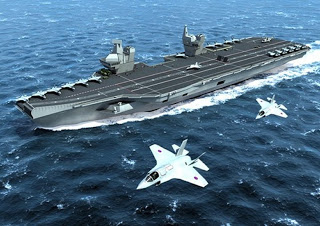
 As if the CVF wasn't controversial enough due to cost, it looks like a major design decision is being made regarding the CVF almost certain to raise the cost considerably more, not to mention substantially influence the F-35 Joint Strike Fighter program. While the US is looking to scrap the F-22 and move up the schedule for the F-35B for the Marines, the Royal Navy may be moving from the F-35 VSTOL version of the Joint Strike Fighter to the catapult variant known as the F-35C.
In a significant about turn the MoD has indicated that it will ditch the jump-jet version of Joint Strike Fighter in favour of the conventional model, as the planes for its two new aircraft carriers.Ahh we get to the heart of global politics of defense alliances in a nutshell. Every year for several years President Bush unsuccessfully tried to cancel the second engine, the Rolls Royce alternative, for the F-35. Every year Congress came through and funded the engine. President Obama is on the verge of potentially finally not funding the alternative Rolls Royce engine, and because of this, the MoD has no intention at all to pay for the alternative engine itself, thus has more flexibility to make decisions regarding the CVF.
The Daily Telegraph has learnt from senior defence officials that an announcement will be made this autumn.
The move, welcomed by many defence analysts and the Royal Navy, will mean that the MoD has wasted £500 million of taxpayers' money paid to Rolls Royce to develop the highly complex engine to allow vertical take-off similar to the Harrier jump jet.
But if the Queen Elizabeth class is going to use catapults, what does that mean? Well, it sounds like EMALS may be an option.
The decision also comes with some risk as the Navy will be reliant on the Americans developing a new electro-magnetic catapult to launch the fighters off the carrier.
"This is a real risk because the new catapult design is a major undertaking. It is not just a widget," said a defence aviation source. "If it breaks then the planes can't fly and the carrier is useless.
"Also the UK has no serving experts in this area of carrier flying so it's a real step in the dark."
In an official statement the MoD said: “To maximise the flexibility that the carriers will offer over their service life, they are being built to an adaptable design that can operate both Short Take Off and Vertical Landing (STOVL) and Carrier Variant (CV) type aircraft.”
It added that the STOVL or “B” variant of the JSF remains “our prefered solution”.
It is very difficult to tell what is happening with the MoD in this decision, because other than assuming the MoD will choose the least expensive option (cost vs capability, MoD chooses less money every time), I am not sure which option is the least expensive option.
As things stand right now, the British are looking to buy 150 F-35Bs, but just changing those into F-35Cs would produce a savings of over $3.7 billion US based on estimates of the F-35B costing £105 million and the F-35C costing £90 million. Then there is the suggestion that if the CVF has F-35Cs the greater range and payload will allow the British to buy fewer than 150 Joint Strike Fighters, further increasing the savings. Clearly some of the money would then be spent adding EMALS to the CVF design, but this plan still produces a clear savings when viewed only from a hardware perspective.
In the end though, I don't think this is going to save any money at all, in fact I would suggest this ends up costing the British a lot more money than they anticipate. First, the British haven't built an aircraft carrier able to catapult aircraft off the deck in 50 years, when HMS Hermes (now known as INS Viraat) was completed. Second, EMALS is hardly a foregone conclusion, that program has a huge cloud of unanswered questions right now. Third, the human factor of training and experience is not insignificant, indeed building up the training and skill sets needed for conventional air operations off an aircraft carriers for two aircraft carriers is a lot easier said than done. Finally, it is never a good idea to change the designs once construction already begins.
I do not think it is difficult to see why the MoD might be making this decision though. In virtually every discussion one of the primary factors driving aircraft carriers as power projection platforms is the ability to operate aircraft at very long range, and that ultimately leads down the road towards long range unmanned combat aircraft systems, all of which will almost certainly be conventionally launched from aircraft carriers throughout the lifetime of the CVF.
This is an important point, and may be what is driving the MoD decision process here. The CVF will almost be obsolete by the time it is launched in the middle of next decade in its expected role as a power projection platform against a peer competitor unless it has conventional launch capabilities. I am a huge fan of amphibious ships like the LHA and LHD, but VSTOL has shorter range and without catapults will not be able to launch the much needed long range unmanned aircraft systems that is needed to allow aircraft carriers to stay well off shore for operations.
In other words, in the 21st century defensive trends suggest Short Take-Off Vertical Landing (STOVL) is an expeditionary capability while Catapult Assisted Take-Off But Arrested Recovery (CATOBAR) is a power projection capability, and it is determined this way primarily due to the range and payload capacity of the aircraft that are launched via those methods. I think someone in the MoD has finally realized that the enormous investment the CVF represents simply makes no sense whatsoever without a Catapult Assisted Take-Off But Arrested Recovery (CATOBAR), because investing that much money into just two aircraft carriers that cannot be power projection capable vessels against potential peers is a terrible idea.
As this is a rumor, albeit a well reported rumor, it will be something to keep an eye on. In the end, probably a smart decision, although the smartest decision would probably be for the MoD to buy 0 CVFs and build a surface combatant and nuclear submarine fleet big enough to protect the interests of Great Britain. That is probably asking too much though.

No comments:
Post a Comment