
 Did anyone else see section 111 - section 113 from the Senate Armed Service Committee markup?
Treatment of Littoral Combat Ship program as a major defense acquisition program (sec. 111)I have never really had a sense the Littoral Combat Ship program was in any trouble on Capitol Hill even when Winter was canceling ships. This doesn't really change my perception in that regard, but the language is a bit tougher than I would have expected.
The committee recommends a provision that would require the Department to manage and report on the Littoral Combat Ship (LCS) program as a major defense acquisition program (MDAP).
The Weapon Systems Acquisition Reform Act of 2009 (Public Law 111-23) emphasizes the need to start acquisition programs on sure footing as a central mechanism by which the Department of Defense (DOD) can get control of cost growth and schedule slippage on MDAP programs. The cost and schedule reporting requirements in chapter 144 of title 10, United States Code, play a key role in ensuring that the Department and Congress are aware of emerging problems in such programs.
The Navy was able to avoid this oversight in the case of the LCS program by claiming that the program was just to build a handful of ships to test their capabilities and then see what the Navy wanted to build later. From the outset of the LCS program, however, program proponents within the Navy, including all three Chiefs of Naval Operations in office during the development of the LCS program, have invariably called this a 55-ship program. Some officials have even suggested that it might grow to be larger than that. The Weapon Systems Acquisition Reform Act of 2009 amended section 2430 of title 10, United States Code, to ensure that the Department include future program spirals in assessing whether a program should fall within the definition of a MDAP. That modification alone should cause DOD to define LCS as a MDAP, but the committee recommends this provision to remove any discretion in treating this program.
Had the Navy leadership been operating within the spirit of the title 10, United States Code, provisions regarding MDAPS, LCS would have fallen under the management and reporting requirements required for MDAPs.
No one can say that MDAP oversight would have prevented the problems of poor requirements generation, poor requirements control, poor program oversight, insufficient supervision of program execution, and abysmal cost estimating. However, when a program is expected to cost roughly $12.0 billion (even under the rosiest cost scenario), it should be subject to the requirements development, cost estimating, acquisition planning, and other requirements established in statute and regulation for the beginning of MDAP programs. Otherwise, we will have little chance of fixing such programs after they fall into trouble, and DOD will never be able to get control of its acquisition problems.
Report on strategic plan for homeporting the Littoral Combat Ship (sec. 112)Now this is going to be an interesting report. You can stick all 55 ships in Mayport (assuming the facilities existed to support 55 ships) and still not put the same number of people in that city as the Navy would by basing a single CVN there. BUT, concentration is going to be more important for the LCS than the frigates, because reasonable expectations would include a large number of shore support folks...
The committee recommends a provision that would require the Secretary of the Navy to report on the Navy's strategic plan for homeporting the Littoral Combat Ship on the east coast and west coast of the United States.
And that is going to be when crew size for the LCS goes from a naval debate to a political debate.
Procurement programs for future naval surface combatants (sec. 113)Nothing really new here, all this means is that force structure for the Navy will come out with the budget, but before the QDR. This is a lot of words that suggests the Senate sees what every one else notices, the Navy has a 2 year plan for surface combatants.
The committee recommends a provision that would prevent the Navy from obligating any funds for building surface combatants after 2011 until the Navy conducts particular analyses, and completes certain tasks that should be required at the beginning of major defense acquisition programs (MDAP).
For at least the past couple of years, the Navy's strategy for modernizing the major surface combatants in the fleet has been in upheaval. The Navy was adamant that the next generation cruiser had to begin construction in the 2011-2012 timeframe. After 15 years of consistent, unequivocal support of the uniformed Navy for the fire support requirement, and for the DDG-1000 destroyer that was intended to meet that requirement (i.e., gun fire support for Marine Corps or Army forces ashore), the Navy leadership, in the middle of last year, decided that they should truncate the DDG-1000 destroyer program and buy DDG-51 destroyers instead.
The Defense Department has announced that the Navy will complete construction of the three DDG-1000 vessels and will build three DDG-51 destroyers, one in fiscal year 2010 and two in fiscal year 2011. Beyond that, the plan is less well defined, and includes building only a notional `future surface combatant,' with requirements, capabilities, and costs to be determined.
Notwithstanding Navy protests to the contrary, this was mainly due to the Navy's affordability concerns. The committee notes with no little irony that this sudden change of heart on the DDG-1000 program is at odds with its own consistent testimony that `stability' in the shipbuilding programs is fundamental to controlling costs and protecting the industrial base.
The Navy claims the change of heart on the DDG-1000 program was related to an emerging need for additional missile defense capability that would be provided by DDG-51s and is being requested by the combatant commanders, and would be used to protect carrier battle groups against new threats.
The committee certainly believes that the services should have the ability to change course as the long-term situation dictates. However, since we are talking about the long-term and hundreds of billions of dollars of development and production costs for MDAPs, the committee believes that the Defense Department should exercise greater rigor in making sure such course corrections are made with full understanding of the alternatives and the implications of such decisions, rather than relying on inputs from a handful of individuals. The committee has only to look at the decision-making behind the major course correction in Navy shipbuilding that yielded the Littoral Combat Ship (LCS) to be concerned by that prospect.
Before deciding on a course of action regarding acquisition of surface combatants after 2011, we collectively have time to perform the due diligence that should be and must be performed at the beginning of any MDAP. That is what this section will ensure.
In addition, in order to deter any delaying action on conducting and completing the activities required by this section before 2011, the committee directs that the Secretary of the Navy obligate no more than 50 percent of the funds authorized for fiscal year 2010 in PE 24201N, CG(X), until the Navy submits a plan for implementing the requirements of this section to the congressional defense committees.
Report on a service life extension program for Oliver Hazard Perry-class frigates (sec. 114)Let it never be suggested that politicians care about defense dollars wasted, because there is no better waste of money than spending $300m on 30 year old ships just to get another 10 years out of them, when a new ship with a 30 year life that can perform the same function can be purchased with the same money.
The committee recommends a provision that would require the Secretary of the Navy to report on a potential service life extension program (SLEP) for the Oliver Hazard Perry-class frigates, to include: (1) costs and schedules for a program, and shipyards capable of conducting such a program; (2) a detailed plan for achieving a 313-ship fleet; (3) the strategic plan for the Littoral Combat Ship (LCS) to fulfill roles and missions currently performed by Oliver Hazard Perry-class frigates; (4) the strategic plan for LCS if a SLEP were performed on Oliver Hazard Perry-class frigates; and (5) a description of the manner in which the Navy has been meeting the needs of United States Southern Command during the past 5 years.
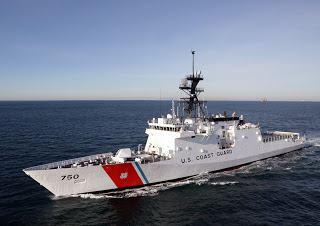
That new ship is called a Coast Guard Cutter. For the same cost of adding 10 more years to 30 frigates (which btw doesn't include support for Romeo's, that would cost more), Congress could build 10 more Bertholf class high-endurance cutters that could go at least 30 years.

No comments:
Post a Comment