
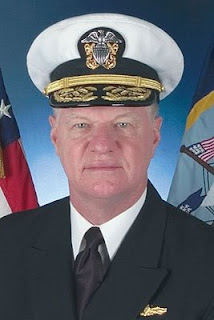
 Next week I intend to expand on the topics covered in Thursdays 2+ hours of Senate testimony by Secretary Ray Mabus (PDF), Admiral Gary Roughead (PDF), and General James Conway (PDF). If you haven't see the hearing or didn't follow it, the links above are to the testimonies and you can watch the entire Q&A video on the Committees website. This post represents some initial reactions, obviously with tons of details to follow.
For the most part, I have avoided discussion of the FY 2010 budget discussion until this point. I was left with the sense in April that the decisions by Secretary Gates regarding the Navy framed a direction forward, but the most important result of the decisions made by Gates in the Navy discussion was the way ahead regarding DDG-1000. That decision all at once removed the allbitross of the shipbuilding discussion from the neck of Admiral Roughead, and in my opinion he has been brilliant in the public ever since. Amazing what happens when he doesn't have to answer the same question asked 100 different ways every time he goes into public. I have watched many hearings with Admiral Roughead giving testimony, in my opinion Thursday he was at his best.
I think General Conway is underrated. He is clearly one of the most impressive leaders in the armed forces of this generation. The Marines are at war, have been consistently engaged since 2001, are in the process of growing the size of the Marine Corps, are emerging with still new technologies like the MV-22 that adds range and speed to the operational campaign, thus drastically changes how the Marines deal with the logistics and other challenges that come from such dispersion. They have as of this budget increased the planned size of the amphibious fleet to 38 ships, while also adopting new force structure changes including the establishment of the SC MAGTF. The Marines remain committed to fundamental core capabilities like amphibious assault, are embracing new doctrines like counter-insurgency, and yet the Marines are still adapting doctrine to leverage new capabilities with Sea Basing. Many of these changes are significant, and individually could create major problems to any large organization, and yet the Marine Corps according to General Conway is doing just fine thank you.
General Conway is doing one damn fine job in my opinion, and cannot be praised enough for the achievements the Marine Corps has made under his leadership.
I thought Ray Mabus did fine. Clearly he still has some learning to do on the shipbuilding, maintenance, and operational topics when fielding questions in testimony, but he was better than I expected him to be on the personnel issues, and fielded the mental health question very well.
Piracy
Roughead emphasized the operational security environment as the Navy's focus, and had nothing to offer as a service to US flagged ships. This answer appears to be a reflection of political policy. There are several ways to look at this conclusion, but for me it means the Obama administration is who is on the spot for the safety of ships right now, not the Navy. The DoD's role for the safety of US flagged ships, based on the testimony I heard and even Senator Webb's comment on the subject, is that piracy is a political issue not a DoD issue. It should be noted that on the piracy issue, Webb also made a comment that gave a clear nod to the Navy that being lethal when necessary, that being lethal is a good thing and aligns well to US policy. Sending messages regarding the dangers involved in piracy is the strategic communication strategic aim.
Maintenance
I hope the media starts asking more questions about the life-cycle management programs for fleet maintenance, because this might be the most important program ADM Roughead has established as CNO. It is noteworthy ADM Roughead mentioned the Virginia class as not only a model for how to design ships, build ships, and reduce cost of ships... but it turns out the Virginia class is also the program being used to scale estimating life-cycle management costs. The back log of maintenance facilities on the east coast and the funding short falls are impacting the Navy in a bunch of ways at a cost slightly less than $500 million. For me, the #1 issue towards achieving a fleet with a floor of 313-ships is fleet maintenance and modernization, not shipbuilding.
Shipbuilding
The number of amphibious ships now numbers 38. The LSD will reuse the hull form of the LPD-17, meaning a total of 27 LPD-17 mods will be built. I couldn't be more pleased seeing this stated in testimony. The future Command ship will be built on either the LPD-17 hull form of the T-AKE hull form. Roughead said many times the LCS is "where we will get our numbers" when discussing the LCS, so in his mind it is 55 or bust for the LCS. I never once got the sense any ship smaller than the DDG-51 is on his chalkboard. Roughead credited R&D for reducing the costs of the Virginia class, noted a budget increase for R&D for the rest of shipbuilding (have not confirmed this in the budget, need to do some homework), and cited R&D as a reason the Navy is moving forward with the SSBN(X) now instead of later.
I thought Roughead actually had a good answer to a question regarding how the Zumwalt translates into future ships. He discussed the DDG-1000 new technologies and cited the integrated air defense and BMD technologies of the DDG-51 and said that both will drive towards a cruiser replacement. That answer, for me anyway, gives some purpose to the three new DDG-51s and three new DDG-1000s, but I have a bunch more to say on this topic in detail later.
TacAir
This issue was clearly the one most discussed, specifically the fighter gap. I thought Senator Claire McCaskill was quite entertaining with her forceful approach, and did everything but wear her Boeing T-Shirt to the hearing. I have so much to say on this I'm afraid if I start, I'll write all night, but let me say that I had a problem with the way ADM Roughead talks about this issue in the context of the QDR.
ADM Roughead kept discussing how the QDR will evaluate the fighter shortfall of TacAir platforms by accounting for TacAir in all services to define the requirement. This is the issue with that answer, if the number of tactical aircraft the other services need carries influence for the number of tactical aircraft the Navy needs, then that would imply the total number of aircraft carriers is still under review, and a reduction below 10 aircraft carriers is legitimately on the table.
Why would the number of TacAir platforms in the Air Force matter in the Navy fighter shortfall discussion if Air Force TacAir can't land and take off from aircraft carriers? Isn't the numerical requirement for Naval TacAir determined by the number of aircraft carriers? If not, how is the requirement determined?
ADM Roughead suggested IOC for a N-UCAS program will be in 2020s.
Obviously there were many other issues discussed, including Ballistic Missile Defense, Mayport, and even a nod towards the issue of nuclear power for future ships. In my opinion, FY 2010 budget looked and sounded like the FY 2009 budget with only very minor differences. There was a lot of focus on the China, North Korea, and Iran scenarios, and while I could have missed it, I never heard anything regarding Green or Brown water challenges.

No comments:
Post a Comment