
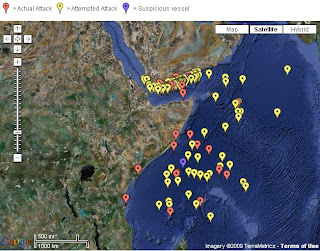
 Give credit where credit is due, Rear Admiral Michelle Howard has been doing a good job with CTF-151 leading the US Navy in efforts to address the piracy problem off the coast of Somalia. We know this because we are beginning to see metrics that suggest positive effects resulting from our operations.
While I don't think I can fully articulate what exactly the US strategy for fighting piracy is, and I have not seen it articulated from a US Navy officer yet, it is clear the tactics are good. According to IMB, as of June 1st, 2009 there have been at least 115 attacks against ships off the coast of Somalia. In all of 2008 there were 111 total attacks off the coast of Somalia. In 2009 there have been 29 hijackings off the coast of Somalia. In 2008, there were 42 hijackings off the coast of Somalia. Media reports have become a steady stream of reporting either killing pirates, capturing pirates, or turning pirates over to legal authorities by members of the international coalition. All of this suggests the tactics being used are having positive results.
This report from the BBC suggests we are seeing strategic influence regarding piracy though, and I highly recommend reading the article in full. There are three specific things in the article that stuck out for me.
First, it turns out that precision killing of pirates, and avoiding excessive force with overwhelming firepower, combines for a good thing (duh!). This is an interesting comment from a Somali woman discussing pirates in Puntland.
"They drive around in expensive cars, they offer our sons lots of money, so of course piracy is an exciting option," she says.Actually, the Indians, Russians, and British have all killed pirates too, but the Indians and Russians also got off to a bad start by killing innocent fishermen as well. Regardless, sending a clear signal to the population regarding the danger and potential consequences of piracy is good, not bad, as long as we are exercising good judgment regarding when to use lethal force.
"But nobody likes them any more, and now it's really dangerous. The (French and the Americans) have been killing pirates, so we think it's a really bad thing to do."
Articles on piracy lately have suggested a trend that the piracy business is not as prestigious as it used to be. There are rumors of entire tribes rejecting piracy altogether, and other articles noting that in the future, piracy may not be worth it anymore. These articles are suggesting a mood shift in Somalia, and as the BBC article goes on to discuss, there are communication operations working against the pirates inside Somalia.
When they began, Somalia's pirates cast themselves as "Robin Hoods of the sea" - as defenders of the nation's fisheries, first chasing away and later capturing foreign trawlers that had been looting the country's rich and unpoliced seas.Ahh, with power comes blame, and as piracy has expanded it has become a function of a criminal enterprise, not an exercise in governance. I don't know who the Puntland Students' Association is, but they sound like a candidate for strategic communication funding in Somalia.
Much of the money they took as "fines" went back into local schools, hospitals and businesses. No longer.
"They're responsible for so many problems," said Abdifatah Hussein Mohamed. As an activist with the Puntland Students' Association, Abdifatah and his friends have created a multi-media empire.
As the money distribution of piracy operations has become better understood, so has the depths of political corruption in Puntland been exposed. It is widely believed that President Abdirahman Mohamed Farole of Puntland is getting kickbacks from ransom money paid to pirates. That is why I think this comment in the same BBC article is very interesting.
President Abdirahman believes that he could bring piracy under control with barely a 10th of the money that shipping companies are paying out as ransoms.If President Abdirahman Mohamed Farole of Puntland is indeed getting kickbacks from piracy activities, does anyone else find it interesting that he floats a number like 7-8 million dollars? I think he just told us his price for cooperation. At minimum, we now know how much money it takes for someone to be a powerful warlord in Puntland. Think about it...
"With $7m (£4.4m) or $8m, we could set up security services and a coastguard that could stop this in its tracks… But the rest of the world has also created this problem by paying out ransoms," he said.

No comments:
Post a Comment