
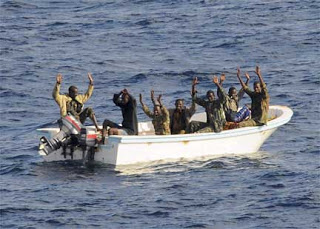
 After breaking off anti-piracy operations for an exercise with Pakistan, four NATO warships have resumed operations off Somalia and will continue its mission until June 28. The planned trip that would have taken the force to Singapore and Australia has been canceled as a response to the rise in piracy.
While more forces are very helpful against pirates, this activity in NATO is the real development:
NATO states asked military planners on Wednesday to strengthen the rules of engagement for its ships tackling piracy off Somalia after legal restrictions forced some to free pirates they had captured, a spokesman said.The article goes on to say that NATO is exploring a few options including seeking regional members to provide detention for captured pirates and exploring a possible UN role to form of a tribunal for dealing with pirates.
Alliance spokesman James Appathurai said the 28 NATO ambassadors also asked the planners to look into the possibility of an expanded, longer-term mission with a stronger mandate.
"This is a very serious challenge," he said. "The military will assess what is required and we will provide forces against that requirement."
The request by NATO ambassadors to plan for a long term mission is the first real political action I have observed. To date, testimony on Capitol Hill in our own country hasn't looked at solving the problem, rather understanding it. NATO looking for a long term role is a good thing, but it may not be a solution.
It will be interesting to see what comes of this. Will NATO come up with an alliance solution to the problem of piracy from the perspective of addressing the challenge of Somalia, or will NATO produce a military solution that is designed to protect merchant vessels from piracy? It is unclear if the political mandate exists to address the problem in Somalia, or simply address the symptom of piracy.
Given the choice, is NATO the best way to engage with the UN on piracy? It is unclear. While it is good to see European nations stepping up on the issue, this action moves to further highlight the disconnect between the EU and NATO in what this World Politics Review article rightly suggests is interblocking, rather than interlocking action. If the NATO RoE goes beyond the EU RoE, it could put ships of the same nation in a scenario where the response by one is warship is more restricted than the response of another. The press is going to love that...
Is it possible to develop a unified international command approach to fight pirates? Is this even a desired goal? I ask because while there is a lot of overlap in both the EU and NATO. Major participants including Turkey, Norway, Canada, and the US aren't in the EU, while both Finland and Sweden aren't part of NATO, which makes things even more complicated.
Neither NATO or the EU includes India, Japan, Singapore, Malaysia, South Korea, Russia, and China who are already participating in anti-pirate activities off Somalia.
With all five members of the UN Security Council engaged in anti-pirate operations off the Coast of Somalia, it seems to me the Obama administration is missing a real opportunity to reset the narrative of the 21st century following the Bush administration. How many times in history has every major power in the world had their interests aligned in a way where they gather naval forces together in the same seas to fight off the same threat? There are a number of ways to look at piracy, but one of them is the opportunity to make history. The irony being the effort is directly aligned with the Obama administrations foreign policy strategy, and the absence of a public mention of such cooperation has not been observed at the political level.
If it isn't being tried, shame on us. If it is being tried, it would be nice if the US government would tell the American people which countries are against it.

No comments:
Post a Comment