
 Some of this I understand, but some of this is bigger than just a few ships that have had accidents.
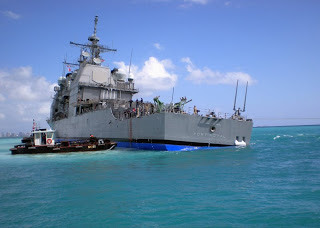
The Navy estimates it will need a total of $163 million to repair the cruiser Port Royal, which ran aground Feb. 5, as well as the attack submarine Hartford and the amphibious transport dock New Orleans, which collided March 20 in the Strait of Hormuz.The math suggests the Navy is in the red $163 million last year on maintenance costs. I think the Navy has a serious problem, and I think it is time to ask tough questions.
But the Senate Appropriations Committee plans to fund only $155 million in ship maintenance in the supplemental. The Navy would need a total of about $580 million to erase its current maintenance deficit of $417 million and pay for the repairs to its three damaged ships.
As I walk around the Joint Warfighter Conference I see plenty of training simulation software. The software looks impressive, but what about the results? Cost savings on the front end training maintenance for ships is not a substitute for working on a ship, doing something for real, and getting experience during training instead of on the job. The INSURV report that reviewed 2008 was not pretty. Is the problem shipboard maintenance or shoreside maintenance of our ships? Either way, the problem looking forward doesn't get easier as we reduce crew sizes as a desired metric for new ships in the fleet.
How many sailors on a Burke are specifically there to fight the ship vs there to service the operations of the ship? If more than half the crew is intended to service the ship, why are ships in the fleet failing INSURVs? Why is the Navy under maintenance budget $163 million? Something is wrong, and it suggests the problem is broad, from the training model all the way down to the service model.
Despite COTS, ships continue to get more complex, not less. All electric engineering does not simplify the operation of a ship, it increases the complexity thus increases the required knowledge of a sailor and an officer. Are we asking chiefs to make up for inexperienced sailors who come into the fleet trained? Are simulators effectively training sailors for the maintenance of the fleet?
The fleet we have, the 22 cruisers and 62 destroyers, will be the core of the US fleet for at least the next 25 years. If we are unable to keep these ships in fighting shape, how do we intend to maintain new ships that are more complex and have fewer crews. The Navy needs to get their hands around this problem, and make fixing the problem a top priority.

No comments:
Post a Comment