
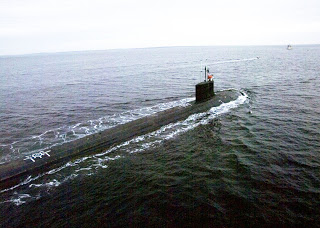
 You don't see this everyday. In fact, this is only the second time a submarine has won the award.
The Virginia-class attack submarine, which is expected to arrive at its new home port at Pearl Harbor for the first time in late July, received the award in Groton, Conn., on Thursday for its part in counter-drug operations off Central or South America.Virginia class submarines conducting anti-drug operations isn't exactly the stuff that justifies 2+ billion dollar expense. While I get it, and I won't talk about it, I have no problem with critics of the submarine force for things like this. For industrial base purposes alone, particularly as we are seeing construction costs rise to levels that make competition on the export market difficult, I seriously wonder if it is time to take a look at a few aggressor squadrons of conventionally powered submarines.
The operations took place in the Eastern Pacific in support of Joint Interagency Task Force South from Feb. 20 to April 17, 2008, the Navy said.
"I had no imaginable idea that this is what we'd be doing," said Sonar Tech Master Chief Petty Officer Bob Crossno, the chief of the boat for Hawai'i. "We're not doing the stuff we did in the Cold War or World War II. With our advanced technologies, we can interact with other fleets and other services to support maritime security operations."
Much of the submarine's support during the operations is classified, the Navy said
Given the award was given for intelligence purposes, it is entirely possible that nuclear power is what enables the submarine to be effective in this role.
If submarines become valuable tools in the low intensity fight for drug smuggling, building 8 conventionally powered submarines may be worth looking at. I'm not a big fan of conventional powered submarines for the US Navy, but I am not against looking into it either.
At the end of the day, the submarine community needs to find a better balance discussing capabilities without giving away classified data. Submarines are expensive, and the submarine fleet is unlikely to grow until they are able to explain their value to the taxpayer. I believe it can be done without giving away classified information, but I don't make those decisions.

No comments:
Post a Comment