
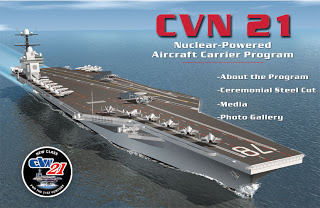
 The House Appropriations Defense subcommittee held a hearing on Wednesday with Allison Stiller, Deputy Assistant Secretary of the Navy for Ships and Vice Adm. Barry McCullough, Deputy Chief of Naval Operations for Resources providing testimony. As I understand it, the hearing was open but apparently very few reporters actually attended, after all, there is no budget to discuss right? John Murtha attended, and he asked some very good questions.
Emelie Rutherford has a report out on Thursday in Defense Daily (subscription only) discussing the hearing. In particular, she is reporting on some questions John Murtha apparently "peppered" those giving testimony on the topic of EMALS. The answers are very interesting (emphasis mine).
"We're looking at all options," said Allison Stiller, deputy assistant secretary of the Navy for ships. "There has been cost growth to the EMALS system. We're looking at the total cost of acquisition and life cycle for EMALS and steam. We're looking at the schedule and what does that do if we went back to steam...(and how that would impact) the CVN-78 (schedule)."Cost Growth? Steam?
"(We're) in the process of getting information from industry so that we can make an informed decision," she added. "We've had independent technical looks at it within the department."
At yesterday's hearing, Stiller said the cost-and-schedule comparison data is being prepared by Northrop Grumman [NOC] Shipbuilding Newport News, which last September was awarded a $5.1 billion contract to build the next-generation aircraft carrier CVN-78, the Gerald R. Ford.How is it even possible a 100,000 ton ship with a certified design already cutting steel is apparently facing problems so severe that the potential to redesign towards steam is real enough to mention in testimony, and yet there not a schedule issue?
Murtha asked if the EMALS issues will slow down work on the CVN- 78. Stiller replied that the Navy does "not see that it will have an impact on the actual schedule of the carriers at this point."
Allison Stiller goes on.
"There's a lot of rigor we want to go through for component testing, so that we understand the reliability of components, as well as system testing," Stiller said. "We're in the component-testing phase right now. We have seen minor issues in testing which we've been able to resolve. But there is some concern (regarding) schedule....One of the things we want to evaluate going forward is if the development (stage) is still ongoing, how do we mitigate the risk to this carrier schedule so that that doesn't hurt it. Right now we don't see it impacting the carrier schedule."Adm. Barry McCullough goes on to give the Navy's official line.
Vice Adm. Barry McCullough, deputy chief of naval operations for integration of capabilities and resources, told Murtha that the Navy has determined cost growth with EMALS has not exceeded lifecycle savings the advanced system is expect to generate because of factors including reduced personnel requirements.VADM McCullough is right about the massive savings potential the Ford class carrier will have over the Nimitz class. With the intended design that includes EMALS, the Ford class CVN cost savings will be enormous. If we look at manpower alone, if the Navy saves $75,000 annually on the 2000 additional crew members alone, and 75K per sailor annually is being conservative, the life cycle savings in manpower alone is around $7.5 billion. Add in the excessive wear on the aircraft caused by steam catapults and the energy- absorption system for aircraft landings, and the Ford class has enormous potential to save on operating costs.
McCullough said the Navy's current plan is to "continue with the Electromagnetic Aircraft Launch System."
"That's going to be briefed to the CNO (Chief of Naval Operations Adm. Gary Roughead) and the acting (Navy) secretary here in the next week to 10 days," the admiral said.
To review the odd series of answers given in testimony, there has been cost growth for EMALS. This was apparently not revealed in the opening statement, rather was admitted only when EMALS was asked about directly by John Murtha. The exact or even a ballpark figure for the cost growth was apparently never given, but given the options discussed, clearly the cost growth must be enormous. Allison Stiller testifies that the Navy is "looking at the schedule and what does that do if we went back to steam," yet apparently doesn't believe that the problem with EMALS that could result in a redesign to steam "will have an impact on the actual schedule of the carriers at this point."
That doesn't make any sense to me. How is that even possible? Is she expressing faith, dishonesty, or ignorance regarding how conflicting this combination of statements is?
If the ship has to be redesigned for steam, the ship will have to be redesigned not only for the launch system, but also to address the new landing system that is dependent upon EMALS as well. Not only that, you have to redesign the ship for more people, account for the changes to weight and balance, and who knows how many sections of the ship are going to need new plumbing, cooling, and water breaks that comes with a redesign for steam. One would expect this also requires a design change to the nuclear reactor, you know, since that is where the catapults would get the steam from. EMALS is gigantic, with three 80,000-pound motor-generators required for each of the four catapults, which consumes an enormous amount of the Ford class design.
How is it possible the Navy believes EMALS can be interchanged for steam without any impact to schedule? It isn't possible, it isn't even probable, which raises questions regarding the intent of the statements.
In what world does it make sense that a problem is so serious, and apparently so expensive that redesigning a 100,000 ton aircraft carrier for steam catapults AFTER construction has already begun is an option being seriously considered, and yet, the schedule for the ship is just fine? The cost growth for EMALS must be pretty high if the Navy is seeking input from industry on the cost and schedule impact of switching to a steam catapult. What is really telling though is that if the Navy has already actually got to the point where they are weighing the cost and schedule impacts of the redesign, including leveraging both the industry team and an independent internal analysis as described in the Defense Daily article, it becomes very clear that the expenses of the undisclosed EMALS problem is going to be very high.
I still have not heard of any specific problem with EMALS. What I do hear is the EMALS system described as a science project, and it simply doesn't work yet. It will be interesting to learn the results of the briefing Vice Adm. Barry McCullough suggests will be given to the CNO "in the next week to 10 days."
My take from the testimony is that the cost growth for EMALS is very high, and the delay options are not good regardless of whether the Navy changes to steam catapults or waits for EMALS. I also think that when John Murtha figures out he was essentially given a whirl in the Navy spin cycle, he is going to rightfully be upset about it.
Wednesday was the wrong way for the Navy to begin FY 2010 budget discussions. The new SECNAV has a lot of work to do. I would suggest starting by promoting an atmosphere of honesty and transparency before someone in Congress gets really pissed off.

No comments:
Post a Comment