
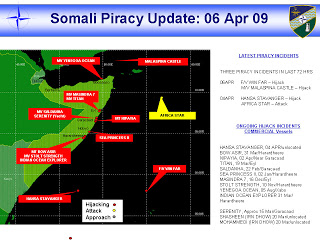
 It was a busy weekend for the international coalition of naval forces protecting commercial vessels off the Horn of Africa. The pirates of Somalia have changed tactics and are finding success attacking vessels in locations away from where international naval vessels are operating. Pirates are also hijacking more Yemeni boats lately and exploiting them as a launch platform for other attacks.
Even with the presence of Standing NATO Maritime Group ONE giving a helping hand to the EU Atalanta forces, US led Combined Task Force 151 forces, and a half dozen Asian naval forces; the number of attacks are increasing as are the number of hijackings. Despite the large international naval presence, the number of hijackings in
EagleOne remains the best source for the running tally of attacks, but it is getting very difficult to keep up. Noteworthy, SNMG1 did get into the action when the Canadian frigate HMCS Winnipeg (FFH 338), recently arriving to the region, scared off some skiffs tailing a tanker in the Gulf of Aden.
One of the smaller vessels hijacked may end up being the vessel to watch. After hijacking a Yemen fishing boat, pirates turned around and used the Yemeni fishing boat to hijack a French-flagged yacht with four crew members in the Indian Ocean. The recent history of piracy against French flagged vessels suggests these pirates might be in over their head.
Also hijacked over the weekend was a Yemeni tugboat, the Taiwanese ship MV Win Far 161, the British owned cargo ship Malaspina Castle, and the 20,000 ton German container vessel Hansa Stavanger.
Analysis:
The New York Times summarizes the problem very well with this quote:
Lt. Nathan Christensen, a United States Navy spokesman, called the rash of attacks “unbelievable.”It isn't just the US Navy, the naval power accumulated off the coast of Somalia includes the greatest collection of global naval power collected since the invasion of Iraq, and even with virtually every major navy in the world involved, the pirates are winning.
He said the Navy was concentrating its efforts on the Gulf of Aden, but that the area around Somalia’s coast was more than one million square miles of sea.
“We can’t be everywhere at once,” he said. “This is basically a case of where the cops aren’t, you’re going to go.”
What is embarrassing is that this is not only quite believable, but it is also quite predictable, because I have written specifically about how piracy was likely to unfold this way. The tactics and capabilities of the international naval force are specific to the combat scenarios that would match those warships against each other, rather than being guided by the nature of the environment and the tactical exploitations available to the enemy. The nature of the anti-piracy operations off the Horn of Africa are defensive and reactive, not offensive or proactive, and the pirates will continue to win under these conditions.
 Lets be blunt. The rules of engagement and the guiding legal principles being applied to fight piracy off Somalia are not sufficient to the task at hand, because to argue otherwise is to suggest the combined naval capabilities of virtually every major naval power is fundamentally inadequate to the task of securing the seas off the coast of a failed state in the 21st century, when in every century wood ships with sails were able to do it.
For all the rhetoric, the worlds Navy's are expending energy as a metric, while the results of continued hijackings clearly tell a different story.
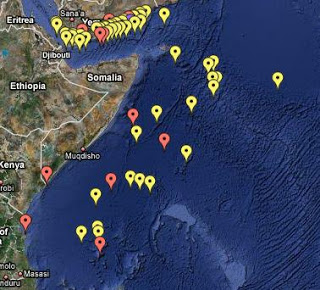
Piracy off the coast of Somalia is up, WAY UP, over 2008 despite all the assembled naval power. If there was any question whether the weather was what was keeping things slower earlier this year, the data seems to suggest weather may have been the only factor. To suggest the naval presence alone can make a difference is to ignore the tactical evolution the pirates have the option to make, and they have done that by simply shifted the attacks from the Gulf of Aden north of Somalia to the Indian Ocean east and southeast of Somalia. Through April 6th, the number of hijackings in 2009 now stands at 8 hijackings of major commercial vessels and several (I've lost count) other hijackings of smaller fishing and yacht vessels. In 2008, there were only 4 hijackings of all kinds total through the end of April.
The number of pirate attacks in 2009 are already over three times higher than 2008, and this is despite somewhere around 27 naval warships from various countries now specifically addressing the pirate issue. There is no question the naval forces are helping, without their presence many of the attacks that ended up unsuccessful would have ended with the ships being hijacked.
The pirates have evolved tactics. How long will it take the naval coalition to adapt? Presence alone does not suffice.
People thought I was crazy when I came out against fighting pirates. Look, we do not have the force structure to do this under the political policy that establishes a restrictive RoE, and we do not have the political will required to be successful with our existing force structure. The US Navy must make an organizational, realistic commitment to the littorals if they want to be able to manage these kinds of problems. That means distributed, sustained manpower and physical presence, not virtual presence with unmanned systems absent manpower represented in the Littoral Combat Ship.
How long before Europe, Asia, or even folks in the US get tired of watching the largest collection of the most advanced naval forces in the world get tactically embarrassed by the former fishing profession of a failed state? Unfortunately, this problem will continue due to lack of political attention until a major disaster strikes, and my bet is it will probably result in a massive environmental tragedy with widespread consequences for a country where the people are already struggling just to eat.

No comments:
Post a Comment