
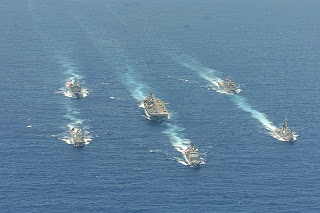
 I have long had the impression the only real influential change that came from Seapower 21 was the constitution of the Expeditionary Strike Group. I have also long believed the Navy needs to discard the legacy Surface Action Group and adopt a task force organization better optimized for the challenges of the 21st century.
I was clearly mistaken, because just as the Navy is turning back the clock to 1991 for the Arleigh Burke destroyer, the Navy is going 1991 with task force organizations as well.
As of March 9, the gator groups were renamed “amphibious ready groups,” reviving a term that was shelved several years ago, and combined with the name of their accompanying Marine expeditionary unit, said Lt. Cmdr. Phil Rosi, a spokesman for Fleet Forces Command. Although these were the first changes to come from a joint Navy-Marine ESG working group, they won’t be the last, he said.The article goes on to explain that Expeditionary Strike Groups aren't going away, because if an admiral or general officer is in command, it is still and ESG instead of an ARG/MEU.
So surface combatants will begin sailing separately as “surface action groups” — another older term — although officials don’t yet know how that could affect their deployments. He also said it wasn’t clear yet whether the surface groups would include set numbers of ships — a certain number of cruisers, destroyers or frigates — or how their missions could change.I love Jon Van Tol's comment on this development.
Retired Capt. Jan van Tol said it’s "unfortunate" that the Navy is returning to an older style of surface deployments, but he said he wasn’t surprised because top commanders never fully realized a strategy to deploy amphibs with warships.I have no idea what is going on. A change like this gives the impression Cooperative Maritime Strategy is a noun, not a verb.
"It’s completely back to the future. I guess ESGs weren’t as useful as we thought."

No comments:
Post a Comment