
As I have said many times, I really like Gene Taylor (D-Miss). He is a maverick, and I like people with fierce independent streaks. When I saw this, I admit I was very impressed. It is a very clever way to create constructive friction in debate regarding the future capabilities of the United States maritime forces.
Thursday, March 26, 2024 -10:00 am - 2118 Rayburn - OpenI wonder if the members of the House realize this has the potential to be one of the most interesting non-budget Navy discussions in Washington DC in many years. I wonder if CSPAN is paying attention, and sees how this could be one of the best made for TV debates we ever see regarding the defense debate. Hell, I wonder if FoxNews, MSNBC, or ABC even gets it. Think about it.
The Seapower and Expeditionary Forces Subcommittee will meet to receive testimony on the requirements for the future capabilities of the United States maritime forces.
Witnesses
Dr. Loren B. Thompson
Chief Operating Officer
Lexington Institute
Rear Admiral William Houley, USN (ret)
Mr. Ron O’Rourke
Senior Naval Analyst
Congressional Research Service
Dr. Thomas P.M. Barnett
Senior Managing Director
Enterra Solutions, LLC
Essentially, Gene Taylor has created a panel that will almost certainly contrast very different perspectives on the national security debate in this country. The panel will offer Dr. Loren B. Thompson's very industrial view in what will almost certainly be in enormous contrast to Dr. Thomas P.M. Barnett's strategic view. Those two may not agree on any single question asked by any member of the House, which is why this panel has all kinds of potential. The panel will also include Bill Houley and Ronald O'Rourke. If it was me, I'd sit Dr. Thompson and Dr. Barnett in the middle of the panel beside each other, and the other two on the ends so they don't get burned by any spontaneous fireworks that might break out in the creative friction.
I love this panel. Let us not forget Dr. Loren B. Thompson was one of SECNAV Winters biggest critics, because Winter was too critical of the shipbuilding industry. Let us also not forget Dr. Thomas P.M. Barnett was who wrote about The Seven Deadly Sins of Network-Centric Warfare, which btw, 10 years and 2 months later is a very interesting historical reflection of where we have been and where we are today.
RADM Bill Houley is also going to be a fascinating member of the panel. He is a former submariner, and has also written one of the most critical Proceedings articles published this year (available free). The key points of that Proceedings article suggests how he might add tremendous value to this discussion.
- Nuclear-powered cruisers are attractive but currently unaffordable even with the persuasive advantage of not having to pull up to the fuel pump.
- Building good hulls here or elsewhere and adding weapon systems after the fact is painful—as in the DD-963—but must be considered.
- Fleet Rehabilitation and Modernization (FRAM) is a concept that also has some appeal even though many would not choose this option for openers.
- The Coast Guard's National Security Cutter is an option the Navy should examine despite the need for significant militarization. Its characteristics (4,300 tons with USCG systems, 418-feet long, 21-foot draft) are attractive, a combined buy with Coast Guard would offer economies of scale, and we would have some choices as to how to arm it properly, even though we cannot turn it into a DDG.
- Not every ship needs to do every mission well, but we all should agree we don't want ships that have no legs and limited uses just so we can achieve a larger number.
- Other allied navies have similar challenges. We need to examine foreign designs, which could be built or assembled in the United States with our own systems.
- Minimizing crew size is a worthy goal, but we need to be realistic. Experience shows that promises of meeting the important requirements of maintenance and upkeep with outside organizations simply have not worked. Make sure each ship has enough crew members to fight and maintain her.
If I was giving testimony on the requirements of the future capabilities of the United States Navy, this would be my opening statement.
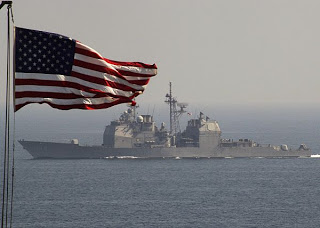 The Navy faces 2 very different challenges looking into the future. The first is the challenge posed by rising powers. Russia, China, and India have clear maritime strategies and all three have political support and policy guidance driving those strategies. China's is central to the sovereignty issues in the Pacific and resources in the Middle East and Africa (and South America is on their radar). India's is sovereignty issues in the Indian Ocean, but also resource driven from the Middle East and Africa. Russia’s is sovereignty in nature with the Arctic and North Africa for resources and influence, which is why they consolidate the Black Sea and deploy to the Med. The distant rising power is Brazil, and they are following the same model China and India did very early in the economic rise of those nations by building submarines (nuclear) first as a form of protectionism.
The major economic powers globally are in agreement regarding the priority to expand in one type of ship specifically: The amphibious ship, which in terms of prestige has become the modern dreadnought. The flexibility of the amphibious ship is unmatched by any other types of naval vessels. In addition to its hard power capabilities as a sea based resource for air-land-sea capabilities, the amphibious ship is also ideal for soft power engagements like the African Partnership Station and the Medical diplomacy we have seen with Operation Continuing Promise to Asia and South America. Major powers are building amphibious ships with modern medical facilities to act as hospital ships to the third world, although even China is building pure hospital ships. Russia’s military modernization expected to begin in 2011 is expeditionary in nature, which reinforces the trend towards the sea by major economic powers in the 21st century.
At the other end of the challenge spectrum we find the littoral challenge. Third world counties globally are acquiring inexpensive modern submarines at a rapid rate. The global coast guard in the third world... sucks. The most likely threats are inexpensive, but have historically been difficult to obtain (getting easier with the use of simi-submersibles for drug smuggling). Anti-ship missiles, mines, small boats, and cheap submarines top the list of technology threats, but the real strategic threat is that the maritime environment is fluid and complex, which doesn't fit neatly into planning for a modern Navy necessary to deal with very high technology threats and very low technology threats simultaneously. The maritime problems in the ungoverned maritime spaces are often criminal; smuggling drugs and smuggling people are far more widespread globally than piracy, but piracy must be taken seriously because it represents the asymmetrical offensive challenge likely to be conducted by and against major powers. The Somali piracy model is, in effect, the 21st century commerce raiding model. These low intensity challenges require a lot of ships to deal with, and all of our European allies are currently reducing the size of their naval fleets, and cutting back on deployments except in the case of Somali piracy.
Unmanned aviation systems can't fill the presence requirement of naval forces, because all they can do is watch or shoot. There has to be a sailor to enforce security. Today we use something like 10 international warships (cutters and PCs + some major warships around the oil terminals) to secure the coast line of Iraq... how long is the coast line of Iraq? We are not prepared to secure long coast lines overseas when required to do so, and it doesn't help that the Navy has not been developing survivable, low cost small platforms to populate the littoral spaces up to 25nm of shore. Survivability does not mean the greatest defensive capabilities offered by armor or technology, there are survivability techniques in aircraft that can be applied to small naval vessles to produce a combat credible capability with smaller ships (see sids comments on the blog). Unfortunately, small ships are not really shipbuilding for warfighting, small ships are inexpensive vessels primarily for peacemaking, and are never seriously considered by the Navy primarily due to tight budgets.
The last major strategic fleet alignment came with Seapower 21 when they broke the fleet into 3 groups:
- Strike Groups centered around an aircraft carrier and escorts including submarines
- Strike Groups centered around a Marine ARG and escorts including submarines
- Action Groups which is basically a cold war legacy.
The biggest challenge the Navy has in terms of money is manpower, so any realistic 21st century future force approach must include an across the board strategy for shipbuilding to manage crew sizes in a realistic way. Reducing crew sizes makes a ton of sense on the large ships, indeed probably the only admirable quality of the DDG-1000 idea was to build a large ship that had a smaller crew. I believe at sea, warfighting takes fewer people in the 21st century on large ships because weapons are smarter and we have unmanned systems to inform and act for the fleet. But the Navy also reduced the crew size of the LCS for a hard total around 75 sailors. This can be fixed up to a crew of 92, but the LCS is only half the solution to the littorals (92 allows the ship to function better and adds maybe 1 helicopter for a total of 2, and 3 unmanned helicopters). The reason the LCS is only half the solution is because it only supports the unmanned systems requirements for the littoral, and skips the human requirement.
The LCS needs to either be augmented with smaller vessels that can meet the manpower requirement, or replaced with another ship. If the LCS is replaced, another ship must be funded to meet the unmanned system requirement, and the Coast Guard's National Security Cutter hull cannot do that. Is Congress ready to support LPD-17 hulls for unmanned systems? For global coverage of unmanned systems, that could mean at least another dozen, or more LPD-17s. That approach could be very expensive, but no one ever talks about unmanned systems deployment alternatives when the discussion is replacing the Littoral Combat Ship, but that requirement emerges as one of the most obvious and challenging aspects of the LCS cancellation topic.
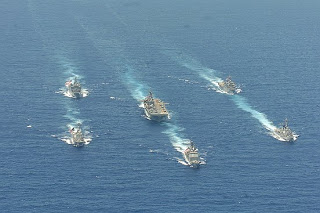 Iraq and Afghanistan have revealed the strategic miscalculation the Navy has made in their 21st century littoral strategy. The littoral is the populated maritime space, and represents the complex human terrain at sea just as population centers represent the complex human terrain on land for the Army and Marines. More human beings are a requirement for complex human terrains, and at sea that means a sailor is required for the physical engagement (cultural awareness) necessary to operate in populated spaces. The littoral combat ship platform delivers unmanned power to the littorals, but the Navy did not compliment this capability with a platform for delivering manpower to the complex human terrain. It is manpower that trains regional coast guards and learns the local culture during peacetime, not unmanned systems.
Secretary Gates talks about balance. Well, the Navy is out of balance. Right now the Navy has big ships with large crews for the major threats, and small ships with small crews for the more numerous small threats. The Navy needs to find balance by building big ships with small crews and small ships with larger crews. This would bring the 'unmanned/less people way of war' model in line with the 'manned/more people to win the peace' model back into balance, and best of all, the ships that end up needing more manpower are in the places where the Marines and Coast Guard are most likely needed on Navy ships, meaning we find true alignment with a bottom up (small ships) approach towards a national fleet and can share costs by including all our maritime service skills in those spaces.
Sea Basing means logistics. Global engagement means physical presence. High end threats require bigger ships but less manpower, but low end threats require more ships (thus smaller ships) but more manpower. The solution to the manpower problem is a joint services approach with a shared costs/resources/capabilities national fleet. Amphibious ships offer the most flexibility for peacetime engagement, but small ships are needed for wider presence nets and for local engagements (and as a cheap way to build up global coast guard capabilities).
The need for a new major surface combatant exists. The SC-21 major combatant strategy is a mess, and it is time to write it off as a plan and move on. The DDG-1000 is too big at 14,500 tons, size necessary to support the stealth requirement, and costs too much to build in affordable numbers. The DDG-51 is a cold war design, and cannot incorporate all of the new technologies that have been developed. The ugly reality is, the Navy needs to design a new major surface combatant somewhere around 10000 tons, probably very similar to the Burkes (the Navy may be calling this Future Surface Combatant (FSC) already), but with the modern technologies that have been developed over the last 30 years. This ship needs to be capable enough to meet future threats at the very high end of warfare at sea, but be cost effective enough to build between 40-70 total, meaning 3 ships annually for a price of around $5 billion annually in FY10 dollars.
Submarines are how we best hedge bets against major powers, but Aircraft carriers are still needed due to reduced bases and to meet the political desire to reduce global footprints of airbases in foreign countries. How many submarines and CVNs we need is a legitimate question. The industry can stay stable at 10 CVNs, one CVN every 5 years or 20 per century, and all studies confirm the big CVN is more cost effective than the many smaller carriers. Submarines is another issue, including the SSBN replacement. These are expensive systems, but critically important weapon systems at sea, which is why globally more submarines are being built than surface warships over 5000 tons. Logistics ships and MSC civilian ships, including JHSVs, have a lot to offer, but they also represent the most obvious soft targets at sea for 21st century irregular challenges.
Finally, there are systematic changes necessary to build enduring quality into our future defense strategies. Defense Policy changes when political parties change. Strategy is supposed to be enduring, but since policy is not enduring, and strategy is driven by policy, the Navy and Air Force in particular, who require long lead times for planning and highly sophisticated equipment to dominate the air and sea, are struggling in developing force structures to meet strategies influenced by constantly shifting political policies. A clearly stated, bipartisan supported defense policy is one of several necessary requirements for realistic enduring defense planning. Without that, the lack of policy guidance leads to a defense acquisition system very much akin to an annual shopping spree for weapon systems. That raises several questions:
1) Can the Obama administration provide leadership for developing a bipartisan defense policy?If #1 - #3 can be achieved:
2) Can Gates provide leadership for developing a defense strategy from defense policy that includes force structure requirements?
3) Has this political-military enduring policy-strategy link even been considered as part of the upcoming QDR process?
4) Do the military services have the leadership to execute towards the future?#4 is a political question for the President, while #5 is a political question for Congress.
5) Is industry prepared to support the requirements?
As you can see, the challenges facing the Navy are quite complex, and this summary only scratches the surface. There is a clear pattern of US Naval decline since the cold war, and it will take the combination of political leadership and leadership in the Navy to plan effectively at a time where our nations maritime services transition from a post cold war Navy into a 21st century Navy.
OK, its a work in progress, but that is the gist of what I'd say. I look forward to this hearing.

No comments:
Post a Comment