
 This Middle East Times article seems to put the struggles of the EU pirate fight into context, which of coarse is an opening for some to express their frustration and criticism.
Pirate attacks on EU ships, which carry valuable resources, are becoming a significant emerging threat to the EU and its well-being, according to a panel of experts.A UN bureaucrat complaining about the EU being dysfunctional. Why am I laughing? We turn to a naval officer to bring sanity and reason back into the discussion.
"There is not enough urgency, insufficient cooperation, weak coordination and inadequate commitment" surrounding the threat of maritime piracy in the Gulf of Aden, said Sandro Calvani, director of the U.N. Interregional Crime and Justice Research Institute at the Madariaga College of Europe Foundation.
"I think this is the first time we've seen all five permanent members of the Security Council actually have military forces operating in the same geographical region and to the same end," said Cmdr. Snowy Lintern, liaison officer of the force.He has other interesting thoughts as well.
But he pointed out that their five ships in theater are scarce. "The density of traffic is 250 ships per day," said Lintern. "Three thousand small boats are engaged in fishing off the coast of Somalia, and all of these 3,000 small boats are exactly the same vessels as the pirates use. So being able to identify which ones are pirates and which ones aren't is a problem for us."
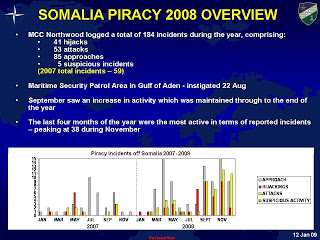
"Pirates don't have very sophisticated surveillance," explained Lintern. "Their ships are sometimes no more than four feet high, making range of eyes about six or seven miles, so if you're not very close to them they're not going to see you."With a drop in the number of attacks and no news of any captures, it would appear the pattern is consistent with last year regarding the activity of pirates in that region. While it is absolutely true naval forces have improved the safety and security of commercial ships, it should be noted that in Feb. 2008 there was one attack, and one hijacking. The third hijacking in that region in 2008 took place in April, and there have already been three this year despite all the naval forces.
...Progress has been made on the informational front, however. Through observation, the EU naval force has gathered sufficient information to offer sea merchants useful advice for safe passage. "It's fairly obvious that the pirates running out of Somalia and Yemen enjoy illicit not only activity but substance as well, and we find that sunrise until about midday is the most dangerous point," says Lintern. "They don't attack at night, because they haven't got the capability to do that, and from midday onwards they've been so busy chewing (the drug) khat in the morning that in actual fact their ability to attack after lunchtime is significantly reduced."
It is a good time to be holding these panel discussions, because if the last two years of history holds true, the first quarter of the year is the slow period.

No comments:
Post a Comment