
 Barack Obama's comments on Tuesday night regarding his strategic vision for the Department of Defense. The following is from the transcript of Obama’s Tuesday night speech.
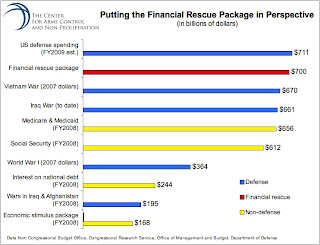
Finally, because we’re also suffering from a deficit of trust, I am committed to restoring a sense of honesty and accountability to our budget. That is why this budget looks ahead ten years and accounts for spending that was left out under the old rules - and for the first time, that includes the full cost of fighting in Iraq and Afghanistan. For seven years, we have been a nation at war. No longer will we hide its price.Navy Times is reporting the Obama administration is expected to announce the Pentagon's top line budget for the next 10 years will be pegged at $537 billion adjusted only for inflation. The DoD top line budget was $512.7 billion in FY2009, so the 2010 figure of the Obama administration represents a 3% increase from last year. On top of $537 billion top line DoD budget for FY2010, the Obama administration intends to seek $75.5 billion in supplemental funding to cover war costs through the rest of 2009, and the budget estimate for war costs in 2010 is $130 billion. For comparison purposes, the war costs in 2008 were $182 billion. To date, $66 billion of supplemental funding has been provided for 2009, so adding in an additional $75.5 billion makes the 2009 estimate $141.5 billion.
We are now carefully reviewing our policies in both wars, and I will soon announce a way forward in Iraq that leaves Iraq to its people and responsibly ends this war.
And with our friends and allies, we will forge a new and comprehensive strategy for Afghanistan and Pakistan to defeat al Qaeda and combat extremism. Because I will not allow terrorists to plot against the American people from safe havens half a world away.
As we meet here tonight, our men and women in uniform stand watch abroad and more are readying to deploy. To each and every one of them, and to the families who bear the quiet burden of their absence, Americans are united in sending one message: we honor your service, we are inspired by your sacrifice, and you have our unyielding support. To relieve the strain on our forces, my budget increases the number of our soldiers and Marines. And to keep our sacred trust with those who serve, we will raise their pay, and give our veterans the expanded health care and benefits that they have earned.
To overcome extremism, we must also be vigilant in upholding the values our troops defend - because there is no force in the world more powerful than the example of America. That is why I have ordered the closing of the detention center at Guantanamo Bay, and will seek swift and certain justice for captured terrorists - because living our values doesn’t make us weaker, it makes us safer and it makes us stronger. And that is why I can stand here tonight and say without exception or equivocation that the United States of America does not torture.
In words and deeds, we are showing the world that a new era of engagement has begun. For we know that America cannot meet the threats of this century alone, but the world cannot meet them without America. We cannot shun the negotiating table, nor ignore the foes or forces that could do us harm. We are instead called to move forward with the sense of confidence and candor that serious times demand.
To seek progress toward a secure and lasting peace between Israel and her neighbors, we have appointed an envoy to sustain our effort. To meet the challenges of the 21st century - from terrorism to nuclear proliferation; from pandemic disease to cyber threats to crushing poverty - we will strengthen old alliances, forge new ones, and use all elements of our national power.
The question is, how do we look at these numbers. It is inaccurate to add the baseline fiscal year budget and the supplemental budgets for totals, because the fiscal year budget ends on September 30th, while the supplemental budgets run until December 31st. This makes it very difficult to determine how much the actual operational cost of war and the DoD operational cost of business is, but we can do some estimating. The supplemental funding for the war in 2008 was $182 billion. The supplemental funding for the war in 2009 is estimated to be $141.5 billion. If we take 1 quarter from 2008 we get $45.5 billion, and three quarters from 2009 gives us $106.13 billion. Add in the FY2009 budget of $512.7 billion, and the defense budget for FY 2009 is actually somewhere around $664.33 billion.
That number is very important, because it not only describes how much money it costs to run the Department of Defense, but it also accounts for the amount of money our nation must spend in order to execute the political policies tasked to the DoD. Everyone who reads this blog should already be aware that since the cold war, there has been a steady increase, not decrease of operational demands on the DoD. With the current issue of Foreign Policy describing the emerging environment as the Axis of Upheaval, with the CIA now giving intelligence briefings to the President that include global economic conditions, and with John McCain giving his latest "We can't afford to lose" speech, this time for Afghanistan; the global security environment of the incoming Obama administration looking forward appears to be at least as uncertain as the Clinton or Bush administrations when they entered office.
I for one am very happy to see Barack Obama discussing the need for tough choices, because I think the first choice to look into is whether the Bush administration policy to increase the size of the Army and Marines was a smart choice. The Bush administration plans to permanently increase the active-duty end strength of the Army by 65,000 and the Marine Corps by 27,000 troops was done in large part based on expectations that the US would continue a policy of large scale troop deployments in major land operations. According to some estimates, this increase of troop strength is expected to add about $100 billion to the cost of the DoD budget over the next six years.
 A modest 3% increase in the defense budget does not seem to account for that, but Barack Obama seems intent on continuing that Bush administration policy. That suggests defense procurement costs will be cut. While there is lots of noise about the good things that could come from the Levin-McCain initiative (PDF), and I agree success in those efforts can be helpful, Barack Obama is absolutely wrong if he is talking about defense when he says "This is America. We don’t do what’s easy. We do what’s necessary." The fact is, if we are going to have a realistic debate on Defense costs, then both Obama and McCain (and Levin) are guilty of taking the easy road on choices because they are outright ignoring the tough challenges.
Lets go back to the 2009 defense budget and break it down.
Total budget = $664.33 billionIf you break down the major categories of the base DoD budget of $512.7 billion, you see where the costs are.
Base DoD budget = $512.7 billion
War Supplemental = $151.63 billion
Military Personnel = $124.8 billionBecause funding in the war supplemental also pays for additional manpower costs, and because I lack a breakdown of that spending, I cannot calculate exactly how much manpower costs are on the total budget, only the base budget. For the base budget, manpower costs run about 25%, about 20% higher than procurement costs. According to Aviation Week, the Pentagons health care costs for manpower are up about 144% since 2001, and this is before we add 92,000 additional troops. These figures also do not include base construction costs directly associated with existing and increasing DoD manpower, and we must also assume additional equipment costs will already cut into the current procurement budget to account for additional land forces.
Procurement = $102.1 billion
Research and Development = $79.6 billion
The cost of operations related to the wars runs around 23% of the total Pentagon budget. This figure can be described as the real cost of political policy. While this number is going to continue to come down over the long term as forces are reduced in Iraq, troop increases in Afghanistan are likely to slow any cost decreases in the short term.
It is very easy for politicians to complain about the high cost of procurement, and there is certainly cost growth in procurement that needs serious congressional oversight. However, it is inaccurate to suggest any hard choices are being made and that oversight is being applied evenly when health care costs are up 140% and the Obama administration is continuing a Bush policy of increasing the size of the total DoD force structure by 92,000 while not also increasing the budget to support those costs. Cost growth isn't unique to procurement, manpower costs related to health care, pay, and benifits is in reality adding a greater strain on the DoD budget, but the way media coverage is regarding defense costs, that fact appears to be largely missing from the discussion. It raises several questions what the strategic vision for the Pentagon is of the Obama administration, including whether or not the Obama administration actually has one yet. Did the Obama administration speech yesterday represent a well defined strategy already prepared looking to the future, or a bookmark pending a future strategic analysis?
The DoD faces enormous cost challenges, but while the procurement budget gets the bulk of the attention because it impacts the private sector, the data suggests the serious cost challenges are primarily due to the out of control growth in costs related to manpower. Where is the strategic discussion for the Department of Defense regarding Economy of Force among our political leaders? McCain and Levin are doing the right thing, but why did they make the easy choice to go after cost growth in procurement, when the hard decision was clearly to take on the challenge of cost growth in supporting the massive manpower of the military services? In the United States, Congress sets troop levels, not the President. Are the executive and representitive branches on the same page regarding manpower issues, or has there even been a discussion?
The DoD faces serious challenges in meeting the political obligations being placed on it for the common defense of our country. Not only must the DoD maintain superiority for our defense tomorrow, but as the largest and most capable political instrument of policy in dealing with international problems, the DoD ultimately finds itself providing security globally today. The Department of State, indeed the nation’s entire foreign policy apparatus can certainly take enormous strides in relieving the DoD of carrying the burden, but getting to that point will take time to develop. Let's be honest, the Bush administration both inherited and left the State Dept. a mess, continuing a pattern of degraded US diplomatic capabilities that began with the end of the cold war. It will take years to redevelop the serious diplomatic skills necessary for the 21st century. Until State can get fixed, America's public diplomacy will continue to wear combat boots.
The challenges we face with emerging global instability combined with rising great powers globally requires a clear strategy for Defense, and as Barack Obama says, tough choices. The question I have is when we will start seeing evidence that our political leaders are ready to take on the tough challenges, like the enormous increasing inflation associated with manpower costs in the DoD, as opposed to the easy choices of simply blaming the high costs associated with a shrinking industry in a country with a slowly dwindling industrial capacity. We need new, creative, and innovative ideas to accompany hard choices. I intend to discuss a few over the coming weeks, I hope others do to.
I leave you with an interesting accounting of how expensive the combination of manpower and operations has become in regards to our nations defense. Even in the worst examples of procurement inflation, nothing approaches this kind of cost growth. From Steven Kosiak of CSBA (PDF):
Estimates of the cost of conducting military operations in Iraq and Afghanistan have grown substantially and consistently over the past half-dozen years. This is true even adjusting for the changes in force levels (i.e., on a cost per troop/year basis). In September 2002, CBO estimated that—based on the costs incurred in the Balkans, Afghanistan and Desert Shield/Desert Storm—sustaining an occupation force consisting of 75,000-200,000 US troops in Iraq would cost some $19-52 billion a year. This equates to an average cost of about $250,000 per troop/year. CBO’s high-end estimate turned out to be fairly close to the mark in terms of the number of troops deployed in and around Iraq after the invasion in the spring of 2003. However, the costs per troop have turned out to be much higher than CBO anticipated based on the cost of past military operations.Hopefully the Obama administration takes time to invest in some creative peacemaking strategies that export security globally. Hopefully, someone in the Obama administration has the courage to make hard choices regarding DoD manpower, and tackle the challenges associated with the increases associated with manpower costs in the DoD. We need to begin discussing Economy of Force as part of our security approach to low intensity warfare challenges so we can maintain our strategic advantages over potential high intensity warfare challenges in the future.
In 2004, CBO released another estimate. This estimate projected the incremental cost of sustaining all US forces engaged in military operations, including not only US forces in Iraq, but those in Afghanistan and personnel assigned to Operation Noble Eagle. This new estimate equated to costs per troop/year of some $325,000. Part of the reason for this higher cost per troop/year is that CBO’s new cost estimate included some funding for classified programs, as well as support to other countries (“coalition support”). According to CBO, its new, higher estimate also resulted from a refinement and reevaluation of its methodology for estimating war costs. At the time, CBO noted that, even with these refinements, its methodology appeared to produce estimates that were some 12 percent below those that would be derived by simply extrapolating from DoD’s expected obligations from 2004 appropriations.
CBO also indicated that it was unlikely that this difference was attributable to increases in the pace of military operations (operational tempo, or OPTEMPO) caused by the worsening security situation in Iraq. It pointed out that most of the costs incurred in overseas military operations are associated with personnel, base support and other factors that are not usually correlated with OPTEMPO. Indeed, CBO noted that, based on DoD reports, costs driven by OPTEMPO appear to account for only about 10 percent of the total costs associated with the war in Iraq and other military operations.
In 2005, CBO again increased its estimate of war-related costs. This time, its estimate equated to costs per troop/year of about $450,000. However, unlike CBO’s 2004 revision of its earlier cost estimates, this change does not appear to have resulted, at least primarily, from a refinement of its methodology. The new estimate made use of a new CBO methodology to estimate the costs of equipment repair and replacement requirements. But for all military personnel and other operations and support (O&S) activities (representing the bulk of the costs associated with military operations), CBO based its estimate not on an independent “bottom-up” assessment but on a simple extrapolation of obligations data reported by DoD in 2004, adjusted to take into account inflation and changes in personnel levels.
Since 2005, CBO has revised its estimates of GWOT costs several more times. Most recently, in March 2008, figures released by CBO indicate that, over the long run, costs per troop/year would average some $775,000. This is some three times more than CBO projected in 2002, based on the cost of recent past wars, and about 70 percent more than its estimate from 2005. In this case, the estimate appears to be based primarily on an extrapolation of funding levels included in the 2008 supplemental request, adjusted for inflation and changes in force levels.
The 8 years of George Bush resulted in 10% steady budget deficits, which means we can realistically suggest that at least 10% of the costs of war operations have been borrowed. These debts mean there is interest to pay down the road, thus making actual operational costs as a result of political policy much higher than just what we have spent to date.
This is the only war in our nations history where we have not raised taxes. The American people have largely not felt the burden associated with the costs of our national security policy in the 21st century. Something has to give. I say bring on the hard choices debate our President is calling for, but when that debate comes, I hope the American people arm themselves with good information because many politicians will take the easy road and just blame procurement. The costs of political policy and the costs of manpower are greater than the costs of procurement, have much greater long term consequences to our defense strategy, and raise the question whether we will make hard choices when it comes to defense, or simply take the easy way out and put all the blame on industry.
Additional budget resources in this post can be found here (PDF) and here (PDF).

No comments:
Post a Comment