
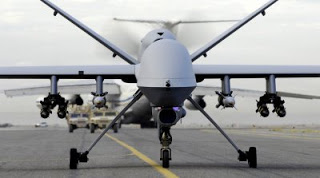
 Check this out. A very interesting evolution of the UCAS concept for naval operations.
U.S. Navy plans to fly the Reaper unmanned aircraft system from forward locations mark a "huge change" in the way the vehicle is used, a top service official said Feb. 5 at AUVSI's Unmanned Systems Program Review 2009.This article is just loaded with good stuff though. We are unlikely to hear much about what is going on in full detail, but even small details like this give us plenty to talk about.
Rear Adm. Mark W. Kenny says flying the Reaper closer to forward ships and sailors--and even controlling its weapons and payloads from sea--will ease up on bandwidth restrictions and will get critical data to his warfighters sooner.
"We can get a higher bandwidth for an aircraft that's flying overhead," he says.
The forward operation of Reapers by the Navy is a program known as Saber Focus, which is mostly classified. According to the United States Fleet Forces' 2009 Annual Plan, it's a one-year combat demonstration to assess the military usefulness to the Navy. Kenny says forward-based ground control stations will handle the flying, instead of operators at Nellis Air Force Base, Nev., but sensor packages and weapons will be "controlled from sea.
To that end, the Navy plans to procure unmanned systems with relatively simple launch mechanisms, deploying autonomous vehicles from the surface rather than beneath the water. Kenny said unmanned systems would help the Navy to watch costs and would also alleviate some of the stress on SEAL teams, given the heavy requirements made of them by commanders and politicians.
"We need to get the man out of the loop," he said.
Kenny also said he is focusing on large-diameter unmanned underwater vehicles. Instead of using them for broad sweeps of the water, such as for anti-mine work, he'd like to stuff them with sensitive instruments and sneak them close to shore where they could overhear and relay signals intelligence, he says.
"Ideally we could have a series of them to cover ports or hotbeds of activity and they collate that [data from the UUVs] on the ship," he says. Pennsylvania State University has the lead on that work, he says, but like Saber Focus, it "gets classified real fast. What we're doing is responding to needs from the front."
I read that as... the Navy believes they can replace submarines with large UUVs with links to a ship for roles of off coast intelligence gathering. I've heard about something similar before.
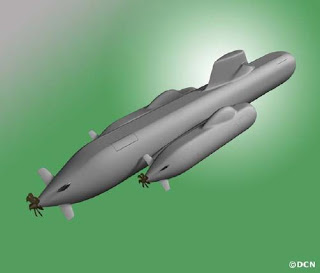
If you recall, at the Euronaval 2004 exhibition DCN revealed they were working on modular capable alternatives to their new "three-in-one" base model. For those not familiar, the SMX "three-in-one" design combined three submarines into one underwater vessel with somewhere around a 3700 ton displacement. The primary vehicle was a command unit nicknamed NCW, and would consist of two operational units called OPS. The NCW unit acts as the Command and Control node for tactical data and forward deploy the OPS vehicles into the operational theater. The primary vehicles would also provide the energy production for the deployable vehicles.
The concept was for the NWC to act as an underwater sea base for the pair of OPS unit crews. Each OPS submarine would displace somewhere around 500 tons and were fitted with a mission-specific modular payload prior to deployment. The OPS unit was invisioned as an AIP driven system that would give it a few days of operation before needing to return to the mothership for recharging battery power and let the crew refresh.
This sortof sounds like something similar, except instead of using a submarine as a host vessel, it sounds to me like a surface vessel is being considered as the host vehicle, and the ~500 ton vessels would be unmanned instead. This would essentially be the next evolution of modularity to include large unmanned vehicles that can be detached as opposed to launched. Maybe I am reading this wrong, but with few details we are unlikely to know for certain.

No comments:
Post a Comment