
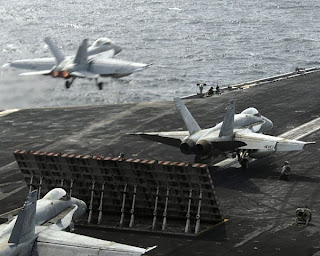
 The F-22 discussion generated a lot of discussion on the blog last week, but it also generated a lot of discussion in my Inbox. Because I am not an expert on aviation, Andrew Niemyer offered to weigh in to the topic with an essay taking the always valuable experts perspective I prefer. Below are his thoughts on the topic.
---
Galrahn’s piece on the arguments over continued acquisition of the F-22 contained an interesting statement, “…I admit to being concerned about the state of air superiority looking into the future. This problem is specific to the US Air Force, because I don't believe the US Navy is going to be able to provide air superiority for itself too much longer into the future against peer competitors, for a several reasons.”
It has occurred to me that since “ID” is mainly surface warfare oriented, with the occasionally foray into things that intentionally sink and those that fly, that a brief discussion is in order regarding what are actually highly defined terms of art when used by practitioners. It is my modest hope that this will help us understand each other when we venture into these kinds of fruitful discussions. This discussion in not meant to be some sort of primer about how major airstrikes are conducted nor will I address some of the major issues attendant to such operations. Rather I hope to illuminate the terminologies meant when I was involved in such operations and later on when I taught some of these same ideas to Battle Group staffs. The basics have not changed, while the applications to achieve the ends continue to evolve.
When used in conjunction with offensive air operations, we need to look at two similar sounding, but dissimilar terms. “Air Superiority” as defined in the NATO Glossary of Terms and Definition is "That degree of dominance in the air battle of one force over another that permits the conduct of operations by the former and its related land, sea, and air forces at a given time and place without prohibitive interference [italics mine] by opposing air forces." On the other hand, “Air Supremacy” is thus defined: “…that degree of air superiority wherein the opposing air force is incapable of effective interference.” [Italics again mine] Similarly, The Department of Defense Dictionary of Military and Associated Terms (short title: Joint Pub 1-02 or JP 1-02 (PDF)) defines Air Superiority like this: “That degree of dominance in the air battle of one force over another that permits the conduct of operations by the former and its related land, sea, and air forces at a given time and place without prohibitive interference by the opposing force.” Note that the only substantive difference is that we speak of an “opposing force” versus an “opposing air force.” [Emphasis mine] JP 1-02 defines Air Supremacy succinctly: “That degree of air superiority wherein the opposing air force is incapable of effective interference.” No quibbles between NATO and our own definition there in the least; everyone’s agreed at least on how it’s defined.
One last term we need to keep in mind is “Air Parity,” and has been called the lowest level of control, meaning control of the skies only above friendly troop positions, or in other words, a stand-off. You’re not coming into my back year without getting into one heck of a fight, and vice versa.
To put the terms in “Airdale speak:” Air Superiority means we will win the fight for control of a particular bit of three dimensional airspace and not have losses so bad that we can’t come back tomorrow morning and do it again. Air Supremacy means that the bad guys will not fly under virtually any circumstance, because if they do, they will die. We are the big dog on the block, period. Air superiority is not necessarily a permanent condition, while air supremacy can be thought of as the ultimate goal of any long term air campaign, much as was sought and attained a near-generation ago in the initial air phase of Operation Desert Storm.
Air superiority can be thought of in three different ways: Control of space, control of time, control of geography or a combination of those three. Depending on the commander’s intent and tasking, we can seek to attain air superiority over a region (which is usually done in the course of a campaign, not an individual air strike or limited series of strikes), over a political area, e.g. a nation, again a campaign objective or a specific piece of territory, say a particular area surrounding a specific target.
If the senior leadership is reacting to a specific set of circumstances and we have been tasked with conducting a specific single or set number of strikes, then those planning the strike may look to attain air superiority in a determined geographic area for a specific time frame, for example, from 0045 to 0130 local time. Why waste energy, effort and resources when it is unnecessary to do so?
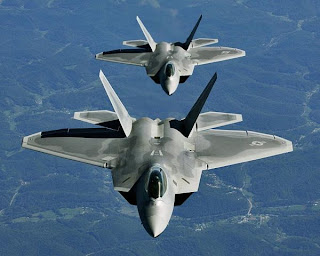 Depending on the methods used to conduct the strike, we may also desire to add in the element of air superiority within a specific block of airspace. An example would be, given the use of precision stand-off weapons, a desire to have air superiority within a block altitude of 15,000 feet above ground level to 50,000 feet, e.g. above AAA range but within SAM altitudes. The SAM threat is more manageable than AAA in this example.
Thus, depending upon the tasking the planners receive from higher authority, they might decide that to achieve that tasking, they want to attain air superiority over the port complex at East Whoozit and environs, from 10,000 feet and above, from 0215 to 0300.
The methodology for attaining air superiority is a complex subject and is, quite naturally, one that has been the subject of considerable research, scholarship and experimentation. It is a topic that has been writ, regrettably, with the blood of thousands of lives as this relatively new area of conflict has developed over the last century. The sometimes dry theories of academics and the polemics of true believers have been embraced, implemented and then faced complex and unforeseen realities in the skies of Europe, the Pacific, the Mediterranean rim, the Middle East and Asia. The brute force of numbers and the finesse of advanced technologies have played their respective rolls and as of yet there is no clear, firm permanent doctrine that will address the issues that each individual theater of operations and Order of Battle of opposing forces bring into the planning and execution equations.
What we do know is what has and has not worked in the specific situations in which those theories were applied. Accurate threat assessment, driven by good, solidly derived intelligence collection is one key. What are the defender’s air defenses like? What is their command and control system for air defense? Is there a single vulnerable node in detecting an attack and directing those defenses? What is their airborne detection and direction capability? What are their airborne defenses like? Are they a competent and well trained force? What’s the geography surrounding the target? Can we use that to our advantage in seeking to gain air superiority? Should we employ fighter sweeps? What kind of CAP should we have for the strike? Keep them close or let them range? How do we suppress the enemy air defenses? Do we seek soft or hard kill? What resources do we have? If we are tasked to go back, what kind of losses in the first attempt can we sustain? These questions that face planners at all levels are just the tip of the proverbial iceberg.
Thus we can see that while the base term “air superiority” is easy to define, it overlies a vastly more complex conceptual structure that those who are really given the mission, well away from the warm glow of a computer screen and the blogosphere, must deal with in the very real terms of treasure, equipment, logistics and human lives.
A final thought: One thing “ID” readers need to bear in mind is that while huge strides have been made in the last 15 years or more in bringing the full focus of Joint warfare into harness, there are some things each service’s air components do better than others. Want Close Air Support? (CAS) I’m calling the Marines; it’s what they do. Want a prolonged air campaign, with 24/7 surveillance, tanking (on their terms, of course) and strike, that goes on and on? Dial “2” for the Air Force. Need a short, sharp shock tomorrow morning, or better yet, tonight? Call the Navy, because contingency air strikes and self-sustaining short termed campaigns waged until the USAF gets its logistics systems in place is what we historically have done very, very well. Yet, as the Navy and Marines proved over Afghanistan, they can and will conduct campaign ops for a sustained period of time, utilizing tanker, electronic warfare and early warning, command and control assets either integral to the embarked Air Wing or tasked from Joint or Coalition assets to achieve the Commander’s tactical and campaign objectives. So long as replenishment and OpTempo can be sustained, the attainment of air superiority and supremacy has a reasonable chance of being achieved; depending of course on the EOB those forces are assigned to deal with. One really, really final thought: The blogosphere has proven to be a great place to think about and discuss the “big ideas.” It has rapidly become a marketplace for theories and concepts big and small. But in the end, all the big words (“enterprise”, “objectify” and “transformational”) aside, it is the core of junior officers, senior and junior enlisted people who actually are given the job to make things work in “the big world.” For all our huffing, puffing and hyperventilating they are the ones who come up with new ways, ideas and tactics for innovative uses for what we, the people, give them. From my direct observation, none of us should ever underestimate the power of a couple First Class Petty Officers, a Chief and a Lieutenant [or a couple of Gunnys and a Captain] to come up with some pretty damn good “hey, what if we try this” ideas.
---
Andrew Niemyer biography: After prior enlisted service, Andy was commissioned in 1973, and following extensive duty at NAS North Island began his flight training in 1975, receiving his wings as an NFO in 1976. From then until 1992 he flew in a variety of carrier and land based Navy aircraft, as well as USAF reconnaissance platforms. These included the EA-3B Skywarrior reconnaissance aircraft, the KA-3 pathfinder/tanker platform and as a bombardier/navigator in the A-6E. He was a qualified Senior Tactical Electronic Warfare Evaluator (SEVAL) in the EA-3B, a Strike Leader in the Intruder as well as a designated Flight Test aircrew for all makes and models of the Skywarrior, finishing his Navy flying with in excess of 3100 hours and over 100 arrested landings in the A-3 series alone. He later worked on the development and initial deployment of a combined Navy/Coast Guard pre-expeditionary command and control program. Subsequently he taught strike warfare fundamentals to Battle Group staff on the east coast. He later was involved in C3IW, IT and transformational issues for DCNO, SPAWAR and CNAVRES. He retired six months after the fall of Baghdad in 2003.

No comments:
Post a Comment