
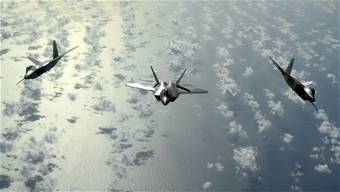
 Both Colin Clark at DoD Buzz and Amy Butler at Aviation Week are reporting today that General Norton Schwartz suggested more F-22s were needed on Tuesday, adding more commentary the F-22 discussion begun by Mark Bowden in his article in The Atlantic from over the weekend.
“We looked at this in a dispassionate and analytical way” and produced a number that “I feel is credible,” Schwartz said during a Defense Writers’ Group breakfast this morning in Washington. The general said he would not release his new number until presenting it to Defense Secretary Robert Gates - but he noted he would not disagree with statements from Navy Adm. Michael Mullen, chairman of the Joint Chiefs of Staff, who told Congress 60 more F-22s were needed.In his The Atlantic article, Mark Bowden used the requirement number of 381, which was a requirement established by the previous administration. Current plans would end the production line of the F-22 at 183, and if 60 more were added that would bring the total up to 243, still 138 short of the previously discussed requirement. The cost for 60 more F-22s would cost somewhere between $11-$12 billion spread out over three years.
This would include orders of about 20 aircraft per year for three years. Lockheed Martin currently has orders for 183 of the twin-engine aircraft.
The proposal to build more F-22s is likely to be well received in Congress, because in Congress the F-22 represents a job program unlikely to be stopped during a down economic period. The F-22 program directly effects 25,000 jobs, and indirectly impacts an additional 70,000 jobs spread out over all 50 states according to Mike Dunn, President of the Air Force Association who shared some of the details of the debate in a PodCast with Stephen Trimble's DEW Line Blog.
Congress has previously given March 1st, 2009 as a deadline for the Air Force to decide on whether to continue the F-22 program. Assuming a three year build period, that would line up the F-35 procurement to begin in 2013 and 2014 as planned, although that assumes no delays in that program (history suggests that would be a bad assumption).
This bit of news adds interesting context for the current F-22 discussion, which flared up again today when Mark Bowden responded to criticism of his article in The Atlantic through the Lowy Institute of International Policy blog. Sam Roggeveen had some comments regarding the original article, and has the response as well. Also weighing in with an opinion today was Matthew Yglesias, who cited the Center for American Progress research released during the transition period that stated $12 billion on F-22s would be better spent on other priorities. Despite high expectations otherwise, I thought the CAP report was one of the less intellectually inspiring and less strategic of think tank reports (and I read every single one of them) released during the presidential transition period, and that is probably why Obama filled out the DoD with CNAS folks while CAP laid off staff for Christmas.
In rereading Mark Bowden's article today, I kept thinking about what Matt Duss said in the blog comments on Tuesday when he called the article "an embarrassingly uncritical bit of propaganda journalism." In reading the article a few more times, I think Matt Duss is wrong about that, his criticism of a paper being a stooge for military industrial complex propaganda and industry would have been better directed at the Washington Post, LA Times, and UPI. Mark Bowden is telling stories about the aircraft and its mission, not pushing talking points of industry like those news services, and it is that type of first hand sourcing that explains why I read the content printed in The Atlantic. I think what we are seeing from Mark Bowden is the result of being out of Washington and actually embedded with the airmen flying the F-22, and what the article does very well is give their side of the story.
I have a theory about the Air Force and Navy. Every problem you can find in both organizations seems to be centric to Washington DC. When you get out with the Navy or the Air Force in the ports, on the air bases, in the ships, and on the planes it is a completely different world with a completely different tone. The Generals and Admirals are just different, but best of all, you get to talk to the Colonel's and Captains, Major's and CDR's, and the view becomes more visible with clarity in opinion. When I read this post on PACAF Pixel's today I realized what drove content in Mark Bowden's post, and it had nothing to do with a political view or industrial view.... he spent a lot of time talking to F-22 pilots. From Lt. Col. "Corky" Corcoran, commander of the 525th Fighter Squadron at Elmendorf Air Force Base, Alaska:
It was an honor and a privilege to host Mark Bowden and his research assistant, Terrence Henry, when they visited Elmendorf AFB last summer. Terrence contacted me several months prior to the visit to begin researching Mark's potential story on the erosion of US Air Dominance. After several discussions I offered up the idea of a visit to Elmendorf during PACOM's NORTHERN EDGE exercise as an excellent opportunity to give both Mark and Terrence a crash course in air combat training and tactics. They accepted.Lets just be blunt here... that is one hell of an opportunity and an experience that is going to shape any view in a 5 page article for The Atlantic.
Neither Mark nor Terrence had any background in Air Combat training or tactics, but they proved to be quick studies.... We started off their visit by introducing them to the 3rd Wing Commander, Brigadier General Tom 'Pugs' Tinsley, and the 3rd Operations Group Commander, Col Jim 'Scorch' Hecker. They interviewed both leaders and were very impressed with their knowledge and professionalism. After those interviews we simply roamed the halls of the RED FLAG - Alaska complex, home to all the units deployed to Elmendorf for the exercise, and introduced Mark and Terrence to folks from every Air Force walk of life. They interviewed F-15 and F-16 Aggressor pilots, E-3 Air Battle Managers, Intelligence officers, Radar experts, threat experts, and of course the F-15, F-16 and F-22 pilots flying the 'Blue Air' role in the exercise. We watched 30-40 minutes of a live NORTHERN EDGE mission on the 'big board' at RED FLAG and explained exactly what the pilots were doing. Mark and Terrence asked very insightful questions and by the time we left the room it was clear they understood what had just taken place before their eyes -- not only the significance of the exercise but the level of difficulty involved and the skill required to succeed.
Finally, we took them to the flight line to watch the launch of the large force exercise. This allowed them to get an up close and personal look at the aircraft they had watched on the big board. The unique opportunity to see F-15s, F-16s, F-18s and F-22s side-by-side on the ramp clearly highlighted the generational leap our joint force has made with the F-22. This also allowed them to briefly interact with the maintainers who keep the fleet in the air -- and Mark and Terrence couldn't have been more impressed with those Air Force professionals.After David Axe spent a lot of time around the F-22, he was a changed man. Is David Axe an industry shrill for the F-22? Of coarse not, he is one of the most knowledgeable independent journalists who covers the Air Force, which is why he is accurately calling out Loren Thompson for being dishonest when framing the F-22 issue.
I think the PACOM Pixels blog fills in 'the rest of the story' regarding what shaped Mark Bowmen's view of the F-22, and as I read the article again and again, I simply don't agree with those who suggest that The Atlantic was printing propaganda, not when there are many legitimate obvious examples of dishonesty and industry driven media attention that so clearly represent what the propaganda on this issue looks like.
Congress is observing the F-22 discussion in the context of a works program, and the Air Force appears to be calling for 60 more F-22s over the next three years. Unless Obama or Gates comes out directly to overrule the Air Force, it is a good bet we will build more of these fighters whether we need them or not. This is by definition the kind of messy nonsense we are used to seeing when there is no clear political leadership or obvious understandable vision from our military services.

No comments:
Post a Comment