
 The Heritage Foundation has released a report titled Quadrennial Defense Review: Building Blocks for National Defense. The key point that enables the report is the requirement for 4% of GDP spending. Quoted are the parts specific to the Navy. First the summery.
The U.S. Navy's primary responsibility is to defend freedom of the high seas, including protecting sea lines of communications. It shares responsibility with the Marine Corps for projecting power from ship to shore in the littorals.Ultimately, besides the photo above, this is all the detail provided to explain the position.
First, the Navy needs to be a blue-water navy. This means that the fleet must include a balance of major surface and subsurface combatants, including aircraft carriers, cruisers, destroyers, and attack submarines. The most prominent capabilities of this balanced fleet will remain:These capabilities enable the U.S. to project military power to distant regions, including Asia, Europe, and the Middle East. They also permit the U.S. to protect vital trade routes.
- Controlling the surface of the oceans in broad areas,
- Controlling the air space over these areas, and
- Conducting anti-submarine warfare.
Once the Navy has established a forward presence in distant littoral areas, which is permitted by its blue-water capabilities, it should partner with the Marine Corps to project power from ship to shore. This will require further balancing the fleet to include amphibious ships, with supporting aviation systems and landing vehicles, littoral combat ships, minesweepers, and maritime prepositioned assets beyond those required for the blue-water fleet.
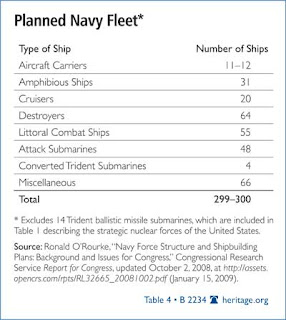
Shipbuilding was not a priority during the Clinton and Bush Administrations. Annual procurement has fallen to just 5.3 ships per year. A lack of funding and the increasing costs of ships under construction have combined to ensure a low rate of shipbuilding that cannot sustain the Navy's 30-year shipbuilding plan for a 313-ship fleet. In addition to the strategic ballistic missile submarines, the fleet includes aircraft carriers, cruisers, destroyers, littoral combat ships, amphibious ships, attack submarines, converted Trident submarines, and miscellaneous other ships.I read this article as a proverbial middle finger to littoral warfare. I also think it is quite bold to state the Navy is a blue water force and if you don't like it, shove it. It is the first time I've observed a report suggest the Navy cancel the Littoral Combat Ships in favor of more battleships and submarines. These are certainly unique opinions, you have to give them that.
The Navy's future force structure is the minimum size needed to secure U.S. maritime interests, but it lacks the proper internal balance and sufficient funding for the necessary shipbuilding rates. Specifically, it shortchanges aircraft carriers, cruisers, destroyers, and attack submarines in favor of littoral combat ships. The U.S. has 11 aircraft carriers, and that number should increase to 13 over the longer term. The number of cruisers and destroyers should increase from a projected 88 to 100, and the number of attack submarines should rise from 48 to at least 60. This should be facilitated, in part, by reducing the projected number of littoral combat ships from 55 to 20.
Further, the QDR should at least consider recommending that the Navy proceed with DDG-1000 procurement instead of extending the construction of DDG-51 Arleigh Burke destroyers by ensuring that the DDG-1000s will have both air and ballistic missile defense capabilities. However, this approach will leave the cruisers with the Navy's primary air and missile defense missions. The QDR should also include a serious discussion of America's shipbuilding industrial base and how to maintain its strategic competitiveness throughout the next two decades.
The question I found myself asking is in what strategic environment would one find this be the desired fleet constitution? Seems pretty obvious to me, Heritage Foundation apparently believes war between the US and China is coming. How else can this be a QDR vision?
I don't need to give my opinion, they read here enough to already know what I think. What say you?

No comments:
Post a Comment